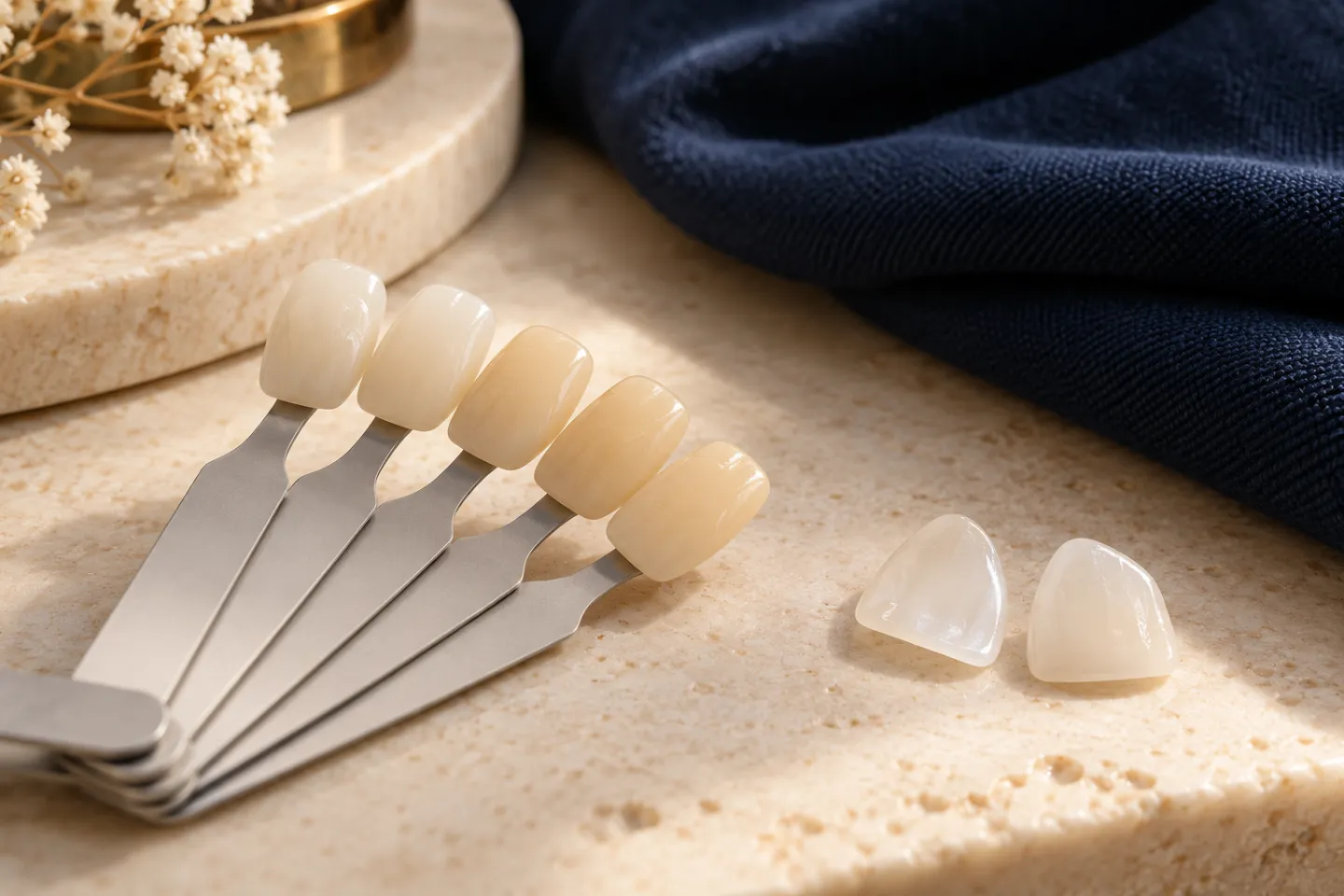
A smile change often begins with a very particular detail: a chipped corner that catches your eye in photographs, one tooth that looks darker than its neighbours, or a space you have thought about for years. The next step need not be choosing a complete set of veneers. It can be understanding that detail and deciding how much change you actually want.
For someone considering dental veneers in Guelph, the most useful consultation connects appearance with the condition of the teeth underneath. A pleasing photograph is only one part of the decision. Preparation, comfort, maintenance and future repairs belong in the same conversation. There is also room to decide that the smile you have does not need a procedure.
This guide offers a way to think through the choice without treating a particular shade, shape or number of veneers as the goal for everyone.
Describe the change before choosing the treatment
Try writing one sentence that finishes, “I would feel happier with my smile if…” Keep it specific. Perhaps you want the edge of one tooth to look more even. Perhaps you want a subtle colour change while preserving the shapes you recognise. “I want a perfect smile” is understandable, but it leaves almost every design choice open to interpretation.
Then write down what you like. A small space, the shape of your canine teeth or the way your smile resembles a parent’s may be something you want to keep. A consultation becomes more useful when your preferences include both change and continuity.
Bring photographs as conversation starters, including photographs of yourself that you like. Explain the feature that appeals to you in another person’s smile rather than requesting an exact copy. The aim is to communicate your taste, not to turn someone else’s face into a specification for yours.
If an important occasion prompted your interest, mention its date early. Allow the dental team to explain what can reasonably be assessed and arranged before you make commitments around the treatment.
What a veneer changes
A veneer is a thin covering attached to the front of a tooth. It may be considered for selected concerns about colour, chips, shape or small spaces. A crown covers much more of the tooth. Veneer treatment commonly involves removing enamel and is therefore irreversible; healthy gums and teeth must be considered first. Grinding, clenching or a deep overbite can affect suitability. The American Dental Association’s veneer overview explains these distinctions and cautions.
This makes the word “veneer” the beginning of a treatment discussion, not a complete description of it. Ask which surfaces would be changed and which would remain. A drawing on a tooth diagram can be more useful than several attractive before-and-after photographs.
For example, if your concern involves a single tooth, ask why the proposed plan includes its neighbours. There may be a considered reason, but you should understand it. You can also request a comparison between a smaller change and a more extensive one. Deciding how many teeth to treat should follow your goals and the examination, not the size of a package.
Porcelain and composite involve different processes
Porcelain veneers are usually made outside the mouth using an impression or scan, then fitted and bonded at a later visit. Composite veneers use tooth-coloured resin shaped directly on the tooth. The Canadian Dental Association’s guide to bonding and veneers introduces these materials and their placement.
Porcelain generally resists staining better; composite may be easier to repair and can involve fewer visits or less preparation. The exact approach depends on the tooth and the intended change. The American Dental Association compares these material tradeoffs.
Instead of asking which material is universally best, ask which tradeoffs matter for your situation. Is the priority matching one neighbouring tooth, changing several visible surfaces, or making a limited repair? How would a chip be addressed? What work is done directly by the dentist and what work involves a laboratory?
It helps to request a written description that identifies the proposed material and the teeth included. “Cosmetic work on front teeth” is too broad to be a useful record of a detailed discussion. The written plan should make sense when you read it later at home, away from shade samples and photographs.
Enamel preparation deserves its own conversation
Before agreeing to treatment, ask the dentist to show you where preparation would occur and explain its purpose. Different plans can involve different amounts of change. An advertisement using words such as “minimal” does not tell you what would happen to each of your teeth.
Veneer preparation creates room for the covering, and the dentist checks the fit and colour before bonding it in place. Veneers can later chip, crack or loosen; some problems can be repaired, while others need replacement. These are long-term restorations that require care, rather than a one-time purchase that ends all future decisions. The Oral Health Foundation explains veneer fitting and maintenance.
A useful question is, “What would I need if this veneer had to be replaced?” The answer is a discussion of possibilities, not a prediction of an exact future procedure. It helps you understand the commitment before the original tooth is changed.
You can take time over this part. If the proposed preparation is not clear, request another explanation, a diagram or a second opinion before proceeding. Choosing a cosmetic treatment does not require making the decision during the same appointment in which it is first discussed.
Compare options against the same goal
Bonding can address smaller areas, while a veneer covers the front surface more broadly. The distinction is useful when a concern is limited to one corner or a small space. The CDA guide above describes both approaches. Other possibilities to discuss include whitening when colour is the main concern, orthodontic assessment when tooth position is central, or leaving healthy teeth as they are.
Compare these options using the same questions. What specific change could each make? What would remain different from your ideal? How much treatment would be involved? What appointments and ongoing care would follow? This prevents a dramatic-looking option from winning simply because its description is more exciting.
Our guide to teeth whitening in Guelph can help you prepare for a separate discussion about colour. The dental veneers education page offers a shorter overview to revisit alongside your proposed plan.
Avoid treating every alternative as a required step. The point is to understand which options deserve consideration for your particular concern. You do not need to pursue every available form of cosmetic dentistry before you can make a sound choice.
Make “natural-looking” specific
People use the word “natural” to mean very different things. One person means a bright, uniform appearance; another means keeping small variations in shape and colour. Explain what the word means to you.
During an appearance discussion, consider the smile as a whole rather than inspecting only a close-up of two teeth. Ask to see how the proposed change relates to the neighbouring teeth and to your usual smile. If a preview, model or temporary stage is available, ask what it can demonstrate and what it cannot guarantee about the finished result.
Useful observations sound like, “These edges feel too square for my preference,” or, “I want the treated tooth to attract less attention.” They are more actionable than saying something is simply wrong. Give yourself permission to describe uncertainty, too. You may need the dentist to explain the available range before you can choose within it.
Make sure you understand when appearance decisions need to be finalised. Ask what happens if you want a change at each stage, and which adjustments would involve new work. Clear expectations are particularly helpful when more than one person or a laboratory contributes to the treatment.
Think about the appointments as well as the result
Someone arranging care around work in Guelph may focus first on the total number of visits. Also ask about their sequence. Which appointment is for planning? When would tooth preparation occur? Is there an interval before the final fitting? What instructions would apply during that interval?
Put these details next to the dates you already know: work travel, a presentation, family commitments or an event. Avoid arranging treatment around a deadline until the proposed schedule is clear. Leave room for questions and follow-up rather than treating the final fitting as the only visit that matters.
A written estimate should identify what is included and how additional work would be discussed. If dental benefits are relevant, confirm the details of your own plan before relying on a reimbursement assumption. Keep the financial conversation connected to the actual proposed treatment, including any preliminary care and later maintenance.
The purpose of this planning is practical. You should know what you are agreeing to, how to organise your time and whom to contact if something needs attention between visits.
Life with veneers still includes ordinary dental care
Teeth with veneers can still develop decay. Daily brushing with fluoride toothpaste, cleaning between teeth and appropriate dental reviews remain important. Restorations may eventually fracture, need replacement or no longer match the surrounding teeth. The Australian Dental Association’s information on crowns, bridges and veneers emphasises this ongoing care.
Ask for instructions that fit the completed work in your mouth. Have the team show you how to clean any area that feels unfamiliar, and clarify what to do if an edge becomes rough or something seems loose. Keep the practice’s contact details with your treatment information so you do not have to reconstruct the plan later.
If you already use a dental appliance, bring it to the discussion. Include it in the treatment plan rather than assuming it will remain suitable after changes to your teeth. Describe any habits or concerns you think could matter, even if you are unsure of their relevance.
It can be helpful to keep a short record of the treatment date, teeth treated and material used. This is especially practical if you move or need care from another office in the future.
A decision you can explain in your own words
Before proceeding, try describing the plan without looking at the paperwork. You should be able to say what you want to change, why the proposed approach suits that goal, what happens to the underlying teeth and what care follows. Any missing part is a good topic for another conversation.
You may decide on a small repair, several veneers, a different treatment or no cosmetic treatment. A useful consultation makes those choices clearer. For anyone exploring dental veneers in Guelph, a satisfying decision begins with a realistic plan that feels like your own, rather than an appearance you feel expected to choose.
Further reading
- American Dental Association: Veneers
- Canadian Dental Association: Bonding and veneers
- Oral Health Foundation: Veneers
- Australian Dental Association: Crowns, bridges and veneers
This article offers general education. Your dental team can help you apply it to your own health, treatment and recovery.