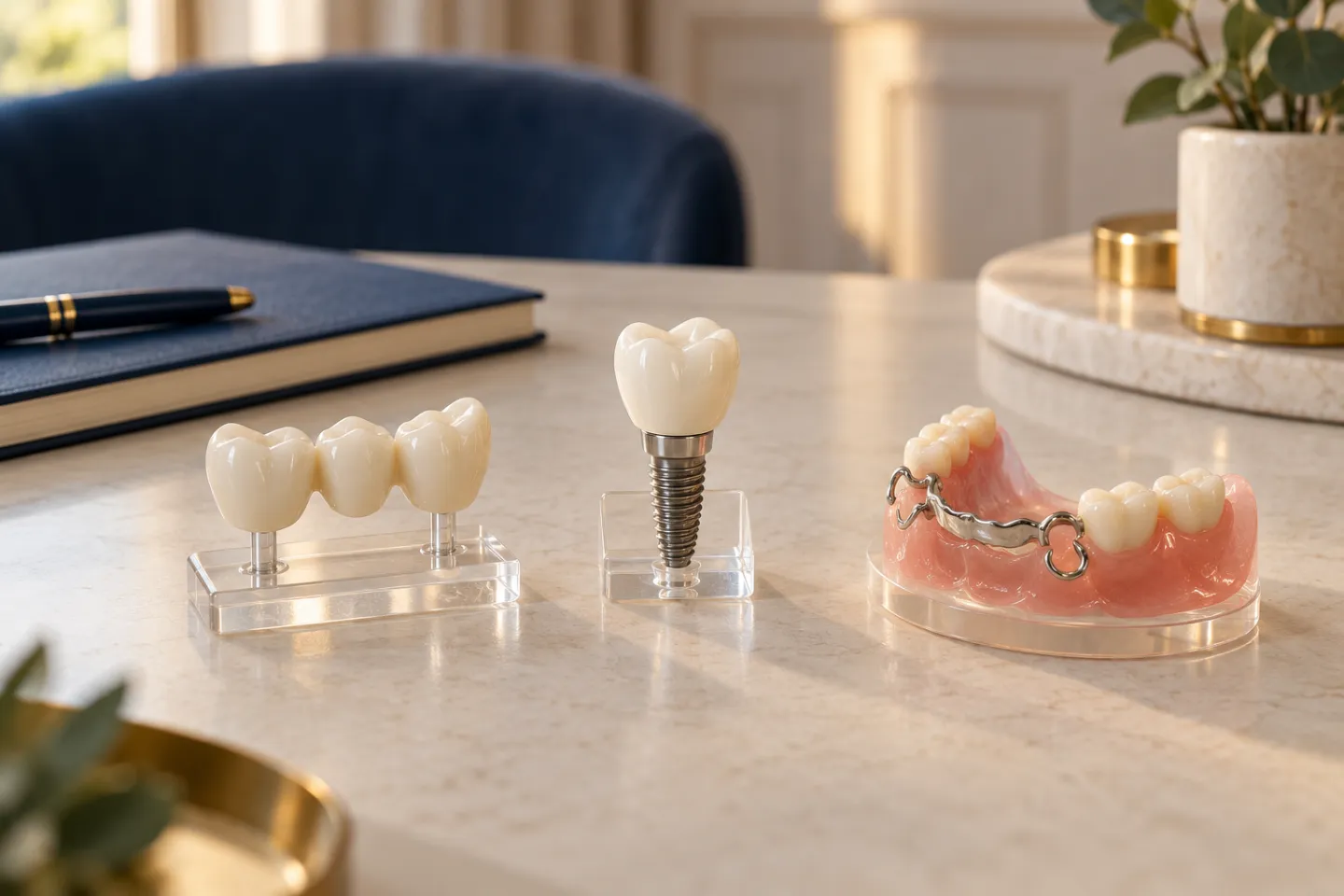
Losing a tooth can change a small part of a day in a surprisingly noticeable way. You may choose the other side when chewing, become careful about certain words or notice the gap whenever someone takes a photograph. For another person, the space may cause little day-to-day difficulty. These different experiences matter when comparing ways to replace teeth.
The main options are familiar names: implants, bridges and dentures. The names alone do not tell you what supports the replacement, whether you remove it yourself or what caring for it will involve. Those distinctions are more useful than a universal ranking from “best” to “worst.”
If you are considering treatment for missing teeth in Guelph, begin with two things: what your mouth can support and what you want the treatment to improve. A useful comparison brings both together, including the work involved after the new teeth are fitted.
Describe the problem before choosing the solution
Missing teeth can affect speech and chewing, and nearby teeth may change position. The effect depends on the location and extent of tooth loss; a gap that is hidden from view can still matter functionally. These are reasons for an assessment rather than assumptions that every space will cause the same problems. The American Dental Association explains the possible effects of missing teeth.
Try describing your concern without using a treatment name. “I would like to bite into food more comfortably” is a functional goal. “I want to stop covering my mouth when I laugh” is an appearance and confidence goal. “My current replacement is difficult to clean” is a maintenance problem. You may have all three, but each deserves to be heard separately.
This also helps when one aim conflicts with another preference. You might strongly prefer something fixed in place while also wanting to avoid surgery or changes to neighbouring teeth. Those preferences do not always point towards the same option. Identifying them early makes the trade-offs visible rather than letting them emerge halfway through treatment.
An implant provides support beneath the visible tooth
A dental implant replaces a missing root and supports an artificial tooth or a larger restoration. It is placed surgically in the jawbone. Suitability depends on factors including general health, gum health and available bone; some people require additional assessment or bone grafting. Placement and the final replacement tooth may involve separate stages and healing time. The Canadian Dental Association describes dental implants and assessment.
The visible tooth is only one part of that plan. When looking at a model, identify the implant in the bone, the connection above it and the replacement that will be seen in your smile. Understanding these separate parts makes it easier to follow an explanation of what is being proposed and what a written estimate includes.
An implant-supported replacement can appeal to someone who wants to discuss an option that does not rely on neighbouring teeth in the same way as a conventional bridge. That preference still needs to be balanced against surgery, healing, maintenance and the particular findings in the mouth. An implant is not a shortcut around assessment of the rest of your teeth.
For a fuller introduction, see our dental implants guide. Use it to understand the vocabulary; the number of implants, design of the replacement and treatment sequence must come from an individual plan.
A bridge spans a space using supporting teeth or implants
A conventional tooth-supported bridge joins an artificial tooth to crowns on neighbouring supporting teeth. Those teeth are prepared for the crowns. Bridges can also be supported by implants, and different designs suit different situations. Cleaning needs to include beneath the replacement tooth as well as around its supports. The CDA explains bridge designs and care.
The condition of the supporting teeth is therefore part of the comparison. A discussion involving teeth that already have large restorations is different from one involving untouched neighbouring teeth. The dentist needs to consider those teeth individually rather than treating them as convenient anchors simply because they are beside the gap.
Not every bridge requires the same preparation. An adhesive, or resin-bonded, bridge uses a wing bonded to a neighbouring tooth and may involve little or no drilling. Its suitability depends on the clinical situation, and loss of the bond is one possible complication. Leeds Teaching Hospitals explains conventional and adhesive bridges.
This is why the phrase “a bridge” needs a second sentence. Which kind is being discussed? Which teeth or implants support it? What happens to those supports during treatment? Our dental bridges guide provides background for understanding a proposed design, including how daily care reaches the surfaces underneath.
A denture replaces teeth with an appliance you remove
Partial dentures replace some missing teeth while natural teeth remain. Complete dentures replace all the teeth in an upper or lower arch. A partial may use clasps around remaining teeth; an overdenture can be supported by retained teeth or implants. Dentures need daily cleaning outside the mouth, and the remaining teeth and oral tissues still need care. The CDA describes the main denture types.
For someone comparing replacements for several gaps, a removable appliance may be part of a coherent plan rather than merely a temporary compromise. The right discussion concerns the proposed design and its practical demands. How will you insert and remove it? Where will you clean it? Is the daily handling manageable with your grip, vision and available support?
Being removable is a feature with different significance for different people. One person may value being able to take an appliance out for cleaning. Another may find the thought of removal uncomfortable or worry about managing it away from home. Neither reaction is trivial. It belongs alongside the clinical assessment when deciding what you can live with comfortably.
You can explore our partial dentures guide if this option is part of your discussion. If an implant-retained denture is proposed, make sure you understand that “implant” does not automatically mean the teeth stay in place permanently from the wearer’s perspective.
Three situations show why the answer can differ
Consider these hypothetical priorities, not treatment recommendations. A person missing one visible tooth may care most about appearance during the treatment period because they speak with clients every day. Their comparison should include what they will wear while the final replacement is being made, rather than looking only at the finished result.
A second person may be choosing between options after several teeth have been lost. Their main worry might be handling a removable appliance because their hands are stiff in the morning. A demonstration with a model, together with an honest discussion of home support, may be more useful than a photograph of an attractive finished smile.
A third person may have lived comfortably with a small gap for years and be reconsidering it now. They need to understand what has changed, whether replacement would address a current concern and what commitments come with proceeding. Another person’s satisfaction with an implant does not answer those questions for them.
Each example changes what a successful outcome means. The clinical examination determines which choices are reasonable; the person’s priorities help distinguish between those choices. A decision feels less pressured when the comparison is based on the life the replacement must fit into.
Include the time between appointments
Treatment is experienced as a sequence of days, not just a before-and-after photograph. Consider meals, work, social events and travel during that sequence. A temporary replacement, when part of the plan, may have different instructions from the final one. Confirm what is expected at each stage rather than treating all the appointments as interchangeable.
For a Guelph household planning around shifts, classes or caregiving, separate active appointments from periods when healing or laboratory work is taking place. You may need flexibility at certain points, but not at every point. A written sequence helps you understand which dates are firm and which depend on an assessment of progress.
Also identify who is responsible for each stage. If more than one clinician is involved, keep their contact details and the purpose of their visits together. A clear handover matters when a question comes up between surgery, temporary treatment and final fitting.
The financial comparison should follow the same sequence. Look at what each estimate includes: assessment, temporary arrangements, the final replacement and any planned follow-up. This is not a reason to assume that one category always costs more over time. It is a way to make sure the plans being compared actually describe the same scope of care.
Maintenance belongs in the original decision
Imagine an ordinary evening with the proposed replacement. Where does the cleaning tool go? Which parts are removable? Is a special technique needed under a connected replacement or around an attachment? A model and demonstration can make those questions concrete before you commit to an approach.
Do not settle for saying that you will “manage somehow” if the method is difficult. The issue might be as simple as needing a different handle, better lighting or help identifying a particular surface. It might also mean that an important design or support question needs further discussion. Discovering that early is preferable to receiving instructions you cannot carry out.
Discuss repairs and review as well as initial fitting. What should you do if something feels different? Which office should you call? What information should you keep about the restoration? These practical details do not predict a complication; they make future care easier to organise if circumstances change.
Is leaving the space an option?
In selected circumstances, accepting a gap may be reasonable, particularly when it has little impact on function or appearance. That decision still needs assessment because neighbouring teeth can move and future replacement may become more complicated. Leeds Teaching Hospitals includes leaving a gap among the options to discuss.
There is a difference between an informed monitoring plan and simply avoiding a decision. With monitoring, you understand the present findings, what would change the recommendation and when reassessment is appropriate. You can revisit the choice if your priorities or clinical situation change.
Likewise, choosing replacement does not require you to select the most elaborate treatment available. A reasonable plan should have a clear purpose, a manageable care routine and an explanation of its limitations. There should be room to say which aspect matters most to you.
When comparing treatment for missing teeth in Guelph, keep the focus on the whole arrangement: support, appearance, function, treatment stages and daily care. The strongest decision is one you can explain in ordinary language, including why it suits your mouth and what you will need to do once the new teeth become part of everyday life.
Further reading
- American Dental Association: Missing teeth
- Canadian Dental Association: Dental implants
- Canadian Dental Association: Bridges
- Leeds Teaching Hospitals: Bridges and alternatives
- Canadian Dental Association: Dentures
This article offers general education. Your dental team can help you apply it to your own health, treatment and recovery.