Root canal treatment has a reputation that can arrive in the room before the explanation does. You may hear the recommendation and immediately picture pain, a complicated appointment or the end of a tooth’s useful life. It helps to slow the conversation down and separate three things: the problem inside the tooth, the treatment used to address it and the restoration that protects the tooth afterward.
For patients considering root canal treatment in Guelph, that separation is especially useful when more than one clinician or appointment is involved. The procedure is not simply a filling with a more intimidating name. It addresses an internal problem while aiming to retain the tooth. Understanding where each stage begins and ends makes the plan easier to follow and helps prevent an unfinished restoration from being mistaken for completed care.
A tooth has an inside as well as an outside
Beneath enamel and dentin lies the pulp, a soft tissue containing nerves, blood vessels and connective tissue. It supports development of the tooth. Once a tooth is mature, it can remain in place without its pulp because the surrounding tissues continue to support it. Root canal treatment removes inflamed or infected pulp and treats the space it occupied. The American Association of Endodontists explains the tooth’s internal anatomy.
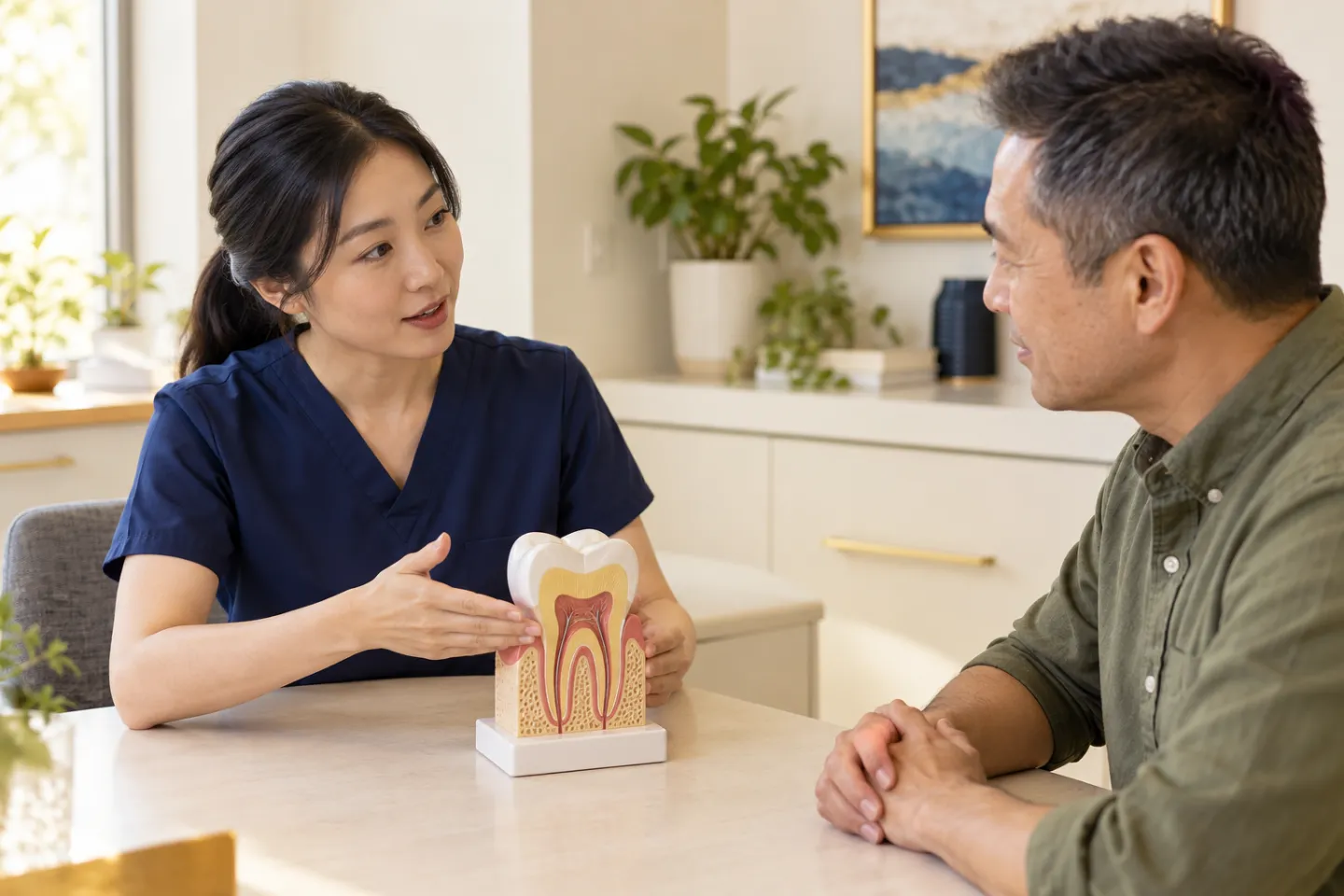
This helps explain the treatment’s goal. The dentist is not removing the whole root from the jaw. The root remains part of the tooth, while the canal system inside it is cleaned and filled. If the terms are confusing, ask to see a tooth model with the outside and inside labelled. Understanding the location of the work often resolves more uncertainty than learning several new technical words.
The outer restoration and the canal filling are also different. One concerns the internal spaces; the other closes and restores the part of the tooth used in the mouth. When someone says they have “had the tooth filled,” it may be unclear which stage they mean. Your own plan should identify both.
The diagnosis matters more than the reputation of the procedure
The Canadian Dental Association and Canadian Academy of Endodontics describe root canal care as treatment for inflamed, infected or injured pulp. Problems may follow deep decay, cracks or other damage. Assessment determines whether the tooth is suitable for this approach; some cases benefit from referral to an endodontist, a dentist with specialist training in this area. Read the Canadian organisations’ explanation of root canal treatment.
Symptoms alone cannot settle the decision. A toothache does not automatically mean a root canal is needed, and the absence of a dramatic toothache does not supply a complete diagnosis. The relevant conversation concerns the findings in your tooth and the purpose of the proposed treatment. Avoid using a friend’s experience as a prediction of what your assessment will show.
At this stage, two questions deserve clear answers: why the inside of the tooth needs treatment, and whether the tooth can be restored afterward. Those are connected but distinct parts of planning. If uncertainty remains, it should be explained rather than hidden behind a general promise to save the tooth.
A referral is also a planning decision, not a verdict that something has gone wrong. Ask what the specialist is being asked to assess or treat and how the information will return to your usual dental office. That makes the handover easier to understand.
Follow the treatment through its three phases
Access and isolation: the area is numbed, and a dental dam isolates the tooth from the rest of the mouth. An opening provides access to the pulp chamber and canals. Cleaning and filling: fine instruments are used to clean and shape the internal spaces, which are then filled and sealed. Restoration: the opening and the remaining tooth need an appropriate restoration. These stages are described in the CDA’s patient guidance.
The number of visits and their length depend on the tooth and the treatment plan. Confirm your actual bookings instead of planning around a fixed duration you found online. If care is divided into stages, know what has been completed after each visit. The distinction is particularly useful when a temporary filling has been placed.
Before treatment begins, agree on how you will communicate if you need a pause or if something feels uncomfortable. A numb area can still leave you aware of pressure or movement, and your experience should be discussed rather than assumed. If anxiety is part of the picture, our dental anxiety article offers ways to prepare that conversation.
You can request an explanation at the level you find helpful. Some people want to understand every stage; others prefer a brief description before each transition. The goal is to stay informed without making the appointment feel like a test of how much dental detail you can tolerate.
Why antibiotics do not replace treatment inside the tooth
An antibiotic prescription can sound like a simpler solution than a dental procedure. However, antibiotics are not routinely recommended for many conditions involving dental pulp and the tissues around the root. The American Dental Association’s guideline prioritises appropriate dental treatment for many such problems in adults who are not severely immunocompromised. Antibiotics may be indicated when infection involves systemic signs, such as fever or malaise, or other clinical considerations. Read the ADA’s guideline on dental pain, swelling and antibiotics.
This is an individual prescribing decision. Do not take leftover medication or someone else’s prescription while deciding whether to attend an appointment. If medicine has been prescribed, follow the clinician’s directions and report problems with taking it. The written plan should distinguish what the medication is intended to do from the dental care still required.
Improvement in symptoms is welcome, but it is not a reason to assume that every stage of care has become unnecessary. Contact the treating office before cancelling a planned visit because the tooth feels better. That keeps the decision connected to the diagnosis rather than to a temporary change in discomfort.
The final restoration is part of protecting the result
After canal treatment, the tooth needs a suitable restoration, which may be a filling or a crown. The choice depends on the remaining structure and the tooth’s needs. Until the tooth is properly restored, heavy biting can put it at risk; the AAE advises completing the restoration promptly and following precautions during the interim period. See the AAE’s explanation of treatment and restoration.
This is the stage most likely to become confusing when appointments are split between offices. The endodontic visit may finish the work inside the canals while another appointment is needed to restore the outside. Before leaving, establish who will arrange that appointment and how soon the clinician recommends it.
Ask for a complete outline of the stages and estimated fees. An estimate for root canal treatment may not mean that every part of the final restoration is included. Clarifying the scope in advance helps you plan without discovering an additional step only after the tooth feels comfortable. Our dental crowns guide explains one possible restorative option.
If travel or a demanding work period is approaching, discuss it before the sequence is booked. For a patient coordinating care in Guelph with appointments elsewhere, write down which office handles each stage. A clear division of responsibility prevents the practical gap in which everyone assumes someone else has arranged the follow-up.
Recovery should have a direction, not just a deadline
Some tenderness around the treated area and jaw soreness can occur after treatment. The AAE advises contacting the treating clinician for severe or persistent pain, visible swelling, an uneven bite, loss of a temporary restoration or the return of earlier symptoms. Follow the personal instructions you receive rather than deciding that every sensation must fit a standard recovery schedule. Read the AAE’s post-treatment guidance.
Notice the overall direction of recovery: whether daily comfort is improving, whether the recommended eating precautions are manageable and whether anything new has appeared. You do not need to repeatedly tap or bite on the tooth to check it. Describe what occurs during ordinary activities if you need advice.
The AAE recommends avoiding heavy biting and hard foods with the treated tooth until it has been appropriately restored and the clinician clears you to resume normal use. Cleaning generally continues with care around the area. Medication instructions should be followed exactly as supplied for your health circumstances. Its root canal explanation covers these precautions.
Have a workable meal plan for the period covered by your instructions. There is no need to invent a restrictive diet from a collection of internet lists. Choose foods that fit the advice you have been given and the way you normally eat. If the guidance conflicts with another medical or dietary requirement, ask the clinicians to clarify how to manage both.
Follow-up looks beyond whether the pain has stopped
Keep the planned review even if the tooth becomes comfortable. Bring any concerns about the restoration, biting or cleaning, and clarify whether further assessment is needed. A useful follow-up conversation connects your experience with the dentist’s findings instead of treating comfort as the only measure that matters.
Save the treatment information with your other health records, particularly if you may change practices. Knowing which tooth was treated and whether the final restoration is complete makes future conversations easier. You do not need a detailed technical diary; the written summary from the treating team is more useful than a reconstruction from memory.
Our root canal treatment guide can help you revisit the sequence. Refer to your own aftercare instructions for decisions about the tooth you have actually had treated.
Sometimes a treated tooth needs another assessment
A tooth that has had root canal care can develop a later problem. The AAE identifies reasons such as complex canal anatomy, contamination through a delayed or damaged restoration, new decay or a fracture. Retreatment may involve reopening the tooth, removing previous canal material, reassessing the spaces and treating them again. It is one possible option, not a guarantee that every tooth can be retained. Read the AAE’s information on endodontic retreatment.
If a previously treated tooth becomes troublesome, start with a new assessment rather than assuming extraction is inevitable or that repeating the original treatment must be the answer. The decision needs to account for the current finding and the condition of the whole tooth. Ask how the proposed option addresses the reason for the problem and what alternatives are appropriate.
Root canal treatment in Guelph is easier to approach when the plan is divided into understandable stages. The work inside the tooth, the final restoration and the follow-up each serve a purpose. Knowing who is completing those stages and how to care for the tooth between them gives you a practical route through treatment, without relying on either frightening stories or promises of a guaranteed result.
Further reading
- American Association of Endodontists: Root canal treatment explained
- Canadian Dental Association: Root canal treatment
- American Dental Association: Antibiotics for dental pain and swelling
- American Association of Endodontists: Post-treatment care
- American Association of Endodontists: Endodontic retreatment
This article offers general education. Your dental team can help you apply it to your own health, treatment and recovery.