

Diagnostic dental care in Guelph
See how much bone is supporting your teeth before deciding what to do next.
Bone loss around teeth happens quietly, usually without pain, and it cannot be seen in a mirror. A bone-loss assessment at Ironwood Dental combines dental x-rays, gum measurements, and a careful exam so you can understand how much support remains, where it has changed, and what that means for your teeth, implants, or future treatment.
Why it matters
Bone is the foundation, and it is easier to protect than to rebuild.
Knowing your bone levels helps us choose the right care, whether that means monitoring, gum treatment, or planning for an implant or bridge.
See what you cannot feel
Bone loss is usually painless in its early stages. X-rays and measurements reveal changes long before a tooth feels loose.
Understand the cause
Gum disease, a missing tooth, an old infection, or heavy bite forces can each leave a different pattern. Identifying the cause shapes the treatment.
Set a baseline for the future
Recording your current bone levels lets us compare future images and tell whether things are stable or changing.
Plan implants realistically
If you are considering an implant, we can tell you whether the site appears to have enough bone or whether grafting may need to be discussed.
Protect neighbouring teeth
Bone loss around one tooth can affect the teeth beside it. Finding it early gives those teeth a better chance.
Make decisions with real information
Rather than guessing, you can weigh options like gum treatment, monitoring, or tooth replacement based on what the images show.
What to expect
An assessment built around clear images and careful measurement.
This is a diagnostic visit. We gather the information we need, explain it in plain language, and leave decisions about treatment for after you understand the findings.
Review your history
We ask about past gum treatment, missing teeth, injuries, and any medical conditions that may affect bone. Previous x-rays from another office are helpful if you have them.
Gum and mobility checks
We measure the pocket depth around each tooth and check whether any teeth move more than they should. These measurements tell us how the gum and bone attachment is holding up.
Targeted dental x-rays
Depending on what we need to see, we may take bitewing, periapical, or panoramic images. These show the height of bone between and around the roots.
3D imaging when it adds value
For implant planning or complex areas, a CBCT 3D scan may be recommended to show bone width and shape as well as height. We explain why before taking one.
Walk through the findings
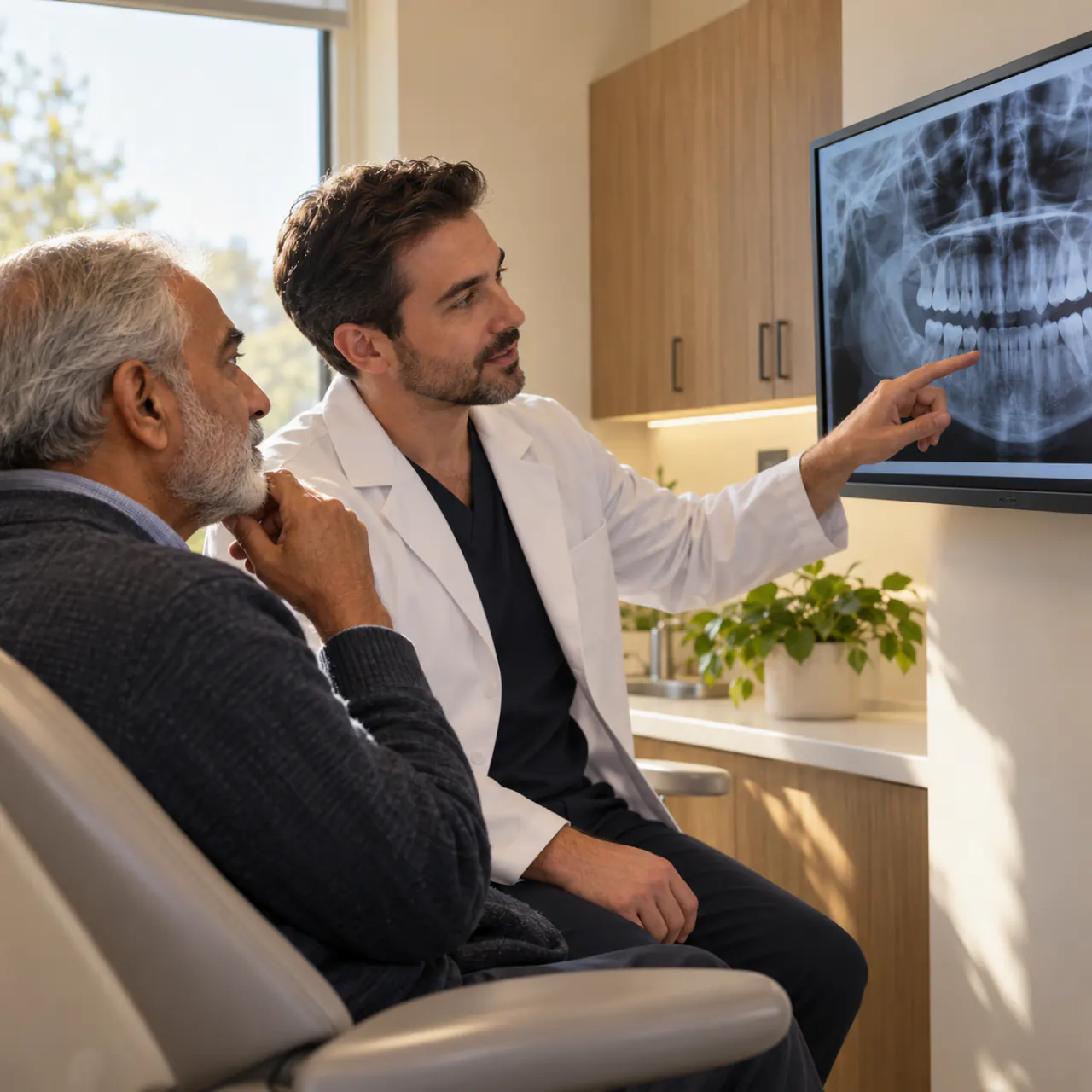
We show you the images on screen and point out where bone levels look healthy and where they have changed. You are welcome to ask as many questions as you need.
Discuss your options
Depending on the findings, next steps may include gum treatment, a monitoring plan, or a conversation about grafting or implants. Complex cases may be coordinated with a trusted specialist.
Assessment details
What we measure, and why bone loss happens.
Bone loss has several possible causes, and the pattern on your x-rays often hints at which one is involved.
What the assessment looks at
- Bone height between and around tooth roots
- Horizontal versus angled patterns of bone loss
- Bone around existing dental implants
- Bone width and shape at sites where a tooth is missing
- Pocket depths measured around every tooth
- Tooth mobility and how the bite loads each tooth
- Signs of old infection at the root tips
- Comparison with any previous x-rays you can provide
Common causes of bone loss
- Periodontitis, the advanced stage of gum disease
- Bone shrinking after a tooth is removed and not replaced
- Infection at the tip of a root
- Inflammation around a dental implant
- Heavy grinding or bite forces on weakened teeth
- Long-term denture wear on the ridge
- Smoking, which can affect gum and bone healing
- Medical conditions such as poorly controlled diabetes
Diagnostics in Guelph
Bone-level assessments at our Kortright Road office.
Patients come to our Guelph office for bone assessments after a hygienist mentions bone loss, after losing a tooth, or when they are thinking about an implant. We take time to show you the images and explain the measurements, so you leave with a clear sense of where things stand.
Related services
Related assessments and treatments
Questions patients ask
Questions about dental bone loss
Patients often hear the words bone loss for the first time at a checkup. These answers cover what it means and what usually happens next.
What does bone loss around teeth mean?
It means the bone that holds your tooth roots in place has shrunk or worn away in some areas. The most common cause is periodontitis, but missing teeth, infection, and bite forces can also play a role. The amount and pattern of loss help us decide what care makes sense.
Can lost bone grow back?
Bone that is lost to gum disease does not usually return on its own, but treatment can often stop further loss. In some situations, regenerative procedures or bone grafting may rebuild part of the bone, and these are planned case by case, sometimes with a specialist.
How do you check for bone loss?
We use dental x-rays together with gum pocket measurements and a check for tooth mobility. When more detail is needed, such as for implant planning, a 3D CBCT scan may be recommended.
Does bone loss hurt?
Usually not, which is why it often goes unnoticed. Some people only notice it when teeth begin to shift, gaps appear, or a tooth feels loose. Regular checkups are the most reliable way to catch it early.
Will I lose my teeth if I have bone loss?
Not necessarily. Many people with mild to moderate bone loss keep their teeth for a long time with good gum treatment and maintenance. The outlook depends on how much support remains and how well the cause can be controlled.
Why does bone shrink after a tooth is removed?
Bone in the jaw is maintained partly by the tooth roots it supports. When a tooth is removed, the bone in that area naturally tends to shrink over time. This is one reason socket preservation or early replacement may be discussed after an extraction.
Do I have enough bone for a dental implant?
That is one of the main questions this assessment can answer. X-rays and, when appropriate, a 3D scan show the height and width of bone at the site. If there is not enough, we can talk about grafting options and whether a specialist should be involved.
How often should bone levels be checked?
It depends on your gum health and risk factors. Patients with a history of gum disease or implants usually have bone levels checked more often than those with healthy gums. We will recommend an interval based on your findings.