

Restorative dentistry in Guelph
Broken tooth repair that rebuilds strength when a large piece of tooth is lost.
When a tooth breaks, it is often a back tooth with a large old filling, or a tooth that has been weakened by decay or grinding. Our team checks how deep the break goes, whether the nerve is involved, and then explains the repair that gives the remaining tooth a good chance of lasting.
Why it matters
A broken tooth is easier to save when it is treated soon.
Broken teeth can collect food and bacteria, crack further, or become painful. Timely care gives you more repair options.
Stop the break from spreading
A weakened tooth can keep cracking. Covering and supporting it early helps protect what is left.
Protect the nerve
When a break is close to the nerve, prompt treatment may lower the risk of sensitivity and infection.
Restore comfortable chewing
Rebuilding the missing part of the tooth lets you chew on that side again without catching sharp edges.
Match the repair to the damage
We choose between bonding, onlays, crowns, or root canal care based on what the tooth actually needs.
Keep your natural root
Even teeth that have broken badly can sometimes be saved, avoiding the need for an implant or bridge.
Clear guidance if it cannot be saved
If a tooth is broken below the bone or split through the root, we explain why and talk through replacement options.
What to expect
Assess the damage, protect the tooth, then rebuild it.
Your first visit focuses on comfort and diagnosis. The final repair may happen the same day or at a follow-up, depending on the damage.
Comfort first
If the tooth is sore or sharp, we start by making you comfortable. We may smooth sharp edges or place a temporary covering.
Exam and x-rays
We look at the break and take x-rays to see how close it is to the nerve and whether the root is affected.
Test the nerve
Simple tests show how the nerve is responding. This helps decide whether a root canal is part of the repair.
Explain your options
Your dentist walks you through the repair options, how long each takes, and what to expect afterward.
Rebuild the tooth
Depending on the damage, we may place a bonded filling, prepare for an onlay or crown, or complete a root canal first. Some repairs are done in one visit.
Check the bite and follow up
We adjust the bite so the repaired tooth is not overloaded. If a crown or onlay is being made, we protect the tooth with a temporary in between.
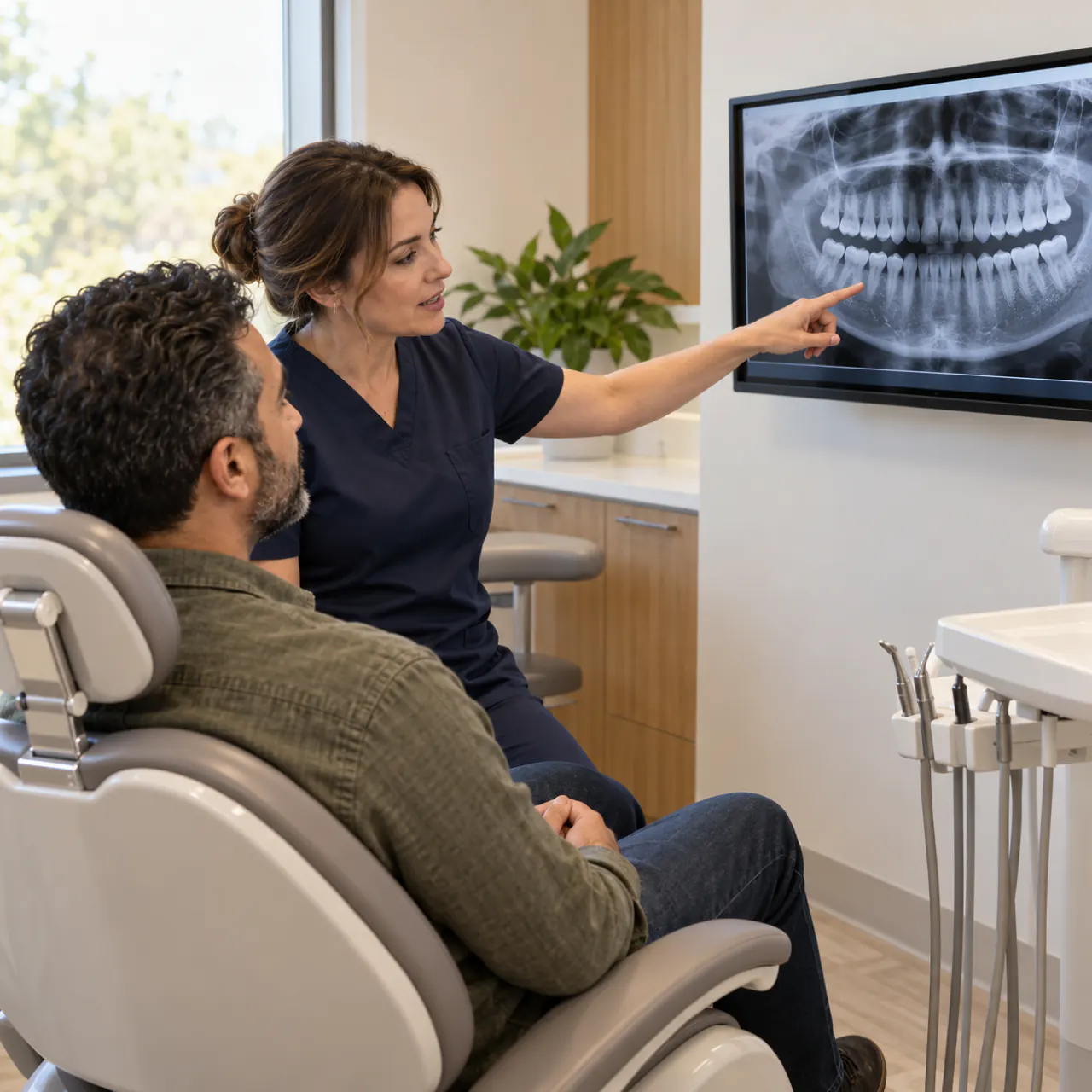
Broken tooth details
How breaks are assessed and the repairs that may follow.
The right repair depends on where the tooth broke, how much remains, and whether the nerve or root is affected.
What we assess
- How much of the tooth has broken away
- Whether the break goes below the gumline
- How close the fracture is to the nerve
- Signs of a crack extending into the root
- The condition of any old filling in the tooth
- Decay that may have weakened the tooth
- Grinding or clenching that may have contributed
- How the opposing tooth meets the broken one
Repairs that may be recommended
- A bonded composite filling for moderate breaks
- An onlay to replace a broken cusp
- A crown to cover and protect a heavily damaged tooth
- Root canal treatment when the nerve is exposed or infected
- A post and core to support a crown when little tooth remains
- Crown lengthening when the break is below the gumline
- A temporary restoration while final work is made
- Extraction and replacement planning if the tooth cannot be saved
Visit us in Guelph
Broken tooth care with extended weekday hours.
Teeth rarely break at a convenient time. Ironwood Dental is open until 8 PM Monday to Thursday and on Saturday mornings, so many Guelph patients can be seen at our Kortright Road West office without missing a full day of work.
Related services
Related care for damaged teeth
Questions patients ask
Broken tooth repair FAQs
Common questions when a tooth has lost a large piece or broken off.
What should I do right after a tooth breaks?
Rinse gently with warm water, save any large pieces, and call our office. Avoid chewing on that side, and cover a sharp edge with sugar-free gum or dental wax if it is rubbing your cheek or tongue.
My tooth broke but does not hurt. Do I still need to come in?
Yes. Many broken teeth do not hurt at first, but the exposed area can decay or break further. Getting it checked early often means a simpler repair.
Can a tooth that broke in half be saved?
It depends on where the break is. If it is above the bone and the root is intact, the tooth can often be rebuilt with a crown and sometimes a root canal. If the split runs down through the root, the tooth may need to be removed.
Will I need a crown for a broken tooth?
Not always. Smaller breaks may be repaired with bonding or an onlay. A crown is usually recommended when a large part of the tooth is gone or the remaining walls are thin.
Why did my tooth break while eating something soft?
Teeth with large fillings, old cracks, or wear from grinding can be weakened over time, so a break may happen during normal chewing. The food was usually just the final straw.
Can a broken tooth be fixed in one visit?
Some can, particularly when bonding is suitable or a same-day crown is an option. Others need a temporary first while a lab-made restoration is prepared.
What if my tooth broke at the gumline?
A tooth broken at or below the gumline may need extra steps, such as root canal treatment, crown lengthening, or a post, to be restored. In some cases extraction is the more reliable option, and we will explain why.
When is a broken tooth an emergency?
Call us promptly if you have strong pain, bleeding that will not stop, or swelling. Facial swelling that affects breathing, swallowing, or vision, or swelling with a high fever, needs emergency medical care right away, so call 911 or go to the nearest emergency department.