

Dental imaging in Guelph
A three-dimensional view when flat x-rays cannot answer the question.
Most dental concerns can be assessed with a clinical exam and standard x-rays. Sometimes, though, we need to see bone width, nerve position, or the exact angle of a tooth root. A cone beam CT, or CBCT, scan gives that 3D view, and we recommend it only when it is likely to change or improve your treatment plan.
Why 3D imaging
Depth and position that a flat image cannot show.
Traditional x-rays compress three dimensions into two. CBCT helps when overlapping structures or exact measurements matter for safe planning.
See bone in three dimensions
CBCT shows the height and width of the jawbone, which can help when planning dental implants or assessing bone loss.
Locate nerves and sinuses
Knowing where the nerve canal in the lower jaw and the sinus floor in the upper jaw sit helps plan certain treatments more safely.
Map impacted teeth
For wisdom teeth or other teeth that have not come in, a 3D view can show their position relative to nearby roots and nerves.
Investigate puzzling root problems
Extra canals, root fractures, or infection that does not show clearly on a regular x-ray may be easier to assess in 3D.
Plan with fewer surprises
Measurements taken from a scan can support more predictable planning for implants, extractions, and some root canal cases.
Help you understand your care
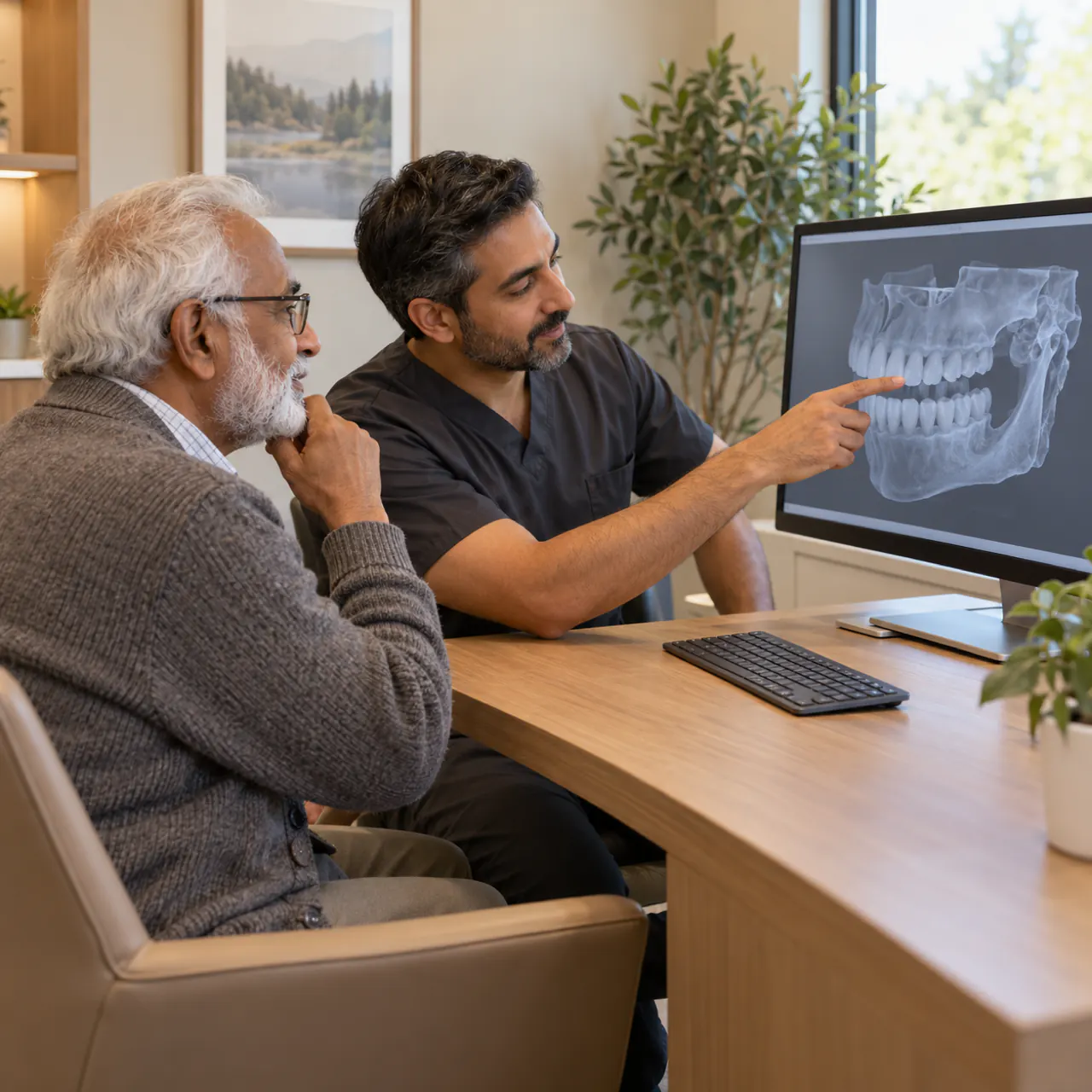
Being able to rotate and view a 3D image often makes it easier for patients to see what the dentist is describing.
Your scan
What happens before, during, and after a CBCT scan.
A CBCT scan is quick and does not involve anything entering your mouth beyond a bite guide in some cases. Here is how the process usually unfolds.
Discuss why a scan is recommended
Your dentist explains what question the scan is meant to answer and how the result may affect treatment. This is a good time to ask about alternatives.
Review health information
We ask whether you are or might be pregnant and note any previous scans. We also confirm what area needs imaging so the scan can be kept as limited as possible.
Remove metal items
Earrings, glasses, hairpins, removable dentures, and similar items are taken off so they do not affect image quality. We will let you know what needs to come off.
Position and stay still
You stand or sit while a head support and sometimes a bite guide keep you steady. The scanner rotates around your head, which typically takes well under a minute.
Images are reviewed
The scan is reconstructed into 3D views that your dentist examines carefully. Complex findings may be shared with a specialist or radiologist when that adds value.
Go over the results together
We show you the relevant views and explain what they mean for your treatment options. You will have time to ask questions before making any decisions.
When it is used
Situations where CBCT may be recommended, and how we keep it purposeful.
CBCT is a diagnostic tool, not a routine screening. These lists explain when it tends to help and the principles we follow.
When CBCT may be recommended
- Planning dental implant position and size
- Assessing bone before a graft or ridge procedure
- Locating impacted wisdom teeth or canines
- Evaluating complex root canal anatomy
- Looking for suspected root fractures
- Investigating persistent infection or unexplained symptoms
- Assessing the jaw joints in selected cases
- Reviewing airway or jaw structure when specialist input is needed
How we keep imaging purposeful
- Recommending a scan only when it may change the plan
- Limiting the scan area to the region of concern when possible
- Using standard x-rays first when they can answer the question
- Asking about pregnancy before any imaging
- Reviewing previous scans so imaging is not repeated unnecessarily
- Explaining the reason for the scan before it is taken
- Sharing results with specialists when coordinated care is needed
- Keeping images in your record for future comparison
Imaging in Guelph
Clear explanations at Kortright Road West.
If your dentist at Ironwood Dental recommends a 3D scan, we will explain why, what it is expected to show, and whether it can be taken at our Guelph office or arranged through an imaging partner. Either way, we review the results with you at our Kortright Road West office in plain language.
Related services
Treatments that may involve 3D planning.
Questions patients ask
CBCT scan questions
Patients often want to know about radiation, comfort, and why a scan is needed. Here are clear answers to the most common questions.
What is a CBCT scan?
CBCT stands for cone beam computed tomography. It is a type of x-ray imaging that captures many images as the scanner rotates around your head, then combines them into a 3D view of your teeth, jaws, and surrounding structures.
How is a CBCT different from a regular dental x-ray?
Regular dental x-rays are flat, two-dimensional images, which can hide depth and overlap structures. CBCT provides a three-dimensional view so your dentist can measure bone and see the position of teeth, nerves, and sinuses more clearly.
Is the radiation from a CBCT scan safe?
CBCT uses more radiation than a single small dental x-ray but generally less than a medical CT scan. That is why we only recommend it when the information is likely to help your care, and we limit the scan to the area that needs to be seen.
Does a CBCT scan hurt?
No. You simply stay still while the machine rotates around your head. Some patients bite gently on a positioning guide, and the scan itself is typically over in less than a minute.
Do I need a CBCT scan before getting a dental implant?
Many implant cases benefit from 3D imaging to assess bone and nearby structures, but it depends on the site and your situation. Your dentist will explain whether a scan is recommended for your plan.
Can I have a CBCT scan if I am pregnant?
Elective imaging is usually postponed during pregnancy unless it is needed for urgent care. Please let us know if you are or might be pregnant so we can discuss the safest approach for you.
Who reads my CBCT scan?
Your dentist reviews the scan for the area being assessed. When findings are complex or outside the area of concern, the images may be shared with a specialist or oral radiologist for further review.
Can I get a copy of my scan?
Yes, you can request copies of your imaging, and we can share scans with your specialist or another dental office with your permission. Let our front desk team know where you would like them sent.