

Sleep appliances in Guelph
Custom sleep apnea appliances, designed around your teeth, your jaw, and the way you sleep.
A custom sleep apnea appliance is made specifically for your mouth, using detailed impressions or scans of your teeth and a record of how your jaw moves. Unlike a one-size device, it can be adjusted in small steps and designed with your bite, dental work, and comfort in mind.
Why custom matters
A device made for your mouth can be more comfortable and easier to fine-tune.
Fit and adjustability are what make a sleep appliance wearable night after night. A custom design is built with both in mind.
A precise, secure fit
Because it is made from records of your own teeth, a custom appliance grips securely without needing to be bitten into place.
Adjustable in small steps
Most custom designs allow the forward jaw position to be changed gradually, which helps balance comfort and effectiveness.
Designed around your dental work
Crowns, bridges, implants, and sensitive teeth can be accounted for in the design, which helps protect them.
Comfortable for your sleep style
Features such as lateral movement, a slim profile, or room for the tongue can be chosen to suit how you sleep.
Durable materials
Custom appliances are made from durable dental materials designed to hold up to nightly wear when cared for properly.
Monitored by your dental team
A custom appliance is part of a supervised therapy, with follow-up visits to check your teeth, bite, and the device itself.
How it is made
From records of your teeth to a finished appliance.
Making a custom appliance involves careful records and a few design decisions. Here is the sequence after your dental assessment confirms suitability.
Confirm diagnosis and suitability
We confirm that your physician has evaluated your sleep and that your dental assessment supports an appliance. Any necessary dental care is completed first.
Take impressions or scans
Detailed impressions or digital scans of your upper and lower teeth are taken. Accuracy here determines how well the appliance will fit.
Record your starting jaw position
We measure how far your lower jaw can move forward and record a comfortable starting position. This gives the appliance room to be adjusted later.
Choose the design features
We discuss options such as a two-piece adjustable design, how much side-to-side movement it allows, and how thick or slim it should be. The choice depends on your teeth, jaw, and preferences.
Fabrication
Your records are used to make the appliance to your specifications. We check the finished appliance against your models before your fitting visit.
Fitting and adjustment plan
At the fitting, we confirm comfort and retention and explain how adjustments will proceed. The appliance is then fine-tuned over the following weeks.
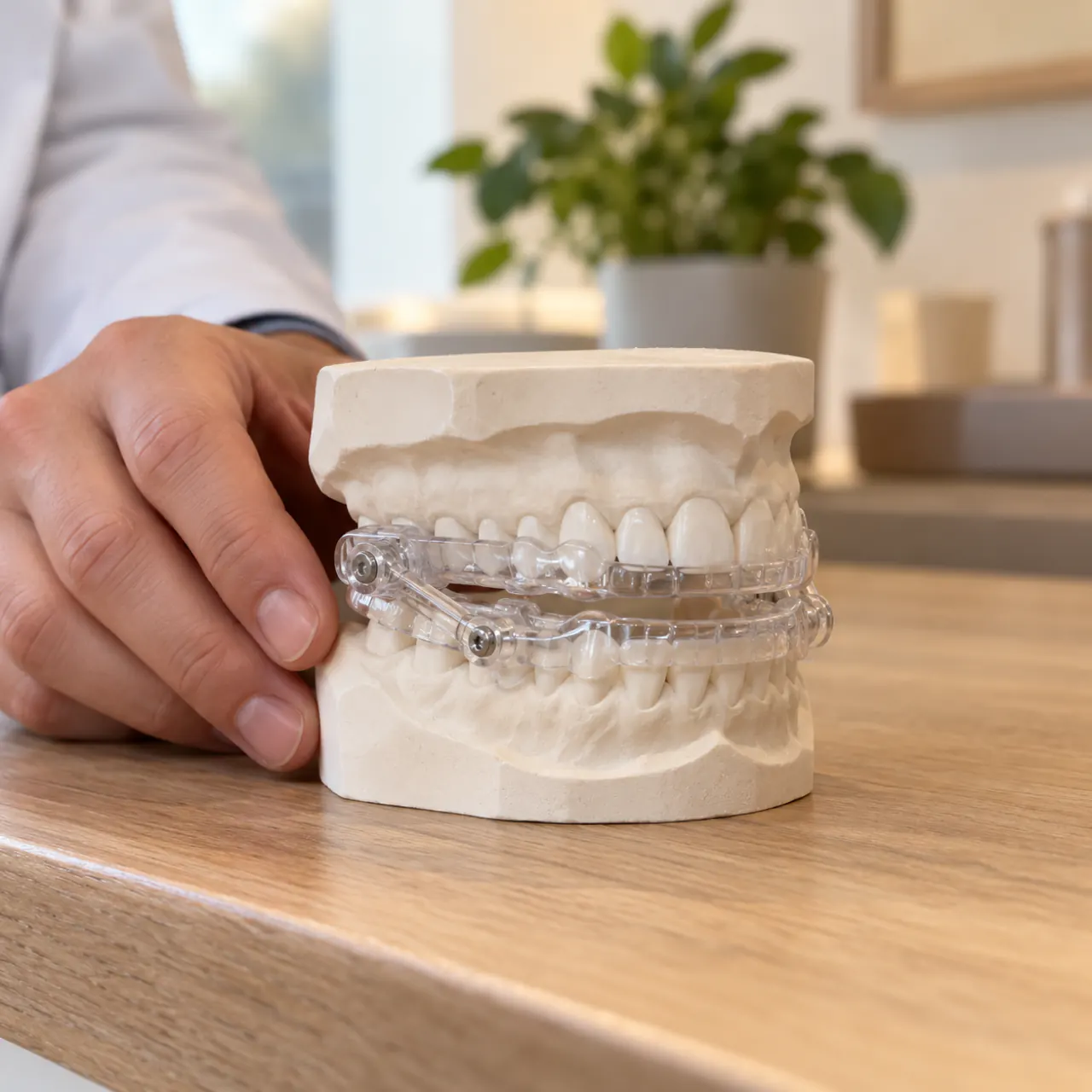
Design details
Design features and what shapes the choice.
Appliance designs vary. We choose features that suit your teeth, jaw, sleep habits, and preferences.
Design features we may consider
- Two-piece upper and lower trays that connect
- Adjustment mechanisms for gradual jaw advancement
- Allowance for some side-to-side jaw movement
- Slim profiles that leave more room for the tongue
- Openings at the front for easier breathing
- Soft liners for sensitive teeth or gums
- Reinforced designs for patients who grind
- Coverage that protects crowns and bridges
What influences the design choice
- How many teeth are available to hold the appliance
- Existing crowns, bridges, and implants
- Jaw joint comfort and range of movement
- Whether you clench or grind at night
- Mouth breathing or nasal congestion
- Sleeping position and how often you move
- Gag reflex and sensitivity to bulk
- Your physician's goals for therapy
Made for Guelph patients
Design conversations that start with how you live.
At our Kortright Road West office, we ask about the practical things, such as whether you sleep on your side, breathe through your mouth, travel often, or have crowns and implants, before choosing a design. Guelph patients appreciate knowing why each feature was chosen.
Related services
Related services for designing and caring for your appliance.
Questions patients ask
Custom sleep apnea appliance FAQs
Answers about what goes into a custom appliance and why the details matter.
How is a custom sleep appliance different from a nightguard?
A nightguard protects teeth from grinding but does not move the jaw. A sleep apnea appliance holds the lower jaw forward to help keep the airway more open. Some sleep appliances also offer some protection from grinding.
What is the appliance made of?
Custom sleep appliances are typically made from durable dental-grade acrylics or similar materials, sometimes with soft liners. We will explain what your appliance is made of and how to care for it.
Can I have a sleep appliance if I have crowns or implants?
Often, yes. The design can account for crowns, bridges, and implants. We check these restorations carefully because they need to withstand the appliance's forces.
Will I be able to open my mouth or talk with it in?
Many designs allow some opening and side-to-side movement, which helps with comfort. Talking is possible but not very natural, since the appliance is meant for sleep.
How long does it take to make a custom appliance?
After your records are taken, fabrication commonly takes a few weeks. We will give you an estimated timeline and book your fitting accordingly.
Can I breathe through my mouth with the appliance?
Some designs include an opening at the front to allow mouth breathing. If you have nasal congestion or tend to breathe through your mouth, let us know so we can consider this in the design.
Is a custom appliance better than a store-bought one?
A custom appliance is fitted to your teeth and adjusted under supervision, which helps with comfort and with monitoring effects on your bite. Store-bought devices are not designed or supervised in this way and are not intended to treat diagnosed sleep apnea.
Does the appliance need to be cleaned in a special way?
Yes. Daily gentle cleaning with a soft brush and cool water, plus any cleaner we recommend, keeps it fresh. Avoid hot water, which can warp the material, and keep it in its case.