

Supportive dentistry in Guelph
Dental visits and daily care adapted to the way your body moves.
Arthritis, stroke, Parkinson's disease, multiple sclerosis, injuries, and recovery from surgery can all make getting to the dentist, sitting in the chair, and brushing at home harder. We plan around those challenges with extra time, flexible positioning, and practical tools so your mouth stays healthy even when movement is limited.
Why it matters
When brushing gets harder, small changes protect your teeth.
Limited movement often means plaque builds up faster in hard-to-reach places. Thoughtful planning keeps dental care manageable and helps prevent bigger problems.
Appointments at your pace
We allow extra time for arriving, transferring, and settling in, so you never feel hurried.
Comfortable positioning
Pillows, a more upright chair, and frequent breaks help if lying back or holding still is difficult.
Shorter, more frequent visits
Breaking care into shorter appointments can be easier on stiff joints, tired muscles, or limited stamina.
Easier home-care tools
Wide-handled brushes, electric toothbrushes, and floss holders can make a big difference when grip is weak.
Extra preventive protection
Fluoride varnish and more frequent cleanings help protect teeth when brushing is harder.
Support for caregivers
If someone helps you with daily care, we show them how to brush and floss for you safely.
Planning your visit
From the phone call to the chair and back home.
Tell us what is hard for you, and we will plan around it. No detail is too small.
Tell us what you need
When you call, mention your mobility aids, any difficulty transferring, and how long you can comfortably sit. We note this in your chart for every visit.
Choose a time that suits you
Many patients with stiffness prefer later mornings, while others tire as the day goes on. We work around your best time of day.
Arrive and settle in
Take your time arriving. We help you to the operatory and can support a transfer to the dental chair if you need it.
Adjust the chair and take breaks
We position the chair and add pillows for comfort, and stop whenever you need to stretch or change position.
Exam and cleaning
Your dentist and hygienist complete your care with attention to areas that may be harder for you to clean. We keep you informed throughout.
Practise with adapted tools
Before you leave, we try out brushing aids with you or your caregiver. We also set a recall interval that matches your needs.
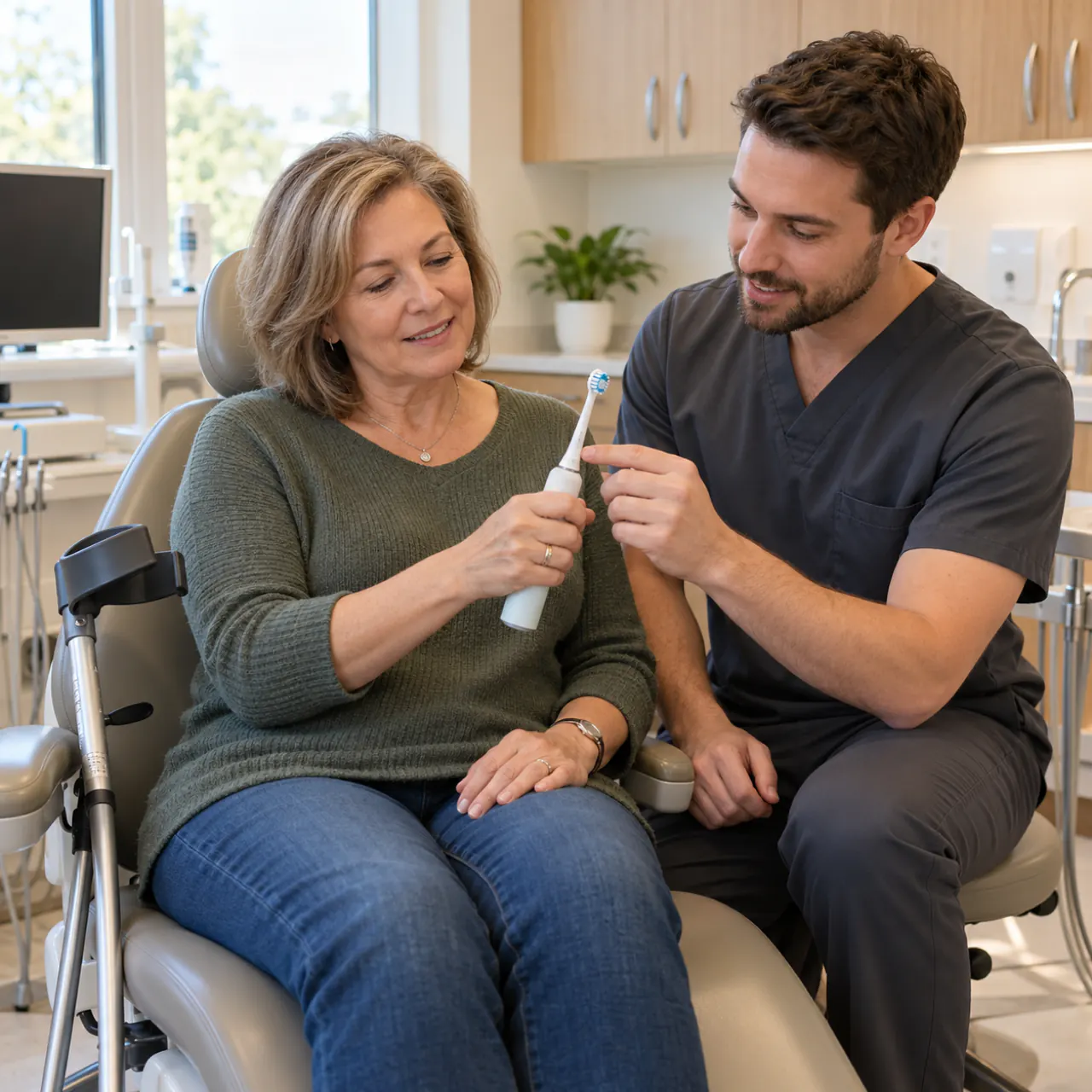
In the office and at home
How we adapt appointments and daily routines.
Different conditions call for different solutions. These are some of the adjustments we commonly make and the tools we may suggest.
How we adapt appointments
- Extra time booked for arrival and transfer
- Semi-upright chair positioning when lying flat is difficult
- Pillows and supports for neck, back, and knees
- Regular breaks to stretch or change position
- Shorter visits with treatment spread over time
- Bite blocks to rest tired jaw muscles
- Help from a caregiver or family member in the room
- Notes in your chart so every visit is planned the same way
Home-care tools that may help
- Electric toothbrushes with larger handles
- Foam grips that widen a regular toothbrush handle
- Long-handled or angled toothbrushes
- Floss holders or interdental brushes
- Water flossers for easier cleaning between teeth
- Suction toothbrushes for those who cannot rinse easily
- Fluoride toothpaste with a flip-top cap
- A seated brushing routine at a sink or table
Getting to our Guelph office
Planning your trip to Kortright Road West.
When you book, let us know if you use a walker, cane, wheelchair, or scooter, or if you will arrive with a driver or by accessible transit. Our team can suggest times when the office tends to be quieter, so you can take your time getting in and settled.
Related services
Related services for patients who need extra support.
Questions patients ask
Limited mobility and dental care FAQs
These answers address common practical concerns from patients and families. Please ask us about anything specific to your situation.
Can I stay in my wheelchair during the appointment?
Some parts of the visit, such as consultations and some exams, may be possible from your wheelchair. For cleanings and treatment, a transfer to the dental chair is often needed. Let us know your needs when booking so we can plan the best approach.
What if I cannot lie back in the dental chair?
We can keep you more upright and use pillows for support. Tell us about any neck, back, or breathing concerns so we can position you comfortably.
My hands are stiff from arthritis. How can I brush properly?
An electric toothbrush with a wide handle, or a foam grip on a regular brush, can be easier to hold. We can help you try different tools and show you techniques that require less grip strength.
I had a stroke and one side is weaker. What should I know?
Food can collect on the weaker side, and brushing may be harder with your non-dominant hand. We can suggest adapted tools and show you or a caregiver how to keep both sides clean. More frequent cleanings may help.
Does Parkinson's disease affect dental care?
Tremors, stiffness, and dry mouth can make brushing and dental visits harder. Booking when your medication is working well, taking breaks, and using an electric toothbrush often help. Please keep taking your medications as prescribed.
Can my caregiver help me during the visit?
Yes. Caregivers are welcome to come into the room, help with transfers if you are comfortable, and learn how to assist with daily cleaning at home.
How often should I have cleanings if brushing is hard?
Many patients with limited mobility benefit from more frequent cleanings, such as every three to four months, but it depends on your gums and cavity risk. We recommend an interval after your exam.
What if I cannot get to the office?
Call us to talk through your situation. We can discuss options such as booking at a time when a driver is available or what information to share with your care home or home care team.