

Implant hygiene in Guelph
Implants do not decay, but they still collect plaque, so they need the right kind of cleaning.
An implant crown cannot get a cavity, yet the gums and bone around it can become inflamed if plaque and tartar build up. Implant surfaces are also different from natural enamel, so they are cleaned with techniques chosen to remove buildup without roughening the parts. This page explains what professional implant cleaning involves.
Why it matters
Clean implant surfaces help keep the surrounding gums calm.
The area where the gum meets the implant is where trouble usually starts. Professional cleaning reaches spots that brushing at home often misses.
Removes hardened buildup
Tartar can form on implant crowns and abutments just as it does on teeth, and it cannot be brushed away once it hardens.
Protects the gum seal
Healthy gum tissue fits snugly around an implant. Keeping it free of plaque helps that seal stay firm and comfortable.
Gentle on implant parts
Instruments and polishing methods are chosen to clean implant components without scratching or roughening them.
Reaches under bridges
Implant bridges and fixed dentures have spaces underneath that are hard to see. Professional cleaning gets into those areas carefully.
Early warning signs noticed
While cleaning, your hygienist watches for bleeding, swelling, or tenderness that may point to early inflammation.
Better home routine
You see exactly where buildup collects on your implant, which makes your brushing and flossing at home more targeted.
During your cleaning
How we clean around implants, step by step.
Implant cleaning is usually part of a regular hygiene visit. The difference is in how carefully the implant areas are checked and which tools are used.
Update your implant history
We note when and where your implants were placed and what is attached to them. If they were placed elsewhere, any records you can share help us.
Check the gums first
Your hygienist looks for redness, swelling, or bleeding around each implant. Gentle probing may be used to check the health of the tissue.
Remove deposits carefully
Plaque and tartar are lifted from the crown and the area at the gumline using implant-appropriate instruments. Natural teeth are cleaned during the same visit.
Clean hard-to-reach spaces
Under bridges and around fixed dentures, we use floss threaders, special floss, or small brushes. Buildup in these areas is often where problems begin.
Polish and rinse
Surfaces are polished with a material suitable for implant restorations. The area is rinsed so loose debris does not stay trapped under the gum.
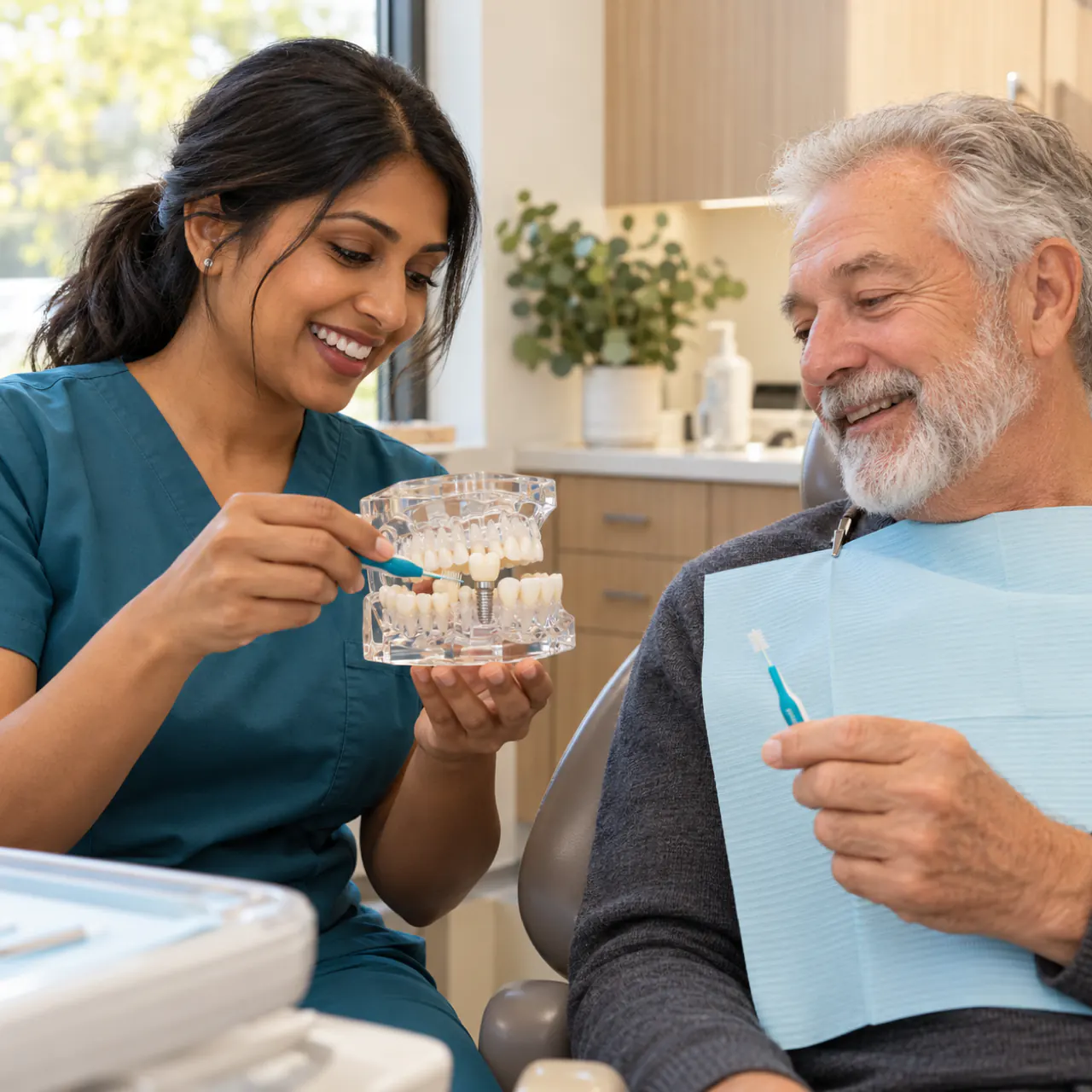
Show you what to focus on
Before you leave, we point out the spots that collected the most buildup and suggest tools for home. If anything looks inflamed, we discuss next steps.
Technique and tools
What makes implant cleaning different.
The goal is to disturb the bacteria and remove hardened deposits while protecting polished implant parts and the delicate gum seal.
What we clean
- Single implant crowns
- Implant-supported bridges
- Fixed full-arch implant dentures
- Abutments and attachments for removable dentures
- The gumline around each implant
- Spaces under bridge and denture frameworks
- Natural teeth next to the implant
- Removable implant dentures brought to the visit
Implant-safe approach
- Instruments chosen to avoid scratching implant parts
- Low-abrasion polishing for crowns and abutments
- Careful work at the delicate gum seal
- Threaders and tufted floss for fixed bridges
- Interdental brushes sized to your spaces
- Water flossers recommended when they suit you
- Gentle probing to monitor tissue health
- X-rays at intervals to check bone around implants
Guelph hygiene care
Implant cleanings that fit your schedule.
Our Kortright Road West hygiene team sees patients early in the morning, into the evening Monday to Thursday, and on Saturday mornings. That flexibility helps keep implant cleanings on track even when life gets busy.
Related services
More ways to look after your implants.
Questions patients ask
Questions about cleaning dental implants
Common questions from patients who have implants. Your hygienist can answer anything specific to your restoration.
Do dental implants need to be cleaned professionally?
Yes. Implants cannot decay, but plaque and tartar can build up and inflame the surrounding gums and bone. Professional cleaning removes hardened deposits that home care cannot.
Is cleaning around an implant different from cleaning a tooth?
The goal is the same, but the approach is adjusted. Implant parts are cleaned with methods selected to avoid scratching them, and extra attention is paid to the gum seal and any spaces under bridges.
Can tartar build up on an implant crown?
It can. Tartar forms when plaque hardens, and it can collect on implant crowns, abutments, and the undersides of bridges just as it does on natural teeth.
Does implant cleaning hurt?
Most patients find it comfortable. If the gums around an implant are inflamed, the area may feel tender, and we can slow down or use numbing gel if needed.
How do I clean under my implant bridge at home?
Floss threaders, super floss, small interdental brushes, and water flossers are common options. Your hygienist can show you which one fits your spaces and how to use it.
Is it normal for my implant gums to bleed when I clean?
Bleeding is a sign of inflammation, not something to ignore. If it happens often, book a visit so we can check whether plaque buildup or an early implant gum problem is the cause.
Will cleaning scratch my implant?
Your hygienist uses techniques and polishing materials chosen to protect implant surfaces. That is one reason it helps to tell us about every implant you have.
Can you clean implants that were placed at another office?
Yes. We regularly see patients whose implants were placed elsewhere. Bringing any records or details about your implant helps us care for it properly.