

Restorative dentistry in Guelph
Dental inlays that rebuild the centre of a back tooth while keeping more of your natural structure.
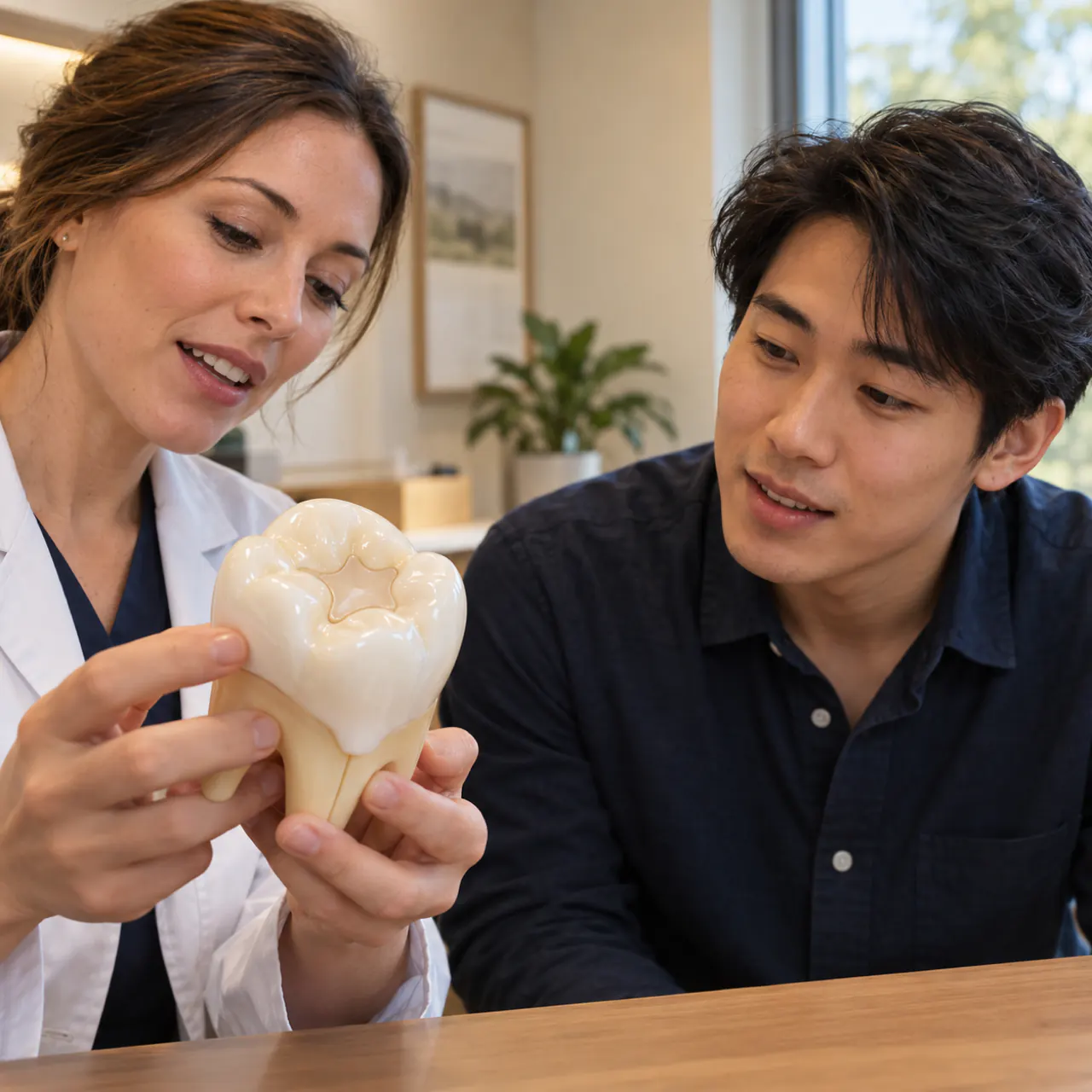
An inlay is a custom-made restoration that fits within the grooves and centre of a back tooth, between the cusps. It is often considered when a cavity or old filling is too large for a direct filling to last well, but the outer walls of the tooth are still strong. At Ironwood Dental in Guelph, we help you compare an inlay with a filling, onlay, or crown so you can choose with confidence.
Why consider an inlay
A middle ground between a filling and a crown.
Inlays are made outside the mouth and then bonded in place, which can give a precise fit and a durable chewing surface.
Keeps more natural tooth
An inlay replaces only the damaged centre, so healthy cusps are left in place rather than reduced as they would be for a crown.
A precise, custom fit
Because the inlay is made to the shape of your prepared tooth, its edges can be shaped and finished carefully before it is bonded.
Durable chewing surface
Ceramic and other indirect materials can handle chewing forces well when the tooth around them is strong.
Tooth-coloured appearance
Ceramic inlays can be shaded to blend with your tooth, which suits patients replacing older metal fillings.
Less shrinkage than a large filling
Large direct fillings can shrink slightly as they set. An inlay is made outside the mouth and then bonded, which can help with fit in larger areas.
Easier to keep clean
Smooth, well-sealed margins are easier to brush and floss around, which supports the health of the tooth over time.
The inlay process
What to expect from preparation to bonding.
Inlays are made to measure, so the process usually involves a careful preparation, a precise impression or scan, and a bonding appointment.
Exam and x-rays
We examine the tooth, the existing filling or cavity, and the strength of the surrounding cusps. X-rays help us look for decay under old fillings or between teeth.
Discuss your options
We compare an inlay with a direct filling, an onlay, and a crown for that particular tooth. You will know why we are suggesting one over another.
Prepare the tooth
After freezing the area, we remove decay or the old filling and shape the inside of the tooth so the inlay can seat cleanly. Healthy structure is kept wherever possible.
Impression or digital scan
We record the exact shape of the prepared tooth and its neighbours. Depending on the case, the inlay may be designed and milled in our office or fabricated by a dental laboratory, with a temporary placed in between.
Bond the inlay
We try in the inlay, check the contacts and fit, and then bond it to the tooth. The bite is checked and adjusted so it feels natural when you close.
Polish and review care
Final polishing smooths the margins. We review brushing and flossing around the new restoration and check it at your regular visits.
Is an inlay right for you
When an inlay is a good fit, and when another option may be better.
The choice depends on how much healthy tooth remains, especially in the cusps. Your exam and x-rays guide the recommendation.
An inlay may be a good choice when
- A cavity is too wide for a long-lasting direct filling
- An old metal filling needs replacing and the cusps are intact
- Decay is between two back teeth but the outer walls are strong
- A large existing filling has leaked or worn at the edges
- You prefer a tooth-coloured restoration for a molar or premolar
- Keeping natural tooth structure is a priority for you
- The tooth has no cracks running into the cusps
- Your bite forces are within a normal range for the material
Another option may suit better when
- One or more cusps are cracked or weakened, which may suit an onlay
- The damage is small enough for a simple composite filling
- The tooth has had root canal treatment and needs full coverage
- Most of the tooth structure has already been lost
- There are visible cracks or symptoms of a cracked tooth
- Heavy grinding places extra stress on the tooth
- Decay extends deep below the gum line
- Multiple surfaces are failing and a crown would protect the tooth
Conservative restorations in Guelph
Inlays planned with your long-term tooth health in mind.
Ironwood Dental has served Guelph families from Kortright Road West for more than 25 years, and we often see teeth with large fillings placed decades ago. When one of those teeth needs attention, an inlay may let us restore it while saving more of the natural tooth than a crown would.
Related services
Related tooth restorations
Questions patients ask
Dental inlay FAQs
Questions patients often ask when an inlay is suggested as an option.
What is the difference between an inlay and a filling?
A filling is placed directly into the tooth and shaped in the mouth in one appointment. An inlay is made outside the mouth to the exact shape of the prepared tooth and then bonded in. Inlays are usually considered for larger areas where a direct filling may not hold up as well.
What is the difference between an inlay and an onlay?
An inlay sits within the cusps of a back tooth. An onlay extends over one or more cusps to protect them. If a cusp is weak or cracked, an onlay is usually more appropriate.
Are dental inlays tooth-coloured?
Many inlays are made from ceramic or composite materials that can be matched to your tooth colour. Gold inlays are another option some patients ask about. We discuss materials based on the tooth and your preferences.
How long does a dental inlay last?
With good home care and regular checkups, inlays can last many years. Their lifespan depends on your bite, grinding habits, diet, and how well the area is kept clean, so we can't promise a specific number of years.
Does getting an inlay hurt?
The tooth is frozen during preparation, so most patients feel pressure rather than pain. Some mild sensitivity for a few days afterward is common and usually settles.
How many visits does an inlay take?
It depends on how the inlay is made. When it can be designed and milled in our office it may be finished in one longer visit, while laboratory-made inlays usually need two appointments with a temporary in between.
Can an inlay replace my old silver filling?
Often, yes, if the tooth around the old filling is still strong. We check for cracks and decay under the old filling first, and if the cusps are weak we may suggest an onlay or crown instead.
Is an inlay better than a crown?
Neither is better in every case. An inlay keeps more natural tooth, while a crown gives full coverage for teeth that are badly broken down or cracked. We recommend the option that best protects your specific tooth.