

Restorative dentistry in Guelph
Dental onlays that protect weakened cusps and help a back tooth handle everyday chewing again.
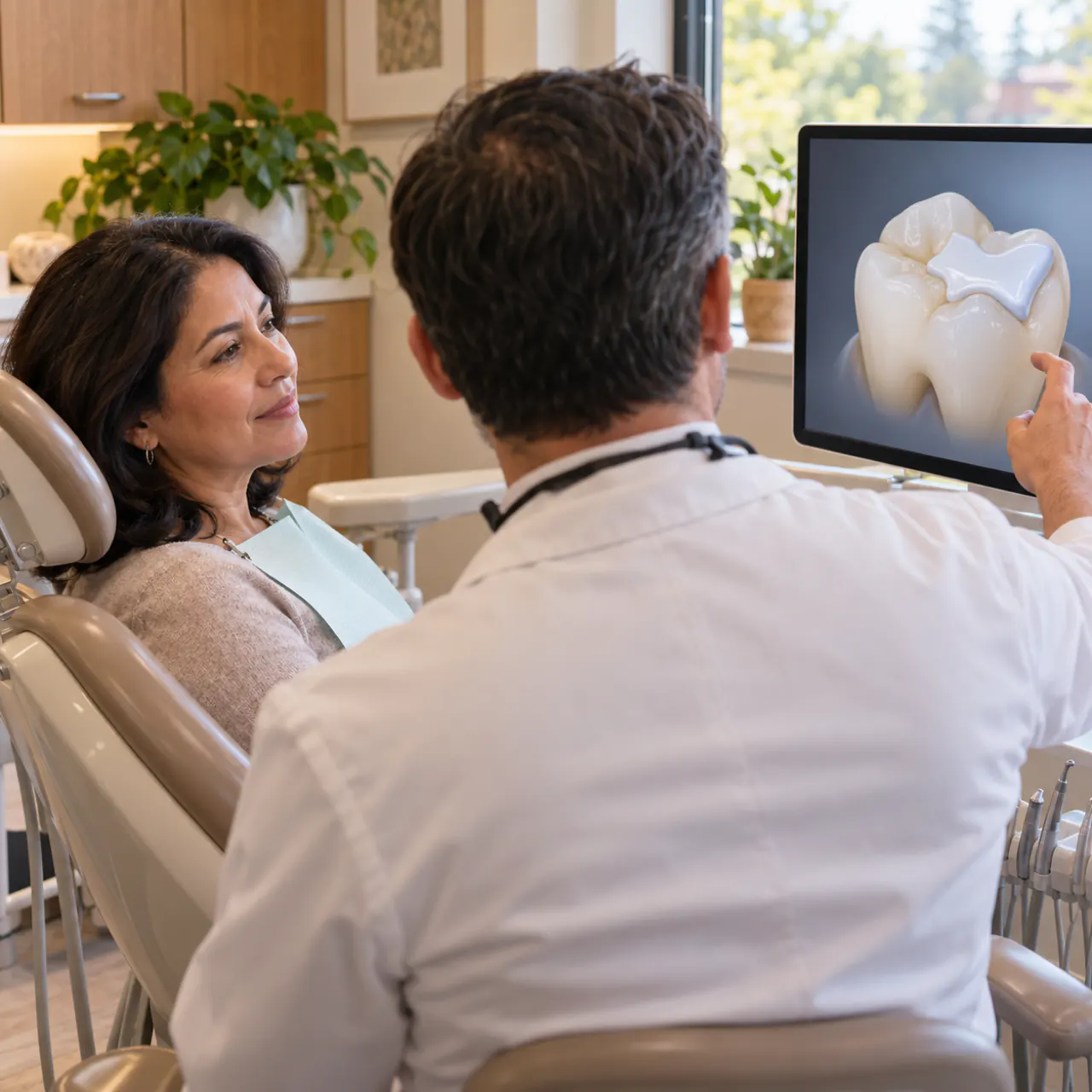
An onlay, sometimes called a partial crown, is a custom restoration that covers one or more of the cusps on a back tooth. It is often recommended when a cusp has broken or is at risk of breaking, but the rest of the tooth is healthy enough that a full crown would remove more structure than necessary. At Ironwood Dental in Guelph, we explain how an onlay fits between a filling and a crown for your tooth.
Why an onlay
Strength where the tooth is weak, and conservation where it is healthy.
Onlays are designed to reinforce a tooth that has lost cusp support, a common problem in molars with large old fillings.
Reinforces weak cusps
By covering and bonding over weakened cusps, an onlay can help reduce the risk of a larger fracture down the road.
More conservative than a crown
A crown generally requires reducing the tooth on all sides. An onlay may only need to cover the areas that are damaged or at risk.
Restores a broken tooth's shape
If part of a tooth has broken away, an onlay can rebuild the missing cusp and the natural contours of the chewing surface.
Natural-looking material
Ceramic onlays can be colour-matched so the restoration blends in with your other back teeth.
Healthier gum margins
Onlay edges can often stay above the gum line, which can make them easier to clean and kinder to the gums.
A stable, even bite
The chewing surface is shaped to meet your opposing teeth so your bite feels balanced once the onlay is in place.
Your onlay appointment
From assessing the cusps to bonding your custom onlay.
We spend time at the start making sure an onlay is the right choice, because the condition of the cusps determines the whole plan.
Examine the damaged tooth
We check the cusps, look for crack lines, and test the bite. X-rays help us look for decay and assess the nerve and surrounding bone.
Confirm the best option
We explain whether an onlay, inlay, crown, or filling best fits the damage. If the tooth also needs root canal care, we talk that through first.
Prepare the tooth
With the area frozen, we remove decay, old filling material, and weak or cracked enamel. The cusps that need coverage are shaped to give the onlay a solid base.
Record the shape
We take a digital scan or impression of the prepared tooth and your bite. Depending on your case, the onlay may be designed and milled chairside or made by a laboratory, with a temporary in place while you wait.
Fit and bond
We check the onlay's fit, contacts, and colour, then bond it securely to the tooth. Bonding helps the restoration and tooth work together as one unit.
Adjust and follow up
We adjust the bite so there are no high spots and polish the margins. At future checkups, we monitor the onlay and the tooth around it.
Onlay details
Signs a tooth may need an onlay, and how to protect it afterward.
Onlays are often recommended after a cusp chips or when an old filling has left thin walls behind.
Signs a tooth may need an onlay
- A cusp has chipped or broken off while chewing
- A large old filling has left thin, weak tooth walls
- A crack line runs into a cusp but not deep into the root
- Pain when biting on one point that comes and goes
- A previous inlay or filling has broken along with part of the tooth
- Wear has flattened the cusps of a back tooth
- Decay has undermined one side of the chewing surface
- A tooth needs protection but most of it is still healthy
Protecting your onlay
- Brush twice daily and floss carefully around the edges
- Avoid chewing ice, pens, or very hard candy
- Use a nightguard if you clench or grind your teeth
- Let us know if your bite feels high after the freezing wears off
- Expect some short-term sensitivity to cold in the first days
- Keep up regular exams so margins can be checked
- Mention any new pain when biting on that tooth
- Limit frequent sugary or acidic snacks around the restoration
Protecting back teeth in Guelph
Onlays at our Kortright Road West office.
Many Guelph patients come to us after a piece of a back tooth breaks off while eating. When the rest of the tooth is sound, an onlay is often one of the first options we discuss, and we can usually see you promptly at 570 Kortright Rd W to protect the tooth before it breaks further.
Related services
Related tooth restorations
Questions patients ask
Dental onlay FAQs
Answers to common questions about onlays, partial crowns, and how they compare with other restorations.
Is an onlay the same as a partial crown?
Yes, the terms are often used interchangeably. Both describe a restoration that covers part of the chewing surface, including one or more cusps, without covering the whole tooth like a crown.
Why would my dentist recommend an onlay instead of a filling?
When a cusp is broken or the tooth walls are thin, a filling alone may not support the tooth well under chewing pressure. An onlay covers and protects those weak areas.
Why not just get a crown?
A crown is a good option for many teeth, but it involves reshaping the tooth on all sides. If a large part of the tooth is still healthy, an onlay may protect it while keeping more of the natural structure.
How long does an onlay take?
Some onlays can be designed and milled in our office in a single visit. Others are made by a laboratory and need two appointments with a temporary restoration in between. We will tell you which applies.
Will my tooth be sensitive after an onlay?
Some mild sensitivity to cold or pressure is common for a short time. If sensitivity is severe, or if biting is painful days later, call us so we can check the bite and the tooth.
Can an onlay be placed on a tooth with a crack?
Sometimes. If the crack is limited to the crown of the tooth, covering the cracked cusp with an onlay may help hold it together. If the crack extends deeper, a crown or other treatment may be needed.
Can onlays be used on front teeth?
Onlays are designed for back teeth, which have cusps for chewing. Front teeth are usually restored with bonding, veneers, or crowns, depending on the damage.
What materials are dental onlays made from?
Onlays are commonly made from ceramic, composite resin, or gold. Ceramic is popular because it is tooth-coloured, while other materials may be considered for particular bite situations.