

Digital dentistry in Guelph
A 3D scan of your teeth in place of a tray full of impression putty.
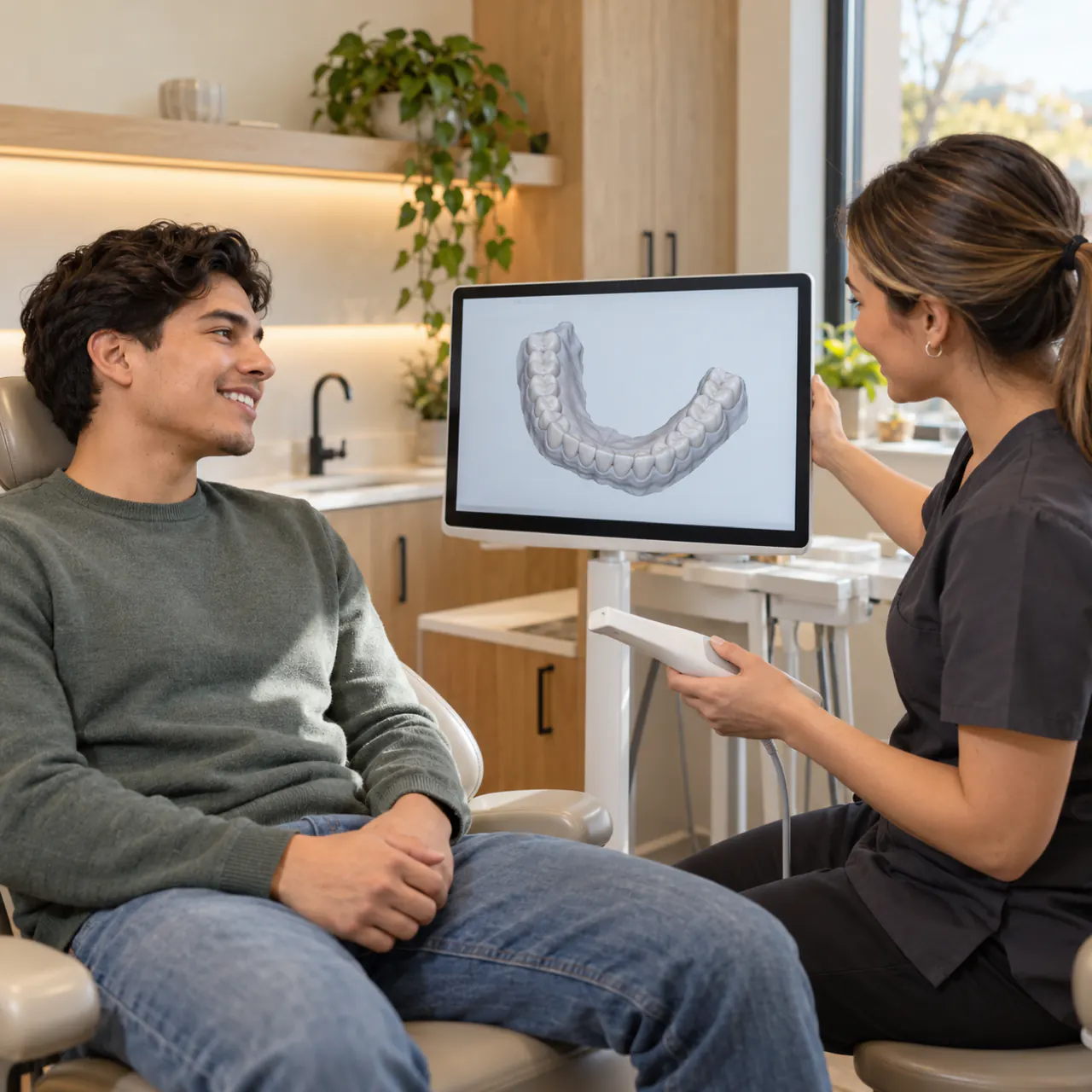
Digital impressions use a small handheld scanning wand to capture a detailed 3D model of your teeth and gums. For many patients, it is a more comfortable alternative to biting into impression material, and the scan can be viewed on screen right away so you can see exactly what we are working with.
Why scan instead of putty
Comfortable, detailed records for the treatment that comes next.
A digital impression is a step in your care, not a treatment on its own. It gives us an accurate starting point for restorations, appliances, and planning.
No impression putty for many cases
Many patients appreciate not having to hold a tray of material in their mouth while it sets. The scanner wand is moved over the teeth instead.
Easier for strong gag reflexes
Because the scanner captures small sections at a time, it can be easier to manage for patients who gag with traditional trays.
A model you can see right away
The 3D image appears on the screen as we scan, so we can show you your bite, worn areas, or the tooth being restored.
Rescanning only the area needed
If a section is unclear, we can rescan just that part rather than repeating a full impression.
Supports CEREC and same-day work
Digital scans are part of the process for CEREC crowns, which may allow some restorations to be designed and made without a second visit.
A record to compare later
Saved scans can help us compare wear, tooth movement, or gum changes over time when that information is useful for your care.
How scanning works
What a digital impression appointment looks like.
Scanning is usually done as part of a larger appointment, such as a crown visit or an aligner consultation. Most patients find it quick and easy to tolerate.
Explain why we are scanning
We tell you what the scan is for, such as a crown, an aligner plan, or a guard. You will know roughly how long it will take before we start.
Prepare the teeth
Teeth are dried and the area kept clear so the scanner can read the surfaces properly. If a tooth is being restored, it is prepared first.
Scan the upper and lower teeth
The wand is moved slowly over each arch while the image builds on screen. You can breathe normally and signal if you need a break.
Record your bite
You close together while we scan the side of your teeth. This shows how the upper and lower teeth meet.
Check the model together
We review the scan for gaps or unclear areas and rescan any spots that need it. This is a good moment to ask what the model shows.
Send or use the scan
Depending on the treatment, the scan is used to design a restoration, sent to a dental lab, or saved for planning. We explain what happens next and when.
Where scans are used
What digital impressions can be used for.
The same scan technology supports many kinds of dental work. Whether a scan is the right choice depends on the treatment and your mouth.
Treatments that may use a digital scan
- CEREC and other dental crowns
- Dental inlays and onlays
- Clear aligners and Invisalign planning
- Retainers after orthodontic treatment
- Custom nightguards and occlusal splints
- Implant crowns and implant planning
- Some sleep apnea appliances
- Study models for bite and wear assessment
Things that help a scan go smoothly
- Letting us know about a strong gag reflex
- Breathing slowly through your nose
- Signalling with a hand if you need a pause
- Keeping your tongue relaxed and to one side
- Telling us if your jaw tires from staying open
- Mentioning any sore or sensitive teeth beforehand
- Asking to see the scan on screen if you are curious
- Understanding that some cases may still need a traditional impression
Digital records in Guelph
Scanning as part of your visit on Kortright Road West.
Digital impressions are taken right in the treatment chair at our Guelph office, often during the same visit where we prepare a tooth or discuss an appliance. If you have a strong gag reflex or have struggled with impression trays before, let us know when you book so we can talk about what to expect.
Related services
Treatments that may start with a digital scan
Questions patients ask
Digital dental impression FAQs
Common questions about intraoral scanning and how it compares to traditional impressions.
Is a digital impression better than a traditional impression?
For many treatments, digital impressions are accurate and more comfortable for patients. Some situations, such as certain denture cases or areas that are hard to reach with the scanner, may still be better served by traditional impression material. We choose the method that fits your treatment.
Does a dental scan use radiation?
No. An intraoral scanner uses light to capture the surface of your teeth and gums. It is not an x-ray and does not show what is inside the tooth or below the bone.
How long does a digital impression take?
A scan of one area may take only a few minutes, while a full scan of both arches and the bite takes longer. The time also depends on how easy it is to keep the teeth dry and clear.
Will the scanner make me gag?
Many patients who gag with impression trays find scanning easier, because the wand is smaller and moves around the mouth in sections. If you have a sensitive gag reflex, tell us and we can take short breaks.
Can a digital scan be used for Invisalign?
Yes. Digital scans are commonly used to plan Invisalign and other clear aligner treatment. The scan helps show how your teeth currently sit and how they might be moved.
Do I need a scan for a nightguard?
A nightguard needs an accurate record of your teeth, which can come from either a digital scan or a traditional impression. We will recommend the approach that suits the type of guard and your bite.
Can I see my scan?
Yes. The 3D model appears on the monitor as we scan, and we are happy to rotate it and point out what we are looking at. Many patients find it helps them understand their treatment.
Does a digital impression mean I get my crown the same day?
Not always. A scan is one part of the process. Whether a crown can be made in a single visit depends on the tooth, the material, and your treatment plan, which we will discuss with you.