

Failing tooth replacement in Guelph
When a tooth cannot be saved, it may be possible to remove it and place an implant in one visit.
A cracked root, a tooth that has broken below the gum, or one with repeated infections often has to come out. In the right conditions, the implant can go into the socket at the same appointment, which may reduce the number of surgical visits and help preserve the shape of the gum and bone. Whether that is wise depends on what we find in and around the socket.
Why combine the steps
One surgical visit instead of two, when the socket allows.
The traditional approach removes the tooth, waits for healing, then places the implant. Combining them can shorten treatment for suitable cases.
Fewer surgical appointments
Removing the tooth and placing the implant together can mean one procedure instead of two separate surgeries.
Shorter overall timeline
Skipping the separate socket-healing stage may shorten the time until your final crown, depending on healing.
Helps maintain the gum line
Placing an implant soon after extraction may help support the bone and gum contours, which is especially important in the smile zone.
Less time with a gap
In some cases a temporary tooth can be attached the same day, though this depends on how stable the implant is.
Grafting at the same time
Small gaps between the implant and socket walls can often be filled with graft material during the same visit.
A clear fallback plan
If the socket is not suitable once the tooth is out, we can graft it and place the implant later, so the visit is still productive.
From failing tooth to implant
How extraction with immediate placement usually works.
Much of the decision is made before the appointment, but the final call is confirmed once the tooth is out and the socket can be seen.
Confirm the tooth cannot be saved
We examine the tooth and review x-rays to confirm that extraction is the right choice. If saving it is reasonable, we discuss that first.
Study the socket in 3D
A CBCT scan shows the thickness of bone around the root and the space below it. This helps predict whether an implant can be stabilized immediately.
Plan for both outcomes
We explain what happens if immediate placement goes ahead and what happens if the socket needs to heal first. You agree to both possibilities before the day.
Gentle tooth removal
The area is numbed and the tooth is removed as carefully as possible to protect the surrounding bone. Any infected tissue is cleaned from the socket.
Place the implant if stable
If the bone walls are intact and the implant can be anchored firmly, it is placed and any small gaps are grafted. A healing cap or temporary tooth may be attached.
Heal, then restore
The implant integrates with the bone over the following months while you follow soft-food and cleaning instructions. Once healed, the final crown is made.
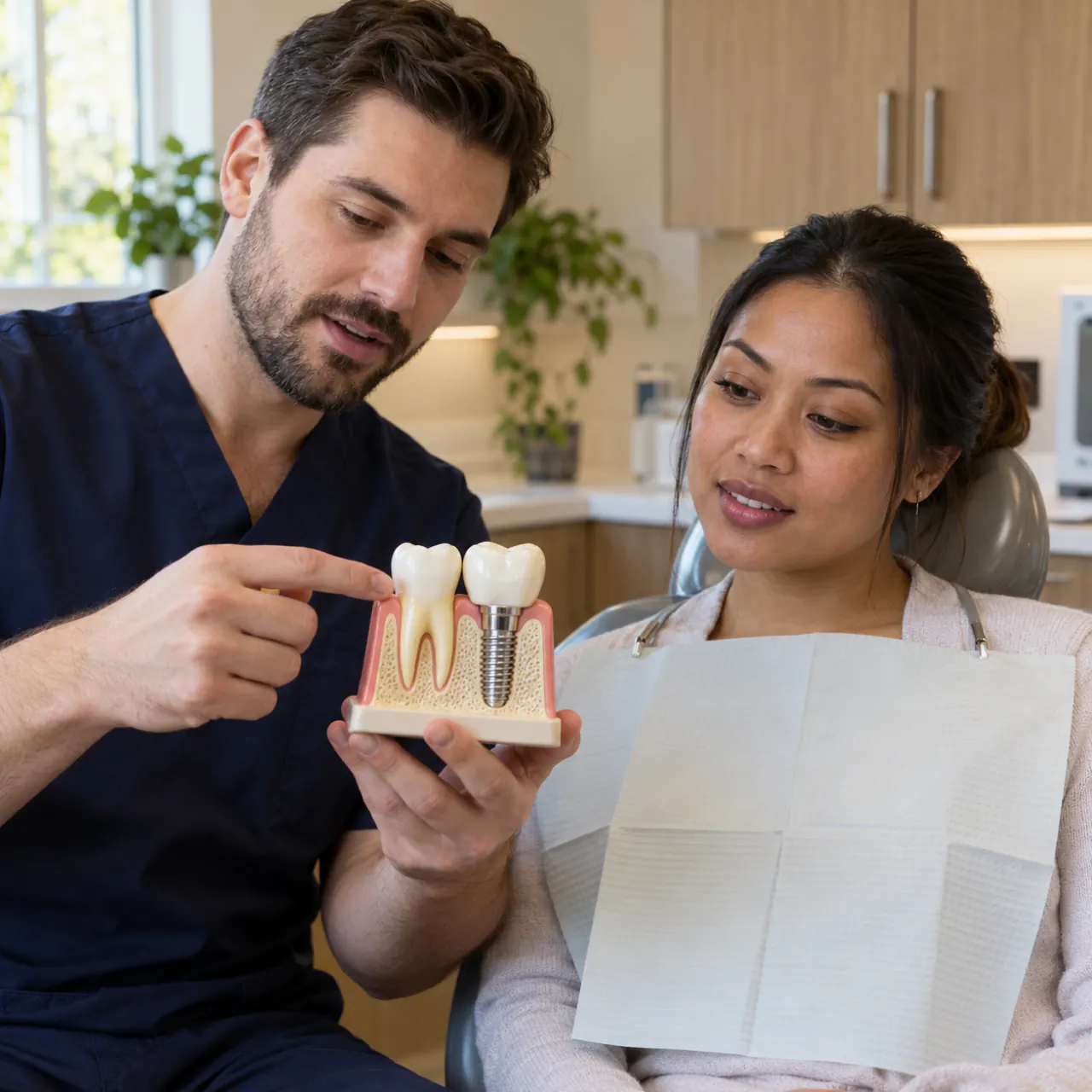
Deciding factors
When same-visit placement may or may not suit you.
Immediate placement needs stable bone around the socket and a healthy enough site. If those are missing, waiting is often the better choice.
Often favourable for same-visit placement
- A single failing tooth with intact bone walls
- No active, spreading infection at the site
- Enough bone beyond the root tip to anchor the implant
- Healthy gum tissue around the tooth
- A non-smoker or someone willing to stop during healing
- A balanced bite without heavy grinding
- Good general health and healing
- Commitment to soft-food instructions
Often better treated in stages
- Large infections or abscesses at the root
- Thin or missing bone on the cheek side
- Roots very close to the sinus or nerve
- Severe gum disease around the area
- Multiple adjacent teeth being removed
- Uncontrolled diabetes or other healing concerns
- Teeth that fracture into many pieces during removal
- Situations that call for specialist surgical care
Guelph tooth replacement
A failing tooth does not have to mean a long gap.
If you have been told a tooth at the front or back of your mouth needs to come out, our Kortright Road West team can review whether an immediate implant is worth considering. We plan ahead so you know what to expect on the day and what you will wear while you heal.
Related services
Other services connected to failing teeth.
Questions patients ask
Extraction and immediate implant FAQs
Common questions about removing a tooth and placing an implant together. Your exam and imaging will guide the recommendation.
Can a tooth be pulled and an implant placed on the same day?
Yes, in suitable cases. It depends on the bone around the socket, the presence of infection, and whether the implant can be held firmly. We confirm this with imaging beforehand and once the tooth is removed.
What happens if the implant cannot be placed after the extraction?
We would usually graft the socket to help preserve bone and place the implant once it heals, often a few months later. We plan for this possibility in advance so it is not a surprise.
Can an infected tooth be replaced with an immediate implant?
Sometimes. A small, contained infection may be cleaned out at the time of extraction, but a larger or spreading infection is usually treated first. Facial swelling that affects breathing, swallowing, or vision, or swelling with a high fever, needs emergency medical care right away by calling 911 or going to the nearest emergency department.
Will I leave with a tooth in the gap?
That depends on how stable the implant is. Some patients leave with a temporary crown that is kept out of heavy biting, while others wear a removable temporary while the implant heals.
Is the recovery harder than a regular extraction?
Most patients find recovery similar to a careful extraction, with some soreness and swelling for a few days. We provide aftercare instructions and check in on your healing.
Does immediate placement work for back teeth?
It can, but molars have several roots and wider sockets, which can make immediate stability harder to achieve. Your scan helps us judge whether it makes sense for that tooth.
Is an immediate implant as reliable as one placed later?
When cases are carefully selected, immediate implants can perform well. Choosing the right cases is the key, which is why we do not offer it to everyone.
How soon will I get my permanent crown?
The implant generally needs a few months to integrate with the bone. Once healing is confirmed, impressions are taken and the final crown is made.