

Visual dental exams in Guelph
See the crack, the worn filling, or the stained groove for yourself.
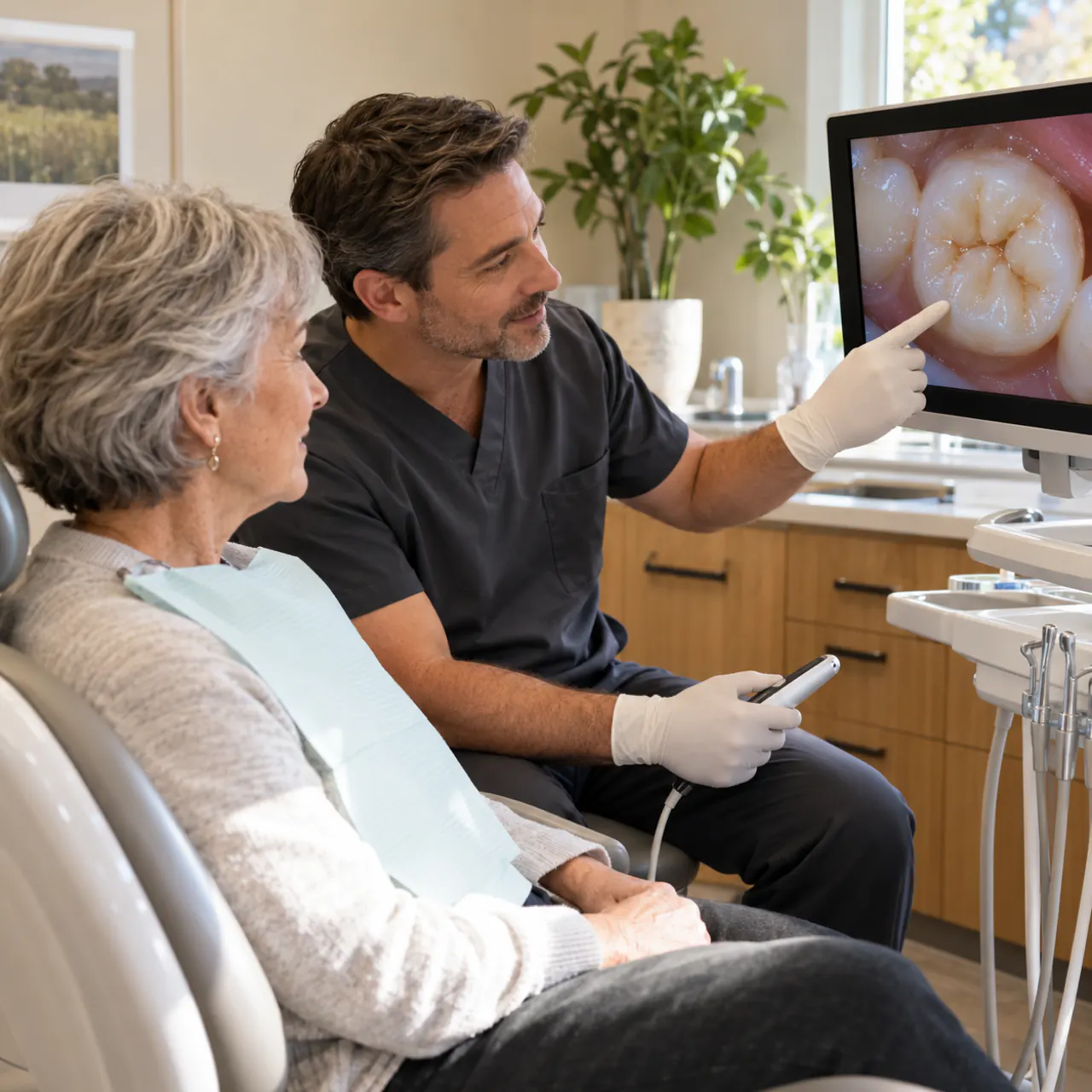
An intraoral camera is a small, pen-shaped camera that takes magnified photos inside your mouth. We put the image on a screen beside your chair so you can see what we are describing, which makes it much easier to understand a finding and decide what to do about it.
Why we use the camera
Clearer conversations about your teeth.
Most people have never seen their own back teeth up close. Photos turn a technical finding into something you can look at and ask about.
See what we are describing
Words like fracture line or open margin are hard to picture. A photo on screen shows you exactly what the dentist means.
Make decisions with confidence
When you can see a problem, it is easier to weigh treatment now, monitoring, or other options with us.
Track changes between visits
Photos saved in your record let us compare a crack, a stain, or a worn edge at your next appointment.
Show areas you cannot see
The backs of molars and the inside surfaces of teeth are almost impossible to see in a mirror at home.
Support for insurance documentation
Photos can be included with treatment records when supporting documentation is helpful, depending on your plan.
A simple, comfortable tool
The camera is small, does not use radiation, and only touches the mouth briefly while the picture is taken.
During your exam
How an intraoral camera exam fits into your visit.
The camera is used alongside the regular exam, not instead of it. It takes only a moment and nothing is uncomfortable about it.
Routine exam begins
The dentist examines your teeth, gums, and dental work as usual. When something is worth showing you, we reach for the camera.
Photograph the area
The camera is placed near the tooth and a magnified image is captured. It takes a few seconds and may be repeated from another angle.
Show the image on screen
The photo appears on the monitor beside you. We point out what we see, such as a crack, decay at an edge, or a chipped filling.
Compare with x-rays if needed
Some findings need an x-ray to understand what is happening below the surface. We explain how the photo and the x-ray fit together.
Talk through your options
We discuss whether the area should be treated, monitored, or simply noted. You can ask questions while the image is still in front of you.
Save to your record
Photos are stored securely in your chart for comparison at future visits. We can also review them again at your next appointment.
What photos can show
What the camera helps us show and what it cannot.
The camera captures surfaces we can see with our eyes, only larger and clearer. It works best when combined with the exam and x-rays when needed.
What intraoral photos can show
- Visible cracks and craze lines in enamel
- Chipped, worn, or leaking fillings
- Gaps or rough edges around crowns
- Dark grooves and surface stains on chewing surfaces
- Tartar deposits along the gumline
- Gum swelling, redness, or recession
- Wear facets from grinding or clenching
- Sores or patches that we want to monitor
What the camera cannot show
- Decay between teeth that is hidden from view
- Infection at the tip of a root
- Bone levels around teeth and implants
- The depth of a crack below the gumline
- Impacted or unerupted teeth
- The inside of a root canal
- Problems under existing crowns
- Anything that needs an x-ray or other imaging to assess
Chairside photos in Guelph
Your photos, explained in the chair.
At our Kortright Road West office, we use intraoral photos to help Guelph patients make decisions they feel comfortable with. If you would like a family member to see what we found, we are happy to walk them through the images too, with your permission.
Related services
Services that connect to visual exams
Questions patients ask
Intraoral camera exam FAQs
What patients usually want to know about dental photos and how we use them.
What is an intraoral camera?
It is a small camera about the size of a pen that takes magnified photos inside your mouth. The images are shown on a screen so you and your dentist can look at them together.
Does an intraoral camera use radiation?
No. The camera uses ordinary light, like a regular camera. It only shows surfaces that are visible, so it does not replace x-rays when those are needed.
Can the camera find cavities?
It can help show decay that is visible on a tooth surface or along the edge of a filling. Decay between teeth or under dental work usually needs an x-ray to detect, so the camera is one tool among several.
Will I be charged extra for intraoral photos?
Whether photos are billed separately depends on the type of appointment and how they are used. If you have questions about costs, our front desk team can go over them with you before your visit.
Can I get copies of my dental photos?
Your photos are part of your dental record. If you would like copies, or if you need them sent to another dental provider, ask our team and we will explain how to request them.
Why did my dentist show me a photo of a crack?
Many cracks are small and do not need treatment right away, but some may grow over time. Showing you a photo helps you understand the finding, and saving it lets us check whether it has changed at your next visit.
Is the camera used on children?
Yes, it can be. Many children enjoy seeing their teeth on the screen, and it can help explain why brushing a certain area is important. We only use it when it is helpful for the visit.
Are intraoral photos kept private?
Yes. Photos are stored as part of your confidential dental record and are only shared with your permission or as required for your care.