

Jaw mobility assessment in Guelph
When your mouth will not open as wide as it should, we measure it, find out why, and plan the next step.
Limited jaw opening, sometimes called trismus, can make eating, brushing, yawning, and even dental care difficult. It may come from tight muscles, a jaw joint disc that has slipped, an infection near a wisdom tooth, a recent dental injection, or other causes. A focused assessment helps tell these apart and decide how quickly care is needed.
Why an assessment helps
Restricted opening affects daily life and dental health.
Identifying the cause early helps you get the right care and keeps everyday tasks like eating and brushing manageable.
An objective baseline
Measuring your opening gives a clear starting point, so improvement or worsening is easy to track.
Spot infection early
Infection near a wisdom tooth or other tooth can cause stiffness. Finding it early allows prompt treatment.
Tell muscle from joint
Tight muscles and a displaced joint disc can both limit opening but are managed differently. The exam helps tell them apart.
Make eating easier
Practical advice on soft foods and smaller bites helps you eat comfortably while your jaw recovers.
Keep your mouth clean
When opening is limited, brushing back teeth is harder. We suggest tools and techniques that help.
Guided recovery
When appropriate, gentle exercises and follow-up help you regain movement gradually rather than forcing it.
The assessment
Measuring, examining, and finding the cause.
We work gently and at your pace. Nothing in this assessment requires you to force your jaw open.
When and how it started
We ask whether the stiffness began suddenly or gradually, and whether it followed dental work, an injection, an injury, a cold, or a period of clenching. This history is often the biggest clue.
Check for urgent signs
We ask about swelling, fever, difficulty swallowing, or a bad taste, and look for signs of infection. These change how quickly care is needed.
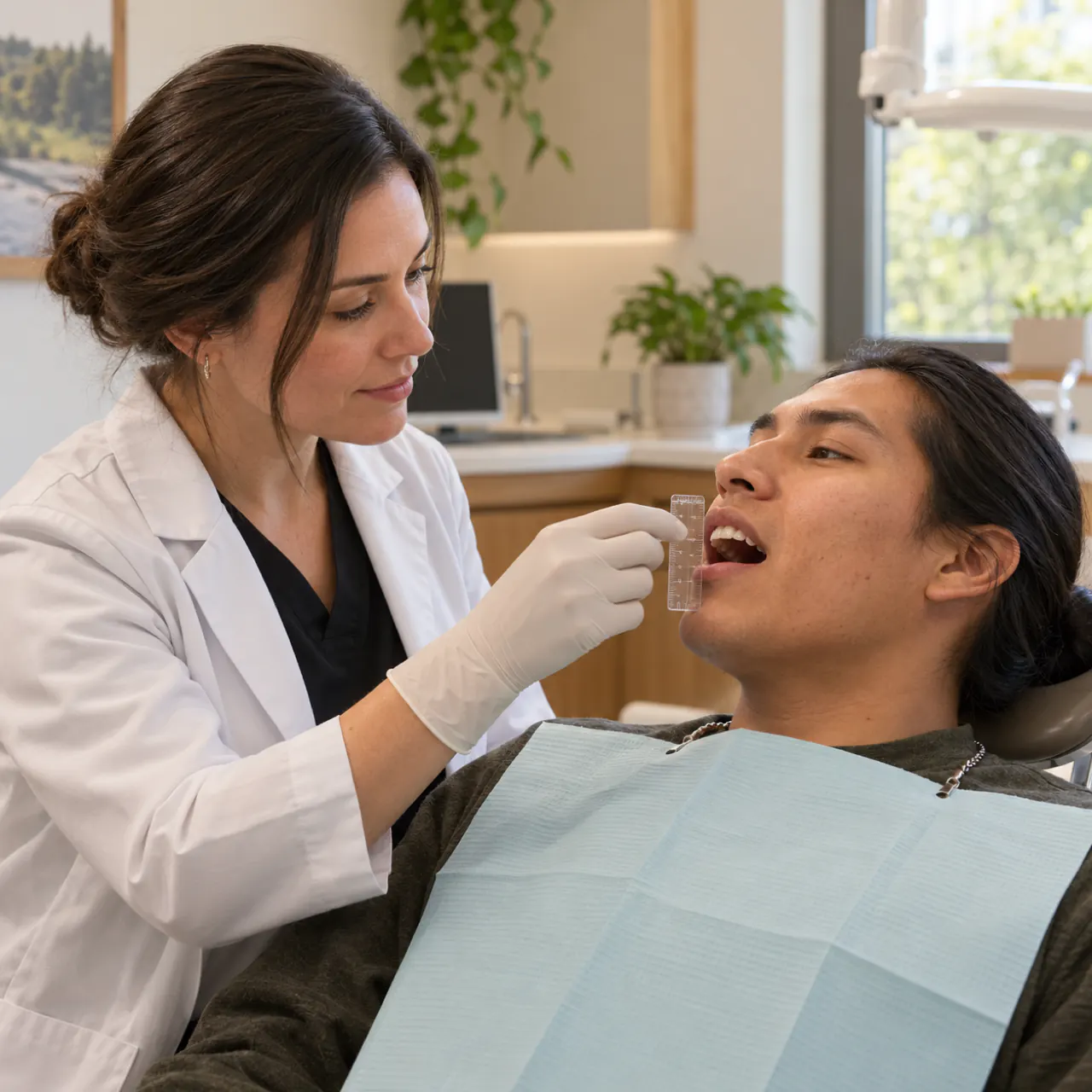
Measure opening and movement
We measure how far you can open comfortably and with gentle effort, and how your jaw moves side to side and forward. We also watch whether it deviates to one side.
Examine joints, muscles, and teeth
Your dentist feels the jaw joints and chewing muscles and examines the teeth and gums, especially around wisdom teeth, as far as your opening allows. We work slowly and stop whenever you need.
Imaging if useful
Depending on your exam, we may recommend a panoramic x-ray or 3D scan to look at the teeth, bone, and joints. These can be helpful when the mouth is hard to examine directly.
Plan and follow-up
We explain the likely cause and recommend care, which may include treating an infection, conservative jaw care, gentle exercises, or a referral. We usually book a follow-up to re-measure your opening.
Causes and urgency
Why opening becomes limited, and when to seek urgent help.
Some causes are muscular and settle with care. Others, like infection, need prompt treatment.
Possible causes of limited opening
- Muscle spasm or soreness after a long dental appointment
- Stiffness after a dental injection near the back of the jaw
- Infection or inflammation around a wisdom tooth
- A jaw joint disc that no longer slips back into place
- Heavy clenching or grinding that tightens the muscles
- A blow to the jaw or face
- Healing after a tooth extraction
- Medical conditions or past treatments that affect the jaw, which may need specialist input
Seek emergency care right away if
- Facial swelling is affecting your breathing, swallowing, or vision: call 911 or go to the nearest emergency department
- You have swelling along with a high fever
- Swelling is spreading quickly under the jaw or into the neck
- You cannot swallow your saliva
- Stiffness follows a significant injury to the face or head
- Your jaw is locked open and will not close
- You feel very unwell alongside jaw stiffness
- If unsure, call us at +1 519 763 1488 for guidance or seek medical care
Jaw stiffness help in Guelph
Gentle, unhurried care when your jaw is stiff.
If opening wide is painful, a long dental appointment can feel daunting. At our Kortright Road West office, we plan shorter, paced visits when needed and take breaks whenever you need them, so the assessment stays as comfortable as possible.
Related services
Related pages for jaw stiffness and pain.
Questions patients ask
Limited jaw opening FAQs
Questions patients ask when their jaw feels stuck, tight, or restricted.
Why can't I open my mouth all the way?
Limited opening can come from tight or sore jaw muscles, a jaw joint disc problem, infection near a tooth, an injury, or stiffness after dental treatment. An assessment helps identify which is most likely in your case.
Is limited jaw opening an emergency?
It can be. If you have facial swelling affecting your breathing, swallowing, or vision, or swelling with a high fever, call 911 or go to the nearest emergency department right away. Stiffness without these signs should still be assessed promptly.
My jaw is stiff after a dental appointment. Is that normal?
Mild stiffness after a long appointment or a dental injection can happen and often improves within days. If it is getting worse, comes with swelling or fever, or has not improved after about a week, please call us.
What is trismus?
Trismus is the term for reduced ability to open the mouth, usually due to muscle spasm or restriction. It has many possible causes, from dental infection and injections to jaw joint problems and certain medical treatments.
Can a wisdom tooth cause limited opening?
Yes. Inflammation or infection around a partially erupted wisdom tooth can make the nearby muscles tighten, limiting opening. This often needs prompt dental care.
Should I try to force my jaw open?
No. Forcing your jaw can make muscles tighter or strain the joint. Gentle, guided exercises may be recommended once we know the cause.
How long does it take for jaw opening to improve?
It depends on the cause. Muscle stiffness may ease over days to weeks, while joint-related restriction can take longer and may need ongoing care or specialist input. We re-measure at follow-up to track progress.
How do I brush my teeth when I can't open wide?
A small-headed or child-sized soft toothbrush, a gentle angle, and a fluoride rinse if recommended can help. We can show you techniques that work around limited opening while your jaw recovers.