

Crown care in Guelph
Loose dental crown treatment in Guelph that looks beneath the crown, not just at it.
A crown that rocks, clicks, or feels different when you bite is often a sign that the cement has broken down or that something has changed in the tooth underneath. Catching it while the crown is still in place gives the best chance of a simple solution. At Ironwood Dental, we find out why it has loosened and explain whether it can be recemented or needs more care.
Why act early
A loose crown is easier to save than one that has fallen out or broken.
When a crown starts to move, bacteria and food can seep under it. Prompt attention protects both the crown and the tooth.
May allow simple recementation
If the crown and tooth are healthy and only the cement has failed, the crown can often be cleaned and cemented back in place.
Stops leakage under the crown
A gap under a moving crown can let bacteria in. Treating it early helps reduce the risk of decay on the tooth beneath.
Prevents swallowing or losing it
Loose crowns often come off while eating. Securing it before that happens avoids the risk of swallowing or misplacing it.
Finds hidden problems
A loose crown can be the first sign of decay, a cracked tooth, or a broken post underneath. Early diagnosis keeps more options open.
Protects the gums
A rocking crown can irritate surrounding gum tissue. A secure fit helps the gums stay calm and healthy.
Honest repair or replace advice
If the crown is worn, cracked, or no longer fits, we explain whether replacing it would serve you better than refitting it.
Your loose crown visit
How we assess and treat a crown that has started to move.
Our first goal is to understand the cause. The right fix for loose cement is very different from the right fix for decay or a broken core.
Tell us what you feel
We ask when you first noticed the movement, whether there is pain or a bad taste, and how old the crown is. These details point us toward the likely cause.
Check the crown in place
We gently test how much the crown moves, examine its edges, and check the gums around it. We also look at your bite to see if it is taking extra force.
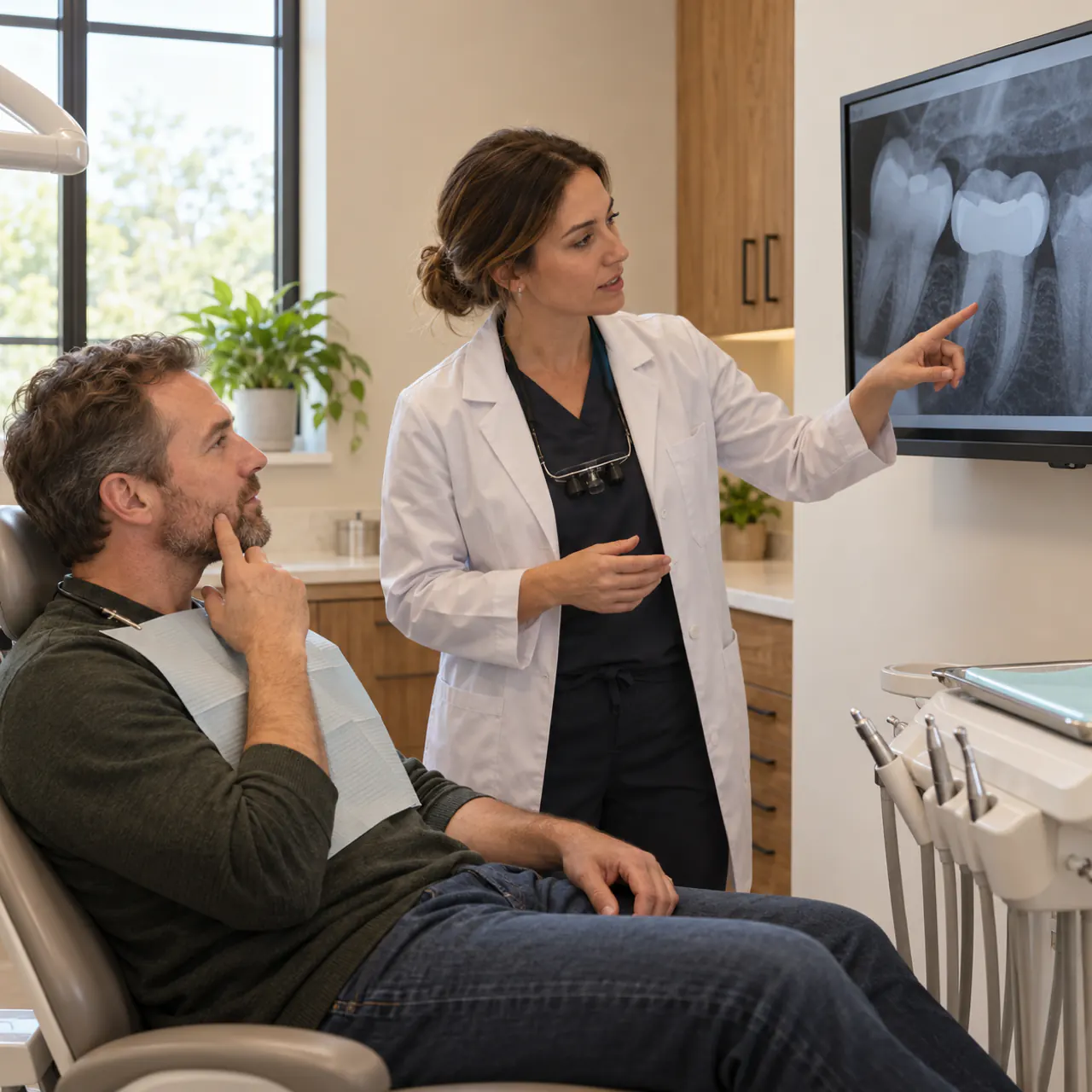
Take an x-ray
An x-ray helps us see decay under the crown, the condition of the root and bone, and whether a post or core is intact. It is a key step in deciding what comes next.
Remove and inspect if needed
If the crown is loose enough, we may remove it to inspect the tooth and the inside of the crown. This shows us whether the tooth is sound and the crown still fits.
Recement or plan further care
When everything is healthy, we clean both surfaces and recement the crown. If there is decay, a crack, or a broken core, we explain the treatment options and may place a temporary crown.
Bite check and follow-up
We check that the crown meets your other teeth evenly and does not feel high. We then monitor it at your regular exams.
Causes and care
Why crowns loosen, and what to do until your appointment.
Most loose crowns have a clear cause that we can identify with an exam and x-ray.
Common reasons a crown loosens
- Cement that has broken down over many years
- New decay at the edge of the crown
- A crack in the tooth beneath the crown
- A broken post or core inside a root canal treated tooth
- Heavy grinding or clenching forces
- Chewing very sticky or hard foods
- A crown that was short or had limited tooth to grip
- Gum recession exposing the root edge
What to do until your appointment
- Call our office as soon as you notice the movement
- Chew on the other side of your mouth
- Avoid gum, caramel, toffee, and very hard foods
- Brush gently around the crown without flossing aggressively
- Do not try to pull or wiggle the crown off
- Avoid using household glue to hold it in place
- If it comes off, keep it in a clean container and bring it in
- Seek urgent care if you notice swelling or a fever
Prompt crown checks in Guelph
Help for loose crowns at 570 Kortright Rd W.
Because a loose crown can come off at any meal, we try to see Guelph patients with this problem promptly. Call +1 519 763 1488 and tell us the crown is moving, and we will look for the earliest appointment that works, including our weekday evening hours.
Related services
Related crown care
Questions patients ask
Loose crown FAQs
Common questions from patients who have noticed a crown that no longer feels solid.
Why does my crown feel loose?
The most common reason is that the cement holding the crown has broken down. Decay under the crown, a cracked tooth, or a broken post or core can also make a crown move. An exam and x-ray help us tell which applies.
Is a loose crown an emergency?
It is usually not a medical emergency, but it should be seen soon. Waiting increases the chance of it coming off, being swallowed, or allowing decay underneath. If you also have swelling, fever, or severe pain, contact us right away.
Can a loose crown be put back on?
If the crown is intact and the tooth beneath it is healthy, it can often be cleaned and recemented. If there is decay or damage, the tooth may need treatment first, and sometimes a new crown is the better option.
Should I take the loose crown off myself?
No. Pulling on a loose crown can damage the tooth or the crown. Leave it in place, chew on the other side, and call us so we can remove it safely if needed.
Why does my loose crown smell or taste bad?
A bad taste or smell can mean food and bacteria are collecting under the crown. That is a good reason to have it checked soon, because it may be a sign of decay.
Can I use temporary dental cement from the pharmacy?
Temporary cement can sometimes help a crown that has fully come off stay in place for a short time, but it is not a fix for a loose crown. If you use it, follow the directions carefully and see us as soon as you can.
My crown is on a dental implant. Is that different?
Yes. An implant crown may loosen because of a loose screw or cement rather than a problem with a natural tooth. It still needs prompt attention, and we check the implant parts as well as the crown.
How can I keep a crown from loosening again?
Avoid very sticky or hard foods, wear a nightguard if you grind, and keep up with brushing, flossing, and regular checkups. These steps help protect the cement seal and the tooth underneath.