

Root canal care in Guelph
Molar root canals that save your strongest chewing teeth when the nerve inside is inflamed or infected.
Molars do most of the heavy work when you chew, and they also have the most complex insides: usually three or more canals spread across two or three roots. When the pulp in a molar becomes inflamed or infected, root canal treatment can often save the tooth. At Ironwood Dental in Guelph, we plan molar root canals carefully and explain each step, including the crown that usually follows.
Why save a molar
Back molars are worth keeping when they can be saved.
Replacing a molar is possible, but keeping your natural tooth often supports your bite, jaw bone, and neighbouring teeth best.
Keeps your natural tooth
Root canal treatment removes the inflamed or infected pulp while keeping the tooth's roots and structure in your jaw.
Relieves deep, lingering pain
Throbbing pain, pain that wakes you at night, or lingering sensitivity from a molar often eases once the pulp is treated.
Protects chewing strength
First and second molars handle heavy chewing forces. Saving them helps you keep eating a wide range of foods comfortably.
Prevents teeth from shifting
Losing a molar can allow teeth to drift and opposing teeth to over-erupt. Keeping it holds your bite in place.
Helps stop infection spreading
Treating an infected molar removes the source of bacteria inside the tooth, which helps the surrounding bone heal.
Often avoids an extraction and implant
When a molar can be saved, you may avoid the extra time and steps involved in replacing it.
Molar root canal steps
How root canal treatment on a molar is carried out.
Because molars have several canals, treatment can take longer and is sometimes completed over two appointments.
Diagnosis and x-rays
We test the tooth, review your symptoms, and take x-rays to see the roots and any infection. In some cases, 3D imaging may be recommended to map complex root anatomy.
Freezing and isolation
We numb the tooth thoroughly and place a thin rubber dam to keep the area clean and dry. This also keeps small instruments and solutions away from your throat.
Access and locate the canals
A small opening is made through the chewing surface to reach the pulp chamber. Molars often have three or four canals, and some have extra or curved canals that take time to locate.
Clean, shape, and disinfect
Each canal is cleaned and shaped with fine instruments and rinsed with disinfecting solutions. If there is significant infection, medication may be placed and the treatment finished at a second visit.
Fill and seal the canals
The canals are filled with a rubber-like material and sealed. A temporary or permanent filling then closes the access opening.
Plan the crown
Root canal treated molars are prone to cracking under chewing forces, so a crown is usually recommended soon after. We schedule that step so the tooth is protected.
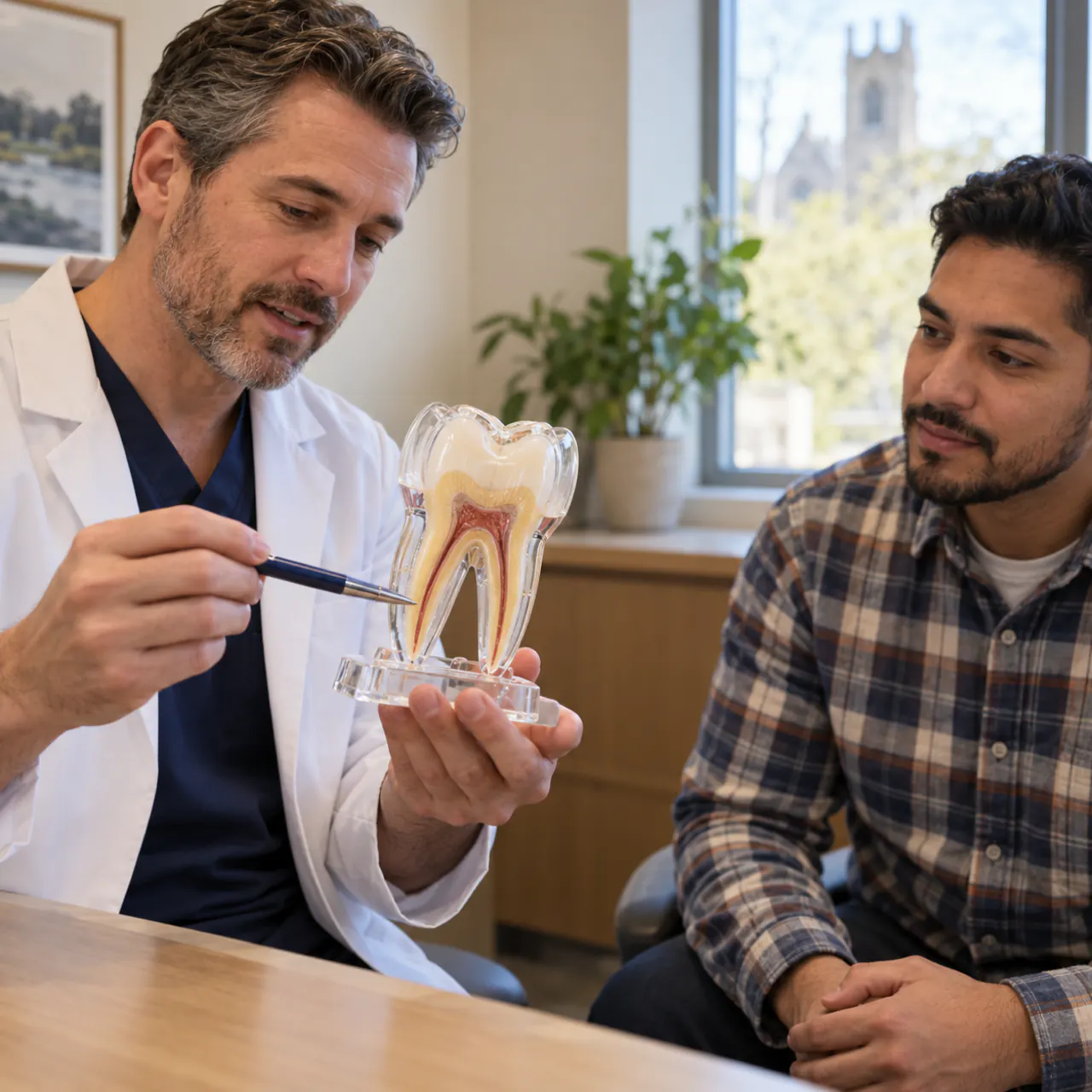
Molar-specific details
Signs a molar may need root canal care, and what makes molars different.
Molars present unique challenges, and knowing them helps you understand your treatment plan.
Signs a molar may need a root canal
- Throbbing pain in a back tooth that lingers or wakes you
- Lingering sensitivity to hot or cold after the source is gone
- Pain when chewing or pressing on one back tooth
- Swelling of the gum near a molar
- A pimple-like bump on the gum that drains
- Darkening of a back tooth
- Deep decay or a large old filling near the nerve
- A crack in a molar that has reached the pulp
What makes molar root canals different
- Usually three or more canals across two or three roots
- Canals can be narrow, curved, or partly calcified
- Upper molars sometimes have an extra, hard-to-find canal
- Limited access at the back of the mouth can lengthen the appointment
- Treatment may be completed in one or two visits
- A crown or onlay is usually needed for long-term strength
- Wisdom teeth are often assessed for extraction rather than root canal
- Complex cases may be coordinated with a trusted endodontist
Root canal care in Guelph
Molar root canals at 570 Kortright Rd W.
A toothache in a back molar often keeps people up at night. Our Guelph office offers weekday appointments into the evening and Saturday mornings, so patients can often be assessed without a long wait, and complex molars may be coordinated with a trusted endodontist when that serves you best.
Related services
Related root canal and restoration care
Questions patients ask
Molar root canal FAQs
Questions patients often ask when a back tooth needs root canal treatment.
Why do molar root canals take longer?
Molars usually have more canals than front teeth, and the canals can be curved or narrow. Each one needs to be found, cleaned, and sealed, which takes time. Being at the back of the mouth also makes access more challenging.
Will my molar need a crown after a root canal?
In most cases, yes. Molars take heavy chewing forces, and a root canal treated tooth can become more brittle. A crown, or sometimes an onlay, helps protect it from cracking.
Is a molar root canal painful?
The tooth is thoroughly frozen, and most patients feel pressure rather than pain during treatment. Some tenderness when chewing for a few days afterward is common and usually manageable with over-the-counter pain relief as directed.
Can a molar root canal be done in one visit?
Many can, depending on the tooth and the level of infection. Some molars are treated over two visits, with medication placed in the canals in between.
Should I just have the molar pulled instead?
Extraction is an option, but losing a molar can affect your bite and may lead to shifting teeth. Replacing it later with an implant or bridge involves its own steps. We explain the pros and cons of each choice for your situation.
Do wisdom teeth get root canals?
Occasionally, if a wisdom tooth is well positioned and important to the bite. More often, a problem wisdom tooth is assessed for removal. We will review both options with you.
Will I be referred to a specialist for my molar root canal?
It depends on the complexity of the tooth. Many molar root canals can be planned within our general practice, while teeth with unusual anatomy, calcified canals, or previous treatment may be coordinated with a trusted endodontist.
What if my molar is causing swelling in my face?
Swelling around a back tooth can mean an infection that needs prompt dental care, so call us the same day. If swelling affects your breathing, swallowing, or vision, or comes with a high fever, call 911 or go to the nearest emergency department right away.