

Oral health screening in Guelph
A quiet, careful check of the tissues most people never look at.
Oral cancer screening is a visual and hands-on examination of your lips, tongue, cheeks, gums, palate, throat, and neck. Most findings turn out to be harmless, but checking regularly means unusual changes can be noticed early and referred for further assessment when needed.
Why screening matters
Early attention to changes you may not notice yourself.
Many early oral changes are painless and easy to miss. A trained eye and a gentle hand-check help catch them sooner.
Changes noticed earlier
Screening at regular visits helps catch unusual patches, sores, or lumps while they are small and easier to assess.
Quick and non-invasive
The check involves looking and gentle touch. There are no needles, no cutting, and no recovery time.
A record to compare against
We note and sometimes photograph areas of interest so we can see whether they have changed at a follow-up visit.
Peace of mind about a spot
Many patients come in worried about a bump that turns out to be a normal feature or a minor irritation. Having it checked can put your mind at ease.
Clear guidance on next steps
If something needs further assessment, we explain why and help arrange a referral to an appropriate specialist.
Conversation about risk
Screening is a good time to talk about tobacco, alcohol, and other factors that affect oral tissue health.
The screening
What happens during an oral cancer screening.
Screening is usually part of your regular dental exam and takes only a few minutes. Nothing about it is invasive.
Review your health history
We ask about tobacco and alcohol use, past sores or lesions, and any changes you have noticed. These details help us interpret what we see.
Look at the lips and face
The dentist checks your face, lips, and the corners of your mouth for asymmetry, colour changes, or sores. This is done in good light before looking inside.
Examine inside the mouth
Your cheeks, gums, palate, floor of mouth, and tongue are examined, including the sides and underside of the tongue. You may be asked to stick your tongue out and move it side to side.
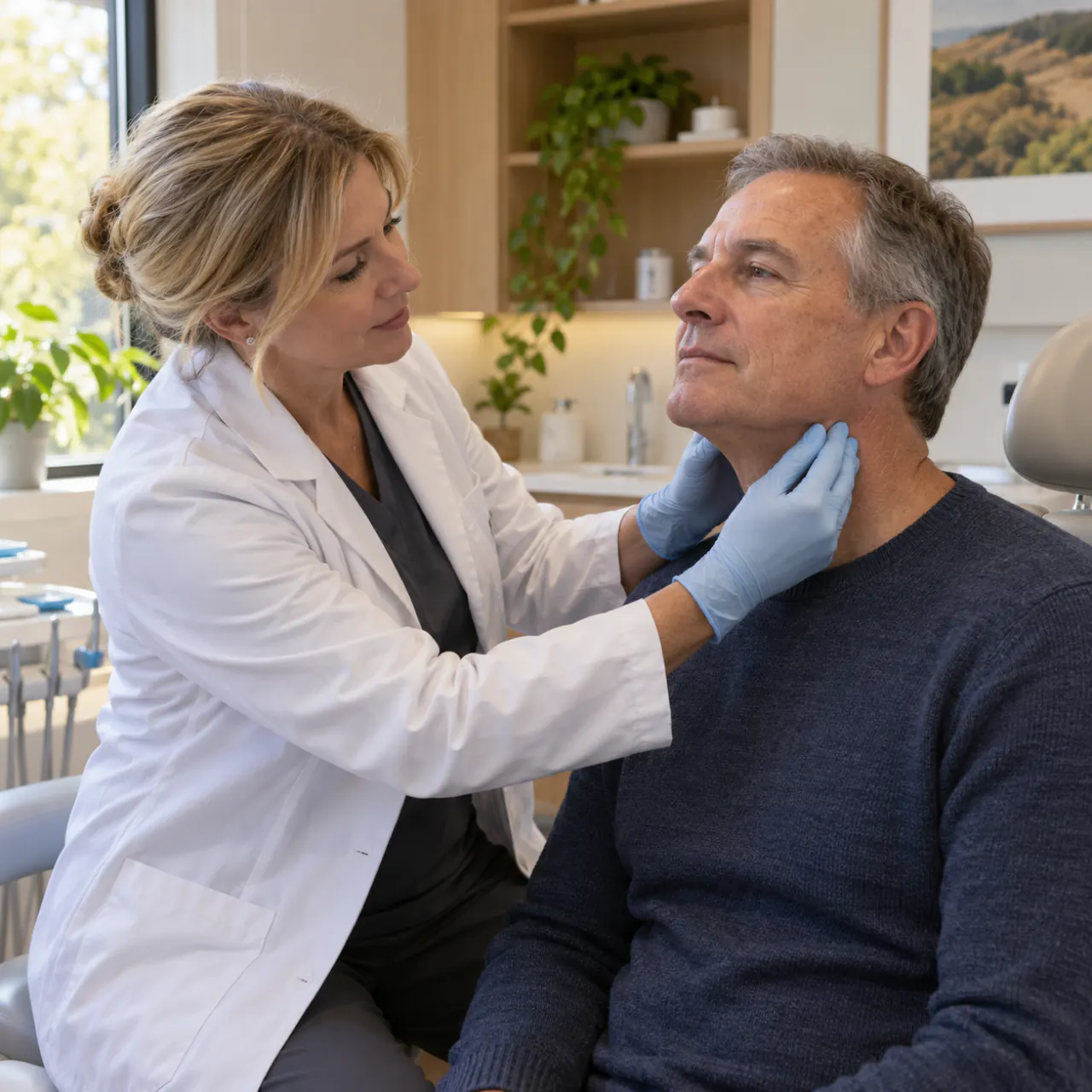
Feel the tissues and neck
The dentist gently feels the floor of the mouth, cheeks, and the lymph nodes in your neck and under your jaw. This helps detect lumps that cannot be seen.
Note and monitor any findings
If we see something unusual but likely harmless, we may photograph it and ask you to return in a couple of weeks. Many irritations heal on their own once the cause is removed.
Refer when further testing is needed
If an area does not heal or looks concerning, we will recommend further assessment, which may include a biopsy coordinated with a trusted specialist. We also suggest keeping your family physician informed.
Signs and risks
What we look for and what raises risk.
Knowing the warning signs helps you speak up between visits. Knowing your risk factors helps us decide how closely to watch.
Signs worth having checked
- A mouth sore that has not healed in two to three weeks
- A white or red patch on the gums, tongue, or cheek
- A lump or thickening in the cheek or neck
- Ongoing hoarseness or a sore throat that does not go away
- Difficulty chewing, swallowing, or moving the tongue
- Numbness in the tongue, lip, or chin
- A change in how your dentures fit without a clear reason
- Unexplained bleeding in the mouth
Factors that may increase risk
- Smoking or chewing tobacco
- Regular heavy alcohol use
- Using tobacco and alcohol together
- A history of HPV infection
- Frequent sun exposure to the lips
- A previous history of oral or head and neck cancer
- A weakened immune system
- Increasing age, though screening matters at every adult age
Screening in Guelph
Part of every thorough exam at our Kortright Road office.
Oral cancer screening is included as part of comprehensive and recall exams at Ironwood Dental. If you have noticed a sore, patch, or lump that is not going away, call our Guelph office at 519 763 1488 and ask for an earlier look rather than waiting for your next checkup.
Related services
Related care and next steps
Questions patients ask
Oral cancer screening FAQs
Answers to questions patients often have about oral cancer checks and what happens if something is found.
How often should I have an oral cancer screening?
For most adults, a screening at each regular dental exam is a reasonable approach. If you have higher risk factors, such as tobacco use or a previous lesion, your dentist may suggest closer monitoring.
Does an oral cancer screening hurt?
No. The screening involves looking at your mouth and gently feeling the tissues of your mouth and neck. It takes a few minutes and should not be uncomfortable.
What happens if you find something?
Most findings are harmless, such as irritation from a sharp tooth or a cheek bite. We often recheck an area in a couple of weeks. If it has not healed or looks concerning, we will recommend further assessment, which may involve a specialist.
Can a dentist diagnose oral cancer?
A dentist can identify areas that look suspicious, but a diagnosis requires testing, usually a biopsy examined by a pathologist. We help coordinate that next step and recommend you keep your family physician involved.
I have a sore in my mouth. Should I wait for my next checkup?
If a sore, patch, or lump has lasted more than two to three weeks, or seems to be getting larger, please call us for an earlier appointment. It is always better to have it looked at than to wait.
I do not smoke. Do I still need screening?
Yes. While tobacco is a major risk factor, oral cancer can also occur in people who have never smoked, including cancers linked to HPV. Screening is helpful for all adults.
Do denture wearers need oral cancer screening?
Yes. People who wear full dentures still need regular checks of their gums, palate, and tongue. Sore spots under a denture that do not heal should always be examined.
Is oral cancer screening part of my regular exam?
Yes. At Ironwood Dental, a soft tissue screening is part of comprehensive new patient exams and regular recall exams. You do not need to book it separately unless you have a specific concern.