

Retainers in Guelph
The right retainer is the one that suits your teeth and that you will actually wear.
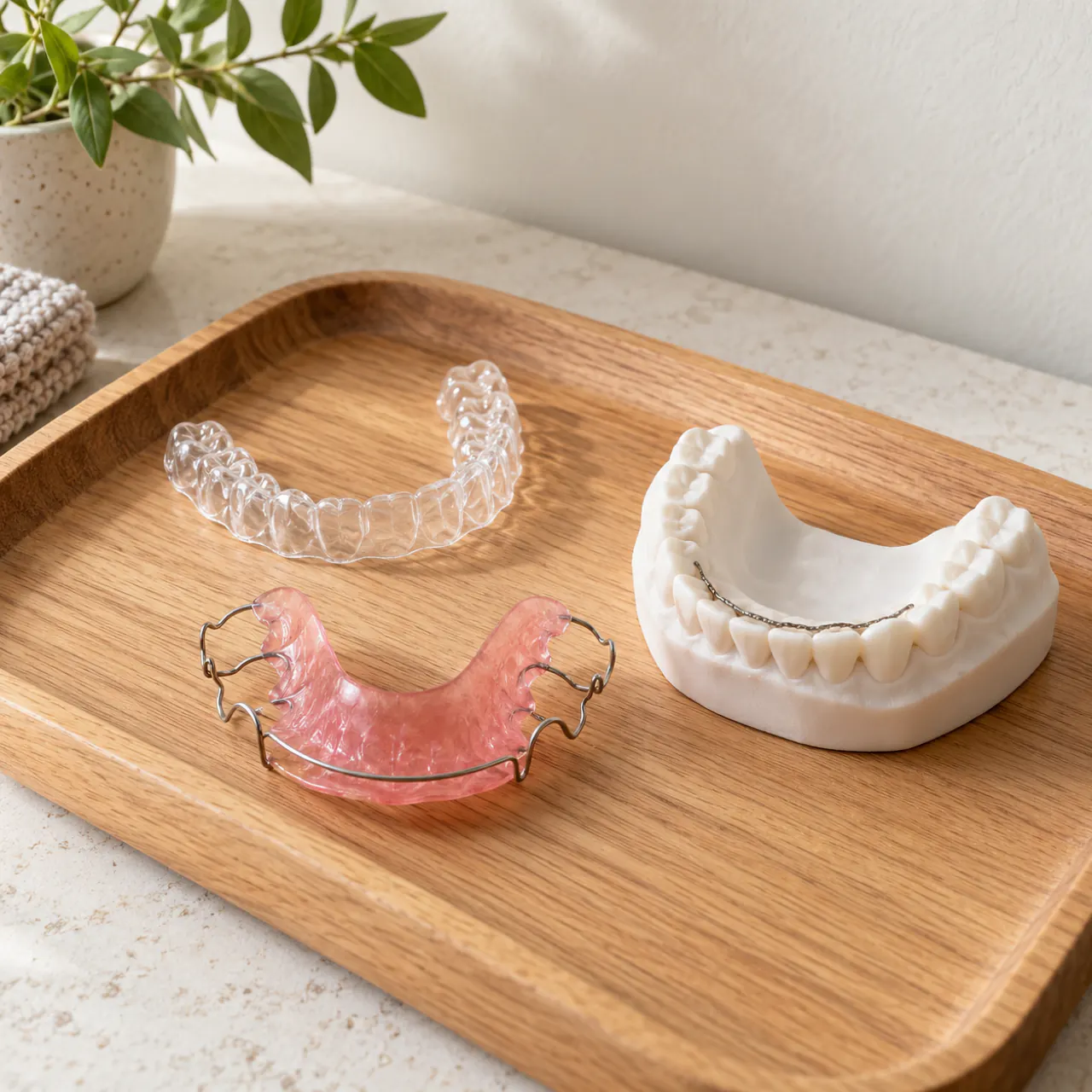
Retainers come in a few main styles: clear removable trays, removable retainers with a wire and acrylic base, and thin wires bonded behind the front teeth. Each has strengths and trade-offs. We help you compare them based on your treatment, your bite, and your daily habits.
Why retainers matter
Every retainer style has the same job: keeping teeth where they belong.
Teeth can drift after orthodontic treatment at any age. Choosing a retainer that fits your life makes it much more likely you will keep your result.
Options for different needs
Clear trays, wire-and-acrylic retainers, and bonded wires each suit different teeth, bites, and routines.
Bonded wires work around the clock
A fixed wire behind the front teeth holds them continuously, without you having to remember to put it in.
Removable retainers are easy to clean
Taking a retainer out lets you brush and floss normally and clean the retainer itself.
Combinations are possible
Some patients benefit from a bonded wire plus a removable retainer at night for extra security.
Some styles can be adjusted
Wire-and-acrylic retainers can sometimes be adjusted slightly, which may be useful in certain situations.
Monitoring built into your exams
We check retainer fit and condition at your regular visits, so problems are caught early.
Choosing your retainer
How we help you pick a retainer style.
The decision depends on how your teeth moved, how your bite works, and what you are likely to keep up with. We walk through it with you.
Review how your teeth moved
We look at what changed during treatment, such as closed spaces or corrected rotations. Some movements are more likely to relapse and may benefit from a particular retainer style.
Consider your bite and habits
Grinding, clenching, and how your teeth meet can affect which retainer lasts best. We also ask about sports, travel, and your daily routine.
Talk through the options
We explain each style, its care needs, and how often it is typically worn. You can ask questions and share your preferences.
Record your teeth
A scan or impression is taken for removable retainers. For bonded retainers, the wire is shaped to follow the back surfaces of your teeth.
Fit or bond your retainer
Removable retainers are tried in and checked for comfort. Bonded wires are attached with tooth-coloured material, and we confirm they do not interfere with your bite.
Learn care and wear routines
We show you how to clean around a bonded wire or care for a removable retainer, and explain your wear schedule. Retainers are then checked at your regular visits.
Comparing options
Removable and bonded retainers side by side.
Here is a plain-language look at the main retainer types and when each may be recommended.
Removable retainer styles
- Clear trays that cover the teeth and are nearly invisible
- Wire-and-acrylic retainers with a wire across the front teeth
- Usually worn full-time at first, then often at night
- Easy to take out for eating, brushing, and flossing
- Can be lost, broken, or chewed by pets
- Clear trays may wear faster for people who grind
- Need daily cleaning and a case when not in use
- Rely on you remembering to wear them
Bonded retainer considerations
- A thin wire attached behind the front teeth
- Holds teeth continuously without daily effort
- Often used after spaces or rotations are corrected
- Not visible from the front when you smile
- Requires careful flossing with a threader or floss pick
- Can collect tartar, so regular cleanings matter
- A bond can loosen without you noticing
- Usually checked at every exam and cleaning
Retainer care in Guelph
Retainers made, fitted, and checked in one Guelph office.
Whether you finished treatment with us or elsewhere, our Kortright Road West team can help you choose, fit, and maintain a retainer. Bonded retainers are checked at every regular exam and cleaning, and removable ones are easy to bring along so we can look at fit and wear.
Related services
More pages about retainers and retention.
Questions patients ask
Orthodontic retainer FAQs
Choosing between retainer types brings up a lot of questions. These are the ones we hear most.
What is the difference between a permanent and a removable retainer?
A permanent, or bonded, retainer is a thin wire attached behind the front teeth that stays in place all the time. A removable retainer is taken out for eating and cleaning and is worn on a set schedule. Some patients use both.
Which type of retainer is best?
There is no single best retainer. The right choice depends on how your teeth moved, your bite, whether you grind, and what you are likely to wear consistently. We recommend options based on your exam.
Is a bonded retainer really permanent?
It is meant to stay in long term, but the bond can loosen or the wire can break over time. It is checked at your regular exams and can be repaired or replaced when needed.
How do I floss with a bonded retainer?
You can use a floss threader, a floss pick designed for bonded wires, or an interdental brush to clean under the wire. Your hygienist can show you techniques that work well for you.
Can I choose a retainer that nobody will see?
Yes. Clear removable retainers are nearly invisible, and bonded retainers sit behind the teeth where they are not seen when you smile. Wire-and-acrylic retainers have a visible wire across the front teeth.
Do I need upper and lower retainers?
Many patients wear retainers on both arches, but it depends on which teeth moved during treatment. We explain what is recommended for you.
Can a retainer move my teeth back if they shifted?
A retainer is designed to hold teeth, not move them. If teeth have shifted only slightly, a retainer that still seats may help, but more noticeable movement usually needs aligners or another form of treatment.
What if my bonded retainer feels loose?
Call us if the wire feels loose, sharp, or different. A loose bond can let teeth shift, so it is best to have it checked and repaired before movement occurs.