

Dental imaging in Guelph
One wide image that shows your whole mouth, jaws, and surrounding structures.
A panoramic x-ray captures both jaws and all of your teeth in a single image, taken while you stand still and the machine moves around your head. It gives a big-picture view that smaller x-rays cannot, which is especially useful for wisdom teeth, implant planning, and checking the jaws.
Why a panoramic view
Seeing the parts of your mouth that close-up x-rays miss.
Bitewing and periapical x-rays show a few teeth in detail. A panoramic image shows how everything fits together.
See wisdom teeth clearly
A panoramic image shows the position, angle, and development of wisdom teeth and how close they sit to nearby nerves and teeth.
Check the whole jaw
The image includes areas beyond the teeth, such as the jawbone and jaw joints, where cysts or other changes may sometimes be found.
Plan implants and dentures
A wide view helps assess bone height and the overall layout before implants, dentures, or larger treatment.
Track development in young patients
In children and teens, panoramic images can show adult teeth still forming and help with orthodontic timing.
Nothing large in your mouth
Unlike some x-rays, you only bite gently on a small guide, which many patients find easier to tolerate.
A useful baseline
For new patients or those starting larger treatment, a panoramic image gives a reference point for the future.
Taking the image
What to expect when you have a panoramic x-ray.
The process is quick and nothing goes inside your mouth except a small bite guide. You stand or sit while the machine does the work.
Explain why it is recommended
We tell you what question the x-ray will help answer, such as checking wisdom teeth or planning an implant. You can ask about radiation and alternatives.
Remove metal items
Earrings, necklaces, glasses, hairpins, and removable dental appliances are taken off. Metal can create shadows that make the image harder to read.
Position you in the machine
You stand or sit with your chin on a rest and bite lightly on a small guide. We adjust the height and alignment so your jaws are centred.
Stay still for a few seconds
The arm of the machine rotates slowly around your head while the image is taken. Holding still and keeping your tongue against the roof of your mouth helps produce a clear image.
Review the image together
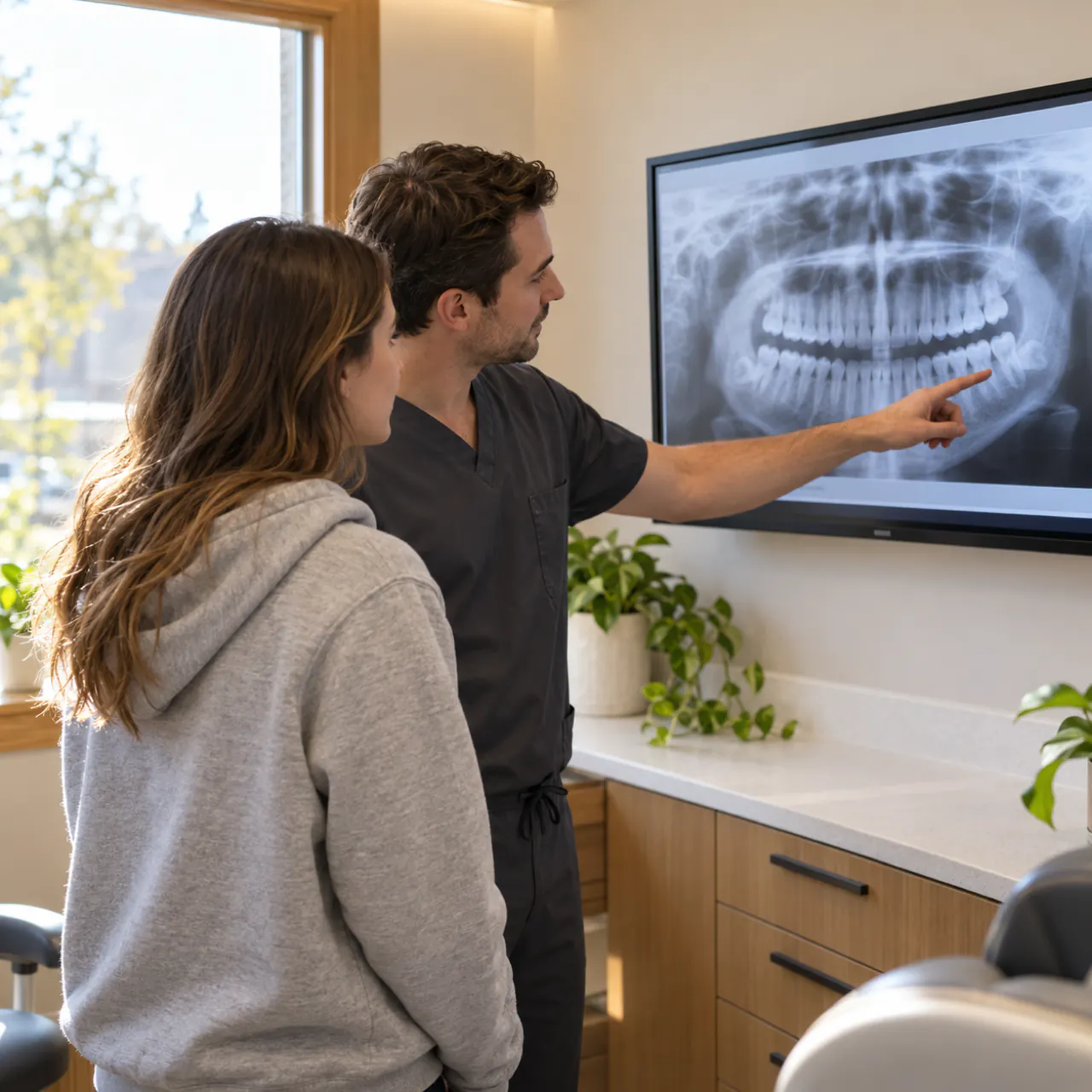
The image appears on screen shortly after. The dentist looks over your teeth, bone, sinuses, and jaw joints and shows you anything of note.
Add detail if needed
If an area needs a closer look, we may recommend a smaller x-ray or, in some cases, 3D imaging. We explain why before taking anything further.
Uses and limits
When a panoramic x-ray helps and what it can miss.
Panoramic images are a tool for specific questions, not something everyone needs at every visit. We recommend them when the information will guide your care.
When a panoramic x-ray may be recommended
- Assessing wisdom teeth in teens and young adults
- Planning dental implants or extractions
- Before making complete or partial dentures
- Checking for impacted or missing adult teeth
- Orthodontic assessments and timing
- Investigating jaw pain or unexplained swelling
- A baseline for new patients with complex needs
- Patients who cannot tolerate smaller x-ray sensors
What a panoramic x-ray may not show well
- Small cavities between teeth
- Fine detail at the tip of individual roots
- Early decay around the edges of fillings
- Exact bone width for implant placement
- Hairline cracks in teeth
- Front teeth, which can appear slightly blurred
- Precise distances to nerves in complex cases
- Soft tissue concerns that need a physical exam
Imaging in Guelph
Wide-view x-rays at our Kortright Road West office.
When a panoramic image is part of your plan, it can usually be taken during your visit at our Guelph office so we can review it with you right away. If you have had one taken elsewhere recently, let us know and we can request a copy to avoid repeating it.
Related services
Care that often uses a panoramic image
Questions patients ask
Panoramic x-ray FAQs
Answers about how panoramic x-rays work, when they are recommended, and how they compare to other images.
What is the difference between a panoramic x-ray and regular dental x-rays?
Regular x-rays, like bitewings, show a few teeth in fine detail and are good for finding cavities between teeth. A panoramic x-ray shows all your teeth and both jaws in one image but with less fine detail. They answer different questions and are often used together.
How much radiation is in a panoramic x-ray?
A panoramic x-ray uses a low dose of radiation. We only recommend one when the information is useful for your care, and we follow standard safety practices. If you have concerns, we are happy to discuss them before the image is taken.
How often do I need a panoramic x-ray?
There is no fixed schedule. Many patients only need one every few years or when a specific question comes up, such as wisdom teeth or implant planning. Your dentist will recommend one based on your needs.
Can I have a panoramic x-ray while pregnant?
Non-urgent x-rays are often postponed during pregnancy. If imaging is needed to diagnose a problem, we discuss it with you and take appropriate precautions. Let us know if you are pregnant or may be pregnant before any x-ray.
Does a panoramic x-ray show cavities?
It can show larger cavities, but small decay between teeth is easier to see on bitewing x-rays. That is why a panoramic image does not replace your regular checkup x-rays.
Is a panoramic x-ray the same as a 3D scan?
No. A panoramic x-ray is a flat, two-dimensional image. A CBCT scan creates a 3D view and is used for more detailed planning, such as some implant or complex wisdom tooth cases.
Why do I need to remove my earrings?
Metal objects near the head can show up as shadows on the image and hide important areas. Removing jewellery, glasses, and removable appliances helps us get a clear picture the first time.
At what age might a child need a panoramic x-ray?
Panoramic images are sometimes taken in later childhood or the teen years to check developing adult teeth, wisdom teeth, or orthodontic needs. Whether your child needs one depends on their development and exam findings.