

Periodontal care in Guelph
Deep gum pockets can often be reduced, making your gums far easier to keep healthy.
A periodontal pocket forms when gum tissue pulls away from the tooth and the space below the gumline deepens. Toothbrush bristles and floss cannot reach the bottom of deeper pockets, so bacteria settle in and inflammation continues. At Ironwood Dental we focus on the pockets themselves: cleaning them thoroughly, tracking how they respond, and planning further steps for any that stay deep.
Why pockets matter
Shallower pockets are pockets you can actually clean.
The depth of a pocket influences how much bacteria it can hold and how well it can be maintained at home and at your cleanings.
Removes what feeds the pocket
Cleaning tartar and bacteria from the root surface inside the pocket removes the main source of ongoing inflammation.
Helps pockets shrink
As inflammation settles, swollen gum tissue often tightens and pocket depths may decrease.
Makes home care effective
Shallower pockets allow brushing and interdental cleaning to reach more of the area you need to keep clean.
Lowers the risk of abscesses
Deep pockets can trap debris and lead to gum abscesses. Reducing them may lower that risk.
Targets the trouble spots
Treatment can focus on specific pockets rather than treating the whole mouth the same way.
Shows measurable progress
Before-and-after pocket readings give you a clear, objective view of how your gums are responding.
What to expect
A step-by-step approach to deep pockets.
Pocket treatment usually starts conservatively. More involved options are considered only for pockets that remain deep after healing.
Map every pocket
We measure pocket depths at six points around each tooth and record bleeding. This map shows exactly which areas need attention.
Thorough root cleaning
Under local anaesthetic, we clean the root surfaces inside the deeper pockets, removing tartar and bacteria. This is the foundation of pocket treatment.
Targeted support where needed
For some pockets, a locally placed antimicrobial or other adjunct may be considered. We explain whether it makes sense for your situation.
Healing time
Gums need several weeks to heal and tighten after cleaning. During this time, careful home care makes a big difference.
Re-measure and compare
We remeasure each pocket and compare it with your starting chart. Many pockets improve, while some may stay deep.
Plan for persistent pockets
For pockets that remain deep, we discuss options such as repeat targeted cleaning, more frequent maintenance, or referral to a specialist for pocket reduction or regenerative procedures.
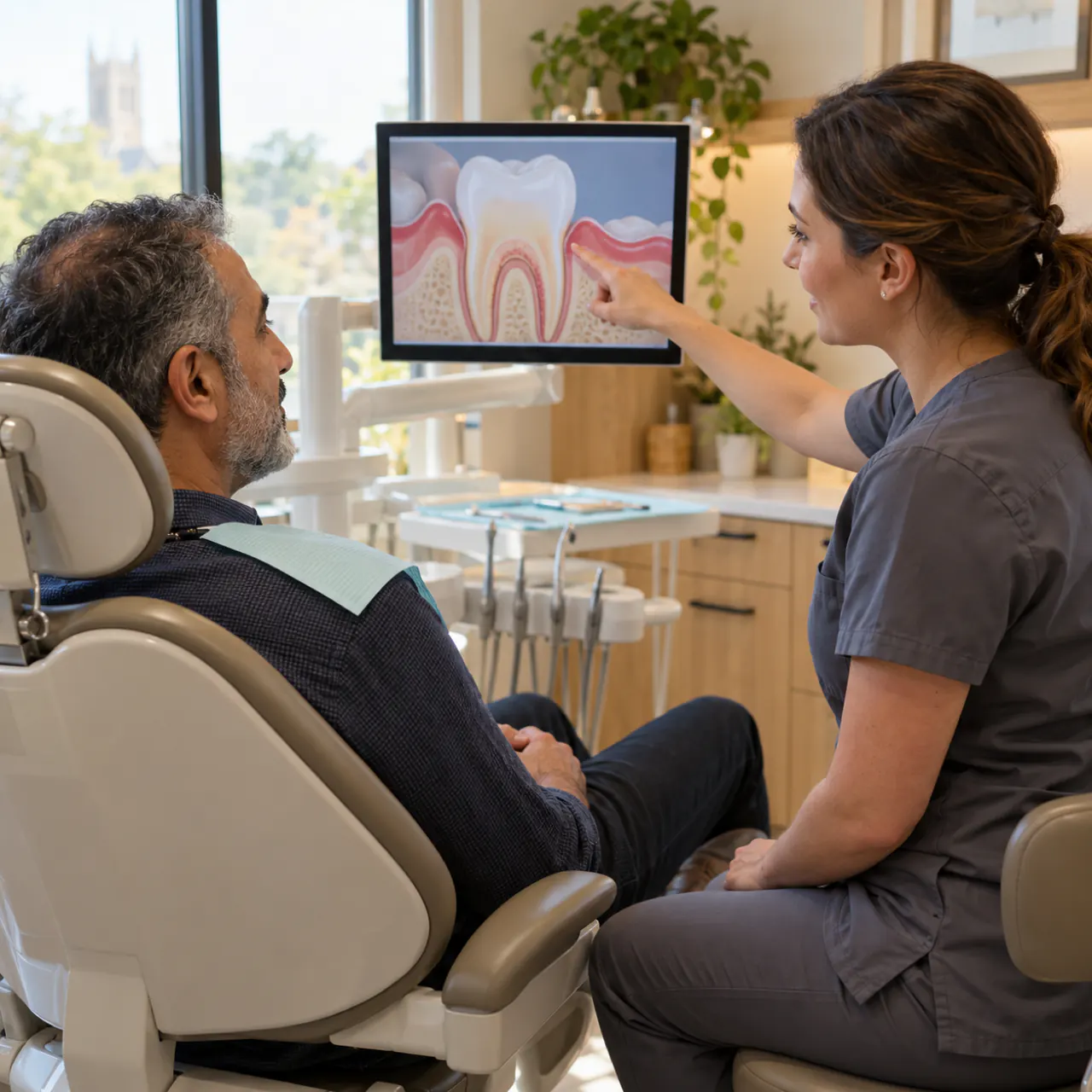
Pocket depths and options
What pocket depths mean, and how persistent pockets may be treated.
Every pocket is measured and tracked individually. Here is how we interpret the readings and what we may suggest if a pocket does not respond.
Understanding pocket depths
- Healthy gums usually measure in the shallow range of a few millimetres
- Bleeding at a shallow reading may suggest gingivitis
- Moderately deep pockets may indicate early periodontitis
- Deeper pockets are harder to clean and may signal bone loss
- A change between visits matters as much as the number itself
- Readings can vary slightly with inflammation and pressure
- Bleeding at a site suggests ongoing activity
- We always explain your own readings in context
Options for pockets that stay deep
- Repeat focused cleaning of specific sites
- Shorter intervals between maintenance visits
- Locally applied antimicrobial products when appropriate
- Adjusting interdental tools to reach the area
- Addressing bite forces on the affected tooth
- Pocket reduction surgery with a specialist
- Regenerative procedures where bone shape allows
- Discussing tooth replacement if support is very limited
Focused gum care in Guelph
Tracking each pocket at our Guelph office.
At our Kortright Road West office we keep a detailed pocket chart for every patient in gum treatment, so you can see which areas have improved and which still need work. When a pocket needs more advanced care, we coordinate with a trusted periodontal specialist and continue your maintenance with us in Guelph.
Related services
Related periodontal treatments
Questions patients ask
Periodontal pocket FAQs
Pocket depths are one of the most important numbers in gum care. These answers explain what they mean for you.
What is a periodontal pocket?
It is a space between the tooth and gum that has deepened because the gum has pulled away or the attachment beneath has broken down. Deeper pockets collect bacteria that brushing and flossing cannot reach.
Can gum pockets shrink back to normal?
Many pockets do become shallower after thorough cleaning and good home care, as the gums tighten. Pockets caused by significant bone loss may not return completely to normal, but they can often be kept stable.
Is a 5 mm gum pocket bad?
A reading in that range is deeper than healthy gums and often suggests periodontitis, especially if it bleeds. On its own a number is only part of the picture, so we consider x-rays, bleeding, and how the reading has changed over time.
How are deep gum pockets treated?
Treatment usually begins with scaling and root planing to clean the root surfaces. After healing, we remeasure. Pockets that stay deep may need more frequent maintenance, targeted treatment, or a specialist procedure.
Can I clean deep gum pockets at home?
Home care cannot reach the bottom of deep pockets, but it does keep the upper part clean and reduces inflammation. Interdental brushes and careful brushing at the gumline are especially helpful. Professional cleaning reaches the rest.
Why do some pockets stay deep after treatment?
Pockets may stay deep if bone loss has changed the shape of the area, if tartar is hard to reach, if bite forces are high, or if risk factors such as smoking or diabetes remain. We look at each of these when planning next steps.
What is pocket reduction surgery?
It is a procedure, usually done by a periodontal specialist, in which the gum is gently lifted so the roots can be cleaned directly and the tissue repositioned to reduce the pocket. It is considered when non-surgical treatment has not been enough.
Do deep pockets mean I will lose my teeth?
Not necessarily. Many teeth with deep pockets can be kept for years with treatment and regular maintenance. The outlook depends on bone support, how well the pocket responds, and your overall risk factors.