

Restorative dentistry in Guelph
Post-and-core restorations that give a heavily damaged tooth a solid foundation for its crown.
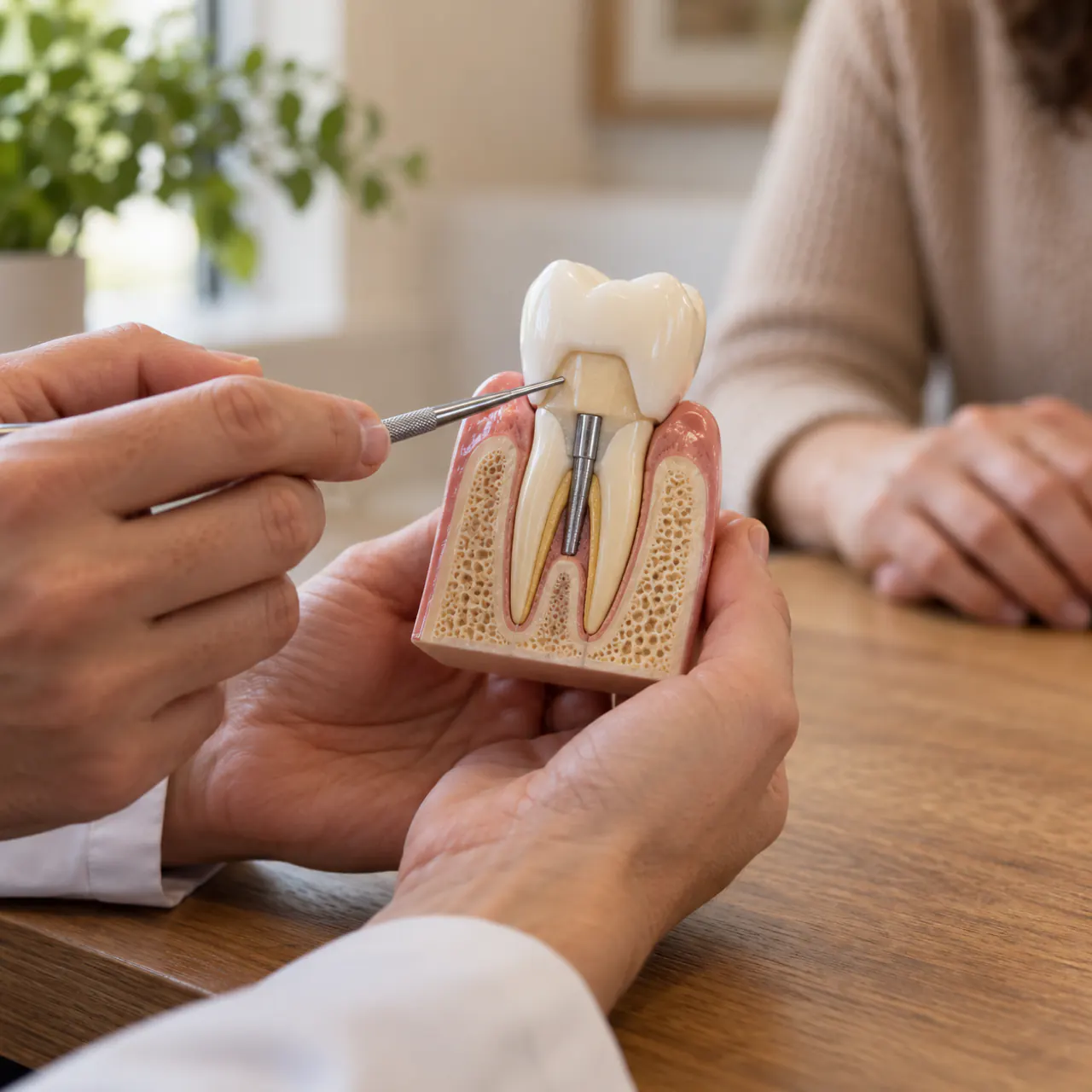
After root canal treatment, some teeth have so little structure left above the gum that a crown would have nothing to grip. A post-and-core restoration rebuilds that foundation: a small post is placed into a treated root canal to help anchor a core, which is shaped to support the crown. At Ironwood Dental in Guelph, we only recommend a post when the tooth truly needs it.
Why a post and core
Rebuilding what a crown needs to hold on to.
A crown is only as stable as the tooth underneath it. When much of that tooth is missing, a post and core can make restoration possible.
Makes a crown possible
When too little tooth remains, a post and core can provide the height and shape a crown needs to stay in place.
Helps retain the core
The post's main job is to help hold the core build-up in place. It does not strengthen the root itself, which is why we only use one when necessary.
Saves a tooth that might be lost
For some badly broken teeth, a post and core is what allows the tooth to be kept instead of extracted.
Tooth-coloured options
Fibre posts and composite cores can be used under ceramic crowns, which may help with appearance in visible areas.
Conservative preparation
We prepare only as much of the canal as needed for the post, preserving as much root structure as we can.
Fits into your crown plan
The core is shaped to suit the crown design, so the two parts work together for a stable fit and natural look.
How it is done
From assessment to a crown-ready foundation.
Post-and-core work is usually done after the root canal is complete and before the final crown is made.
Assess the remaining tooth
We examine how much natural tooth is left above the gum and review x-rays of the root canal filling and root length. This tells us whether a post is needed.
Confirm the root canal is sound
A post is only placed in a well-sealed, healthy root canal. If the existing treatment shows problems, retreatment may be recommended first.
Prepare the post space
With the area frozen if needed, part of the root canal filling is carefully removed to create space for the post, leaving a seal at the root tip.
Place the post
A prefabricated post, often fibre-reinforced, is bonded into the canal. In some cases, a custom post may be made from an impression.
Build the core
Core material is built up around the post and shaped like a smaller version of the tooth. This becomes the foundation for the crown.
Crown preparation
The core and tooth are refined for the crown, and a scan or impression is taken. Your crown may be made the same day or placed at a follow-up visit.
Is a post needed
When a post may be recommended, and when a core alone is enough.
Posts are not needed for every root canal treated tooth. The decision depends on how much natural tooth remains.
When a post may be recommended
- Most of the tooth above the gum has broken away
- Only one or two thin walls remain after root canal treatment
- A front tooth has lost much of its structure
- A previous post and crown has come off
- The tooth needs a crown but lacks height for retention
- A core alone would be unlikely to stay in place
- The tooth is an important anchor for a bridge
- There is enough root length to hold a post safely
When a core alone may be enough
- Several healthy walls remain after root canal treatment
- The pulp chamber in a molar can help retain the core
- The tooth has good height above the gum line
- A conservative onlay can protect the tooth instead
- The root is short or curved, making a post risky
- The root is thin and a post could weaken it
- There is a crack that a post could worsen
- The goal is to keep as much root dentin as possible
Restorative planning in Guelph
Rebuilding root-treated teeth on Kortright Road West.
Patients often come to our Guelph office after a root canal elsewhere, or after a crown has come off a tooth that was treated long ago. We review the tooth carefully at 570 Kortright Rd W and explain whether a post and core can give it a reliable future, or whether another option may serve you better.
Related services
Related root canal and crown care
Questions patients ask
Post-and-core FAQs
Questions patients ask when they hear their tooth may need a post before its crown.
What is a post and core?
A post is a small rod placed into a root canal treated tooth, and the core is the filling material built up around it to form a base for a crown. Together they replace missing tooth structure so the crown has something to hold on to.
Does every root canal treated tooth need a post?
No. Many treated teeth have enough structure left to support a core and crown without a post. A post is only recommended when the tooth needs extra retention for the core.
Does a post strengthen my tooth?
Not really. A post helps hold the core in place, but it does not make the root stronger, and an unnecessary post can remove useful root structure. That is why we use posts only when they are needed.
Is placing a post painful?
Because the tooth has had root canal treatment, the nerve inside has been removed. Freezing may still be used for the gums and surrounding area, and most patients feel only pressure.
What are dental posts made of?
Posts are commonly made from fibre-reinforced materials or metal. Fibre posts are tooth-coloured and are often chosen for teeth that will receive a ceramic crown.
My old crown came off with the post still inside. What now?
Bring the crown and any pieces to your appointment. We will check whether the post and tooth are sound, whether the crown can be reused, or whether a new post, core, or crown is needed.
How long does a post and core last?
With a well-sealed root canal, a well-fitting crown, and good home care, a post and core can serve for many years. Heavy grinding, decay at the crown edge, or root cracks can shorten its life.
Can a post and core be done on the same day as the crown?
Often, yes. The post and core can be placed and the crown preparation completed in one visit. Depending on the crown, it may be placed the same day or at a follow-up appointment.