

Implant problem solving in Guelph
A failing implant can often be managed with a clear, staged plan rather than a rushed decision.
Implants can run into trouble from gum infection around the implant, bone loss, overload, or problems that started during healing. Some can be treated and kept; others are better removed and replaced once the area heals. We start by working out which situation you are in and what a realistic path forward looks like.
Why a careful assessment matters
Understanding why an implant failed shapes what happens next.
Replacing an implant without addressing the original cause can lead to the same problem again. A thorough look at the history comes first.
Know whether it can be saved
Some implants with early bone loss or gum inflammation may respond to deep cleaning and closer maintenance. We tell you honestly whether that is likely.
Limit further bone loss
An infected or overloaded implant can keep losing bone around it. Acting sooner can preserve more bone for a future implant.
Address the original cause
Grinding, gum disease, smoking, a poorly fitting crown, or medical factors may have played a part. Managing them improves the chances for a replacement.
A staged plan you can follow
Removal, healing, grafting if needed, and new placement are mapped out in order so you know what to expect at each stage.
Temporary teeth in the meantime
If an implant needs to come out, we discuss temporary options such as a flipper or modified denture so you are not left with an obvious gap.
Coordination when needed
Complex removals or major bone rebuilding may be coordinated with a trusted specialist, with your care staying organized from our office.
The path forward
Assessment, treatment or removal, healing, and rebuilding.
Not every step applies to every patient. Some implants respond to treatment, and others move straight to a removal and healing plan.
History and records
We ask when the implant was placed, what has changed, and whether there has been pain, bleeding, or looseness. Prior x-rays or records from the placing office are very helpful.
Clinical exam
Your dentist checks the gum around the implant for bleeding, swelling, pus, or deeper pockets, and tests whether the implant itself moves. We also check the crown, screw, and bite.
Imaging
X-rays or 3D imaging show how much bone surrounds the implant and how that compares with earlier images. This is often the key to deciding between treatment and removal.
Treatment or removal decision
If the implant is stable with limited bone loss, we may recommend cleaning and infection control around it. If it is mobile or has lost too much support, removal is usually the safer path.
Healing and rebuilding
After removal, the site is given time to heal, and bone grafting may be recommended to rebuild the area. Temporary teeth are planned so you can function in the meantime.
New implant and follow-up
Once the area is ready, a new implant may be placed using careful planning, followed by a new crown or prosthesis. Ongoing implant maintenance visits help protect the result.
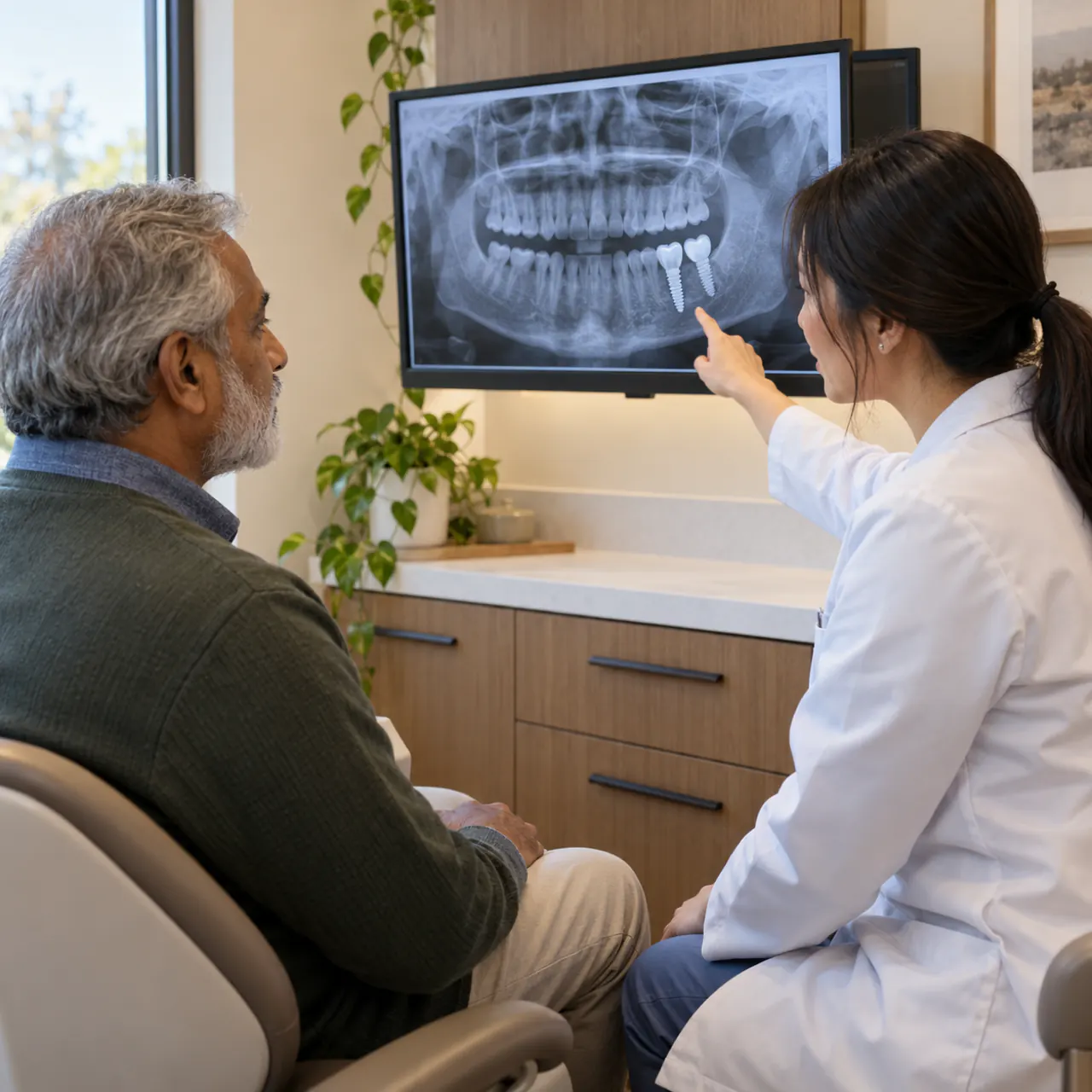
Warning signs and causes
What a failing implant can look and feel like.
Problems around implants are sometimes quiet at first, which is why regular implant checkups are so useful.
Signs an implant may be in trouble
- Bleeding or pus from the gum around the implant
- Gum that is red, puffy, or pulling back to show metal
- A deepening pocket around the implant at checkups
- Bone loss visible on x-rays compared with earlier images
- The implant itself moving, not just the crown
- Pain or pressure when biting on the implant tooth
- A bad taste or persistent odour from one area
- Repeated crown or screw problems on the same implant
Factors that can contribute to implant failure
- Peri-implantitis, an infection of the gum and bone around an implant
- Plaque buildup when the implant is hard to clean
- Heavy biting forces, clenching, or grinding
- Smoking or vaping, which can affect healing and gum health
- Uncontrolled diabetes or other medical conditions
- Limited bone or gum tissue at the time of placement
- Excess cement left under a cemented crown
- A restoration shape that traps food or overloads the implant
Second looks in Guelph
Implant concerns reviewed at our Kortright Road West office.
We see Guelph patients whose implants were placed with us and patients whose implants were placed many years ago somewhere else. Either way, bring whatever records you have and we will look at the implant with fresh eyes. When the situation calls for specialist care, we help coordinate that referral so you are not left sorting it out alone.
Related services
Related implant services
Questions patients ask
Questions about failing implants
What patients want to know when an implant is not doing well.
How do I know if my dental implant is failing?
Common signs include bleeding or swelling around the implant, a bad taste, pain when biting, gum recession that shows metal, or the implant feeling loose. Some problems show up first on x-rays during routine checks, which is why regular implant visits matter.
Can a failing implant be saved?
Sometimes. If the implant is still firm and bone loss is limited, treatment of the infection and closer maintenance may stabilize it. If the implant moves or has lost most of its bone support, removal and replacement is usually more predictable.
Is a loose crown the same as a failing implant?
No. A crown or screw can loosen while the implant in the bone is perfectly healthy, and that is a simpler repair. We test whether the implant body itself is moving to tell the difference.
Can a new implant go in the same spot?
Often yes, after the site has healed and any lost bone has been rebuilt if needed. The timing depends on how much bone remains and how the area heals, and we plan it around your exam findings.
How long will I be without a tooth?
Healing and rebuilding can take several months in some cases. We plan a temporary tooth, such as a flipper or an adjusted denture, so you have something to wear in the meantime.
What is peri-implantitis?
Peri-implantitis is an inflammatory infection of the gum and bone around an implant, similar in some ways to gum disease around natural teeth. It can cause bone loss if it is not managed, and early treatment gives a better chance of controlling it.
Will my health conditions affect a replacement implant?
They can. Conditions such as diabetes and some medications affect healing, so we review your health history and may coordinate with your physician or specialist. Please never stop a medication without medical advice.
My implant was placed somewhere else. Can you help?
Yes. We regularly assess implants placed at other offices. Bringing earlier x-rays and details about the implant system helps us compare and plan, and we can coordinate with a specialist if the case calls for it.