

Root fragment care in Guelph
Retained roots, found and dealt with before they cause trouble under a denture, bridge, or implant.
A retained root is part of a tooth that stays in the jaw after the crown has broken away or after an earlier extraction left a fragment behind. Many are discovered on routine x-rays. Some can be safely monitored, while others are better removed, especially if they are infected or sit where a new restoration is planned.
Why it matters
Dealing with a retained root can clear the way for healthy, comfortable restorations.
A leftover root may be quiet for years, but it can become a source of infection or sore spots. Knowing whether to remove or monitor it gives you peace of mind.
Remove a hidden source of infection
A root that has lost its crown can harbour bacteria and lead to an abscess. Removing it allows the area to heal properly.
Stop sore spots under dentures
A root close to the surface can press on a denture and cause tenderness. Removal often makes the denture more comfortable.
Clear the site for an implant
An implant needs healthy bone free of old root fragments. Removing a retained root is often part of preparing the site.
Resolve unexplained discomfort
Some patients feel occasional pressure or tenderness in an old extraction area. A retained root can be the reason.
Avoid unnecessary surgery
Small, deep, healthy root tips can sometimes be left alone. We will tell you honestly when monitoring is the gentler choice.
Clear records for the future
Whether the root is removed or monitored, it is documented so future dentists understand your history.
The process
How we assess and remove a retained root.
Every retained root is different in depth, size, and location, so the visit starts with careful imaging and a frank conversation.
Review the x-ray finding
We show you where the root sits, how large it is, and whether there are signs of infection around it. We compare with older x-rays if they are available.
Check for symptoms
We ask about tenderness, swelling, a bad taste, or denture sore spots in the area. We also gently examine the gum over the root.
Discuss remove versus monitor
Based on the root's depth, health, and position near nerves or the sinus, we explain the pros and cons of each option. Your plans for a denture, bridge, or implant are part of the conversation.
Plan the removal
If removal is chosen, we decide whether it can be done with a small gum opening or whether imaging and specialist input are needed. Medications and health conditions are reviewed with your physician when appropriate.
Gentle removal of the fragment
After thorough numbing, the gum is opened slightly and the root is carefully lifted out. The site is cleaned and closed, often with a few stitches.
Healing and next steps
We review aftercare and schedule a check to confirm healing. If a denture needs adjusting or relining afterward, we plan that with you.
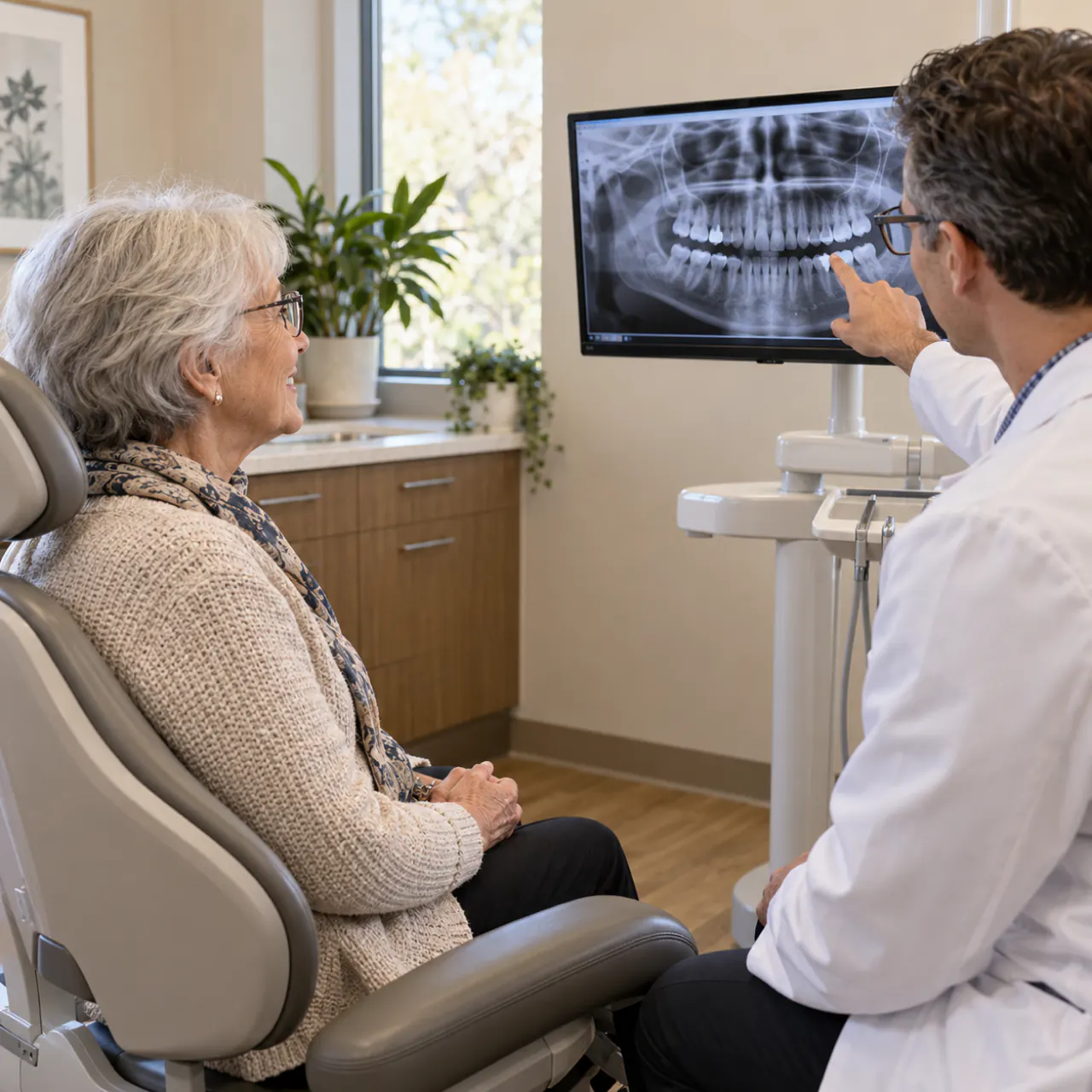
Remove or monitor
When removal is advised, and when watching may be fine.
Not every retained root needs to come out. We weigh the benefits of removal against the risks for your situation.
When removal is usually advised
- Signs of infection or bone changes around the root
- A root close to the surface under a denture
- Recurring tenderness or swelling in the area
- A planned implant at or near the root's location
- A root that is slowly working its way toward the gum
- A broken tooth with decay below the gum line
- Roots that interfere with a bridge or partial denture
- Pain when chewing on the old extraction site
When monitoring may be reasonable
- A small root tip deep in healthy bone
- No signs of infection on the x-ray
- No symptoms in the area
- Removal would risk injury to the nerve
- Removal would risk opening into the sinus
- The root does not affect any planned restoration
- Medical factors that make surgery less advisable
- You are comfortable with periodic x-ray checks
Ongoing care in Guelph
A team that keeps track of your x-ray history.
For many long-time Guelph patients, our Kortright Road West office has years of x-rays on file, which makes it easier to tell whether a retained root is new, changing, or stable. New patients are welcome to bring previous x-rays so we can compare.
Related services
Related services for extractions and restoring the area.
Questions patients ask
Retained root FAQs
Answers to questions patients often ask after being told a root is still in the jaw.
How does a root get left behind?
A tooth weakened by decay or a large filling may break, leaving its root in the jaw. Sometimes a small root tip also remains after an extraction when removing it would have risked damage to nearby structures.
Is it dangerous to have a retained root?
Not necessarily. Many retained roots cause no problems for years. They become a concern when they are infected, cause symptoms, or sit where a denture or implant needs to go.
I have had my dentures for years. Why is this coming up now?
As the jaw bone gradually changes shape, a root that was once deep can move closer to the surface and start pressing against the denture. It can also show up on an x-ray taken for another reason.
Will removing a retained root be painful?
The area is numbed thoroughly before we begin, so you should feel pressure rather than pain. Some tenderness for a few days afterward is normal and is usually manageable with recommended pain relief.
Can I keep wearing my denture after root removal?
Often you can, but it may need to be adjusted or softened while the area heals. We will give you specific advice about when to wear it and when to leave it out.
What if the root is close to the nerve or sinus?
In that case, leaving the root and monitoring it may be safer, or we may recommend 3D imaging and a referral to an oral surgeon. We explain the risks clearly so you can decide together with us.
Do I need a retained root removed before getting an implant?
Usually, yes. Implants need healthy bone, so a root in the planned implant site is typically removed and the area allowed to heal, sometimes with bone grafting, before the implant is placed.
How will I know if a monitored root becomes a problem?
Signs include tenderness, swelling, a bad taste, or a new sore spot under a denture. We also compare future x-rays to check for changes, so let us know about any symptoms between visits.