

Restorative dentistry in Guelph
Root canal crown restoration that finishes the job and protects your treated tooth for years to come.
Root canal treatment saves a tooth from the inside, but it is only half of the plan. Treated back teeth, in particular, can become brittle and are more likely to crack without proper coverage. At Ironwood Dental in Guelph, we plan the final restoration as part of your root canal care, often with a crown, so the tooth can return to full, comfortable use.
Why the crown matters
A root canal saves the tooth. A crown helps keep it.
Putting off the final restoration is one of the most common reasons treated teeth are lost. Here is what a timely crown offers.
Protects against cracking
A crown wraps the tooth and helps distribute chewing forces, reducing the risk of a treated tooth splitting.
Seals the root canal
A well-fitting crown helps keep bacteria from leaking back into the canals, which supports the long-term success of the root canal.
Restores full chewing
Once the crown is in place, the tooth can usually be used normally again rather than avoided.
Replaces lost tooth structure
Decay, old fillings, and root canal access often remove a lot of the tooth. A crown rebuilds its natural shape.
Improves appearance
Treated teeth can darken over time. A tooth-coloured crown can match your neighbouring teeth.
Possible in one visit
For suitable teeth, a CEREC ceramic crown can be designed, milled, and placed in a single appointment at our office.
Your crown visits
How we restore a tooth after root canal treatment.
We usually aim to place the final restoration soon after the root canal, while the temporary filling is still sealing well.
Review the root canal
We confirm the root canal is complete and comfortable, and check x-rays to see that the canals are well sealed and healing as expected.
Decide on the restoration
We look at how much tooth remains and where it sits in your mouth. Most back teeth need a crown, while some front teeth may only need a bonded filling.
Build the foundation
A core build-up replaces missing structure inside the tooth. If very little tooth remains, a post may be added to help hold the core.
Prepare and scan
The tooth is shaped for the crown and a digital scan or impression records the exact shape. A shade is chosen to match your other teeth.
Make and place the crown
For a same-day crown, it is designed and milled while you wait. For lab-made crowns, a temporary is placed and the final crown is fitted at a second visit.
Bite check and long-term care
We adjust the bite, confirm the crown seals well at the gum line, and check it, along with the root canal, at your regular exams.
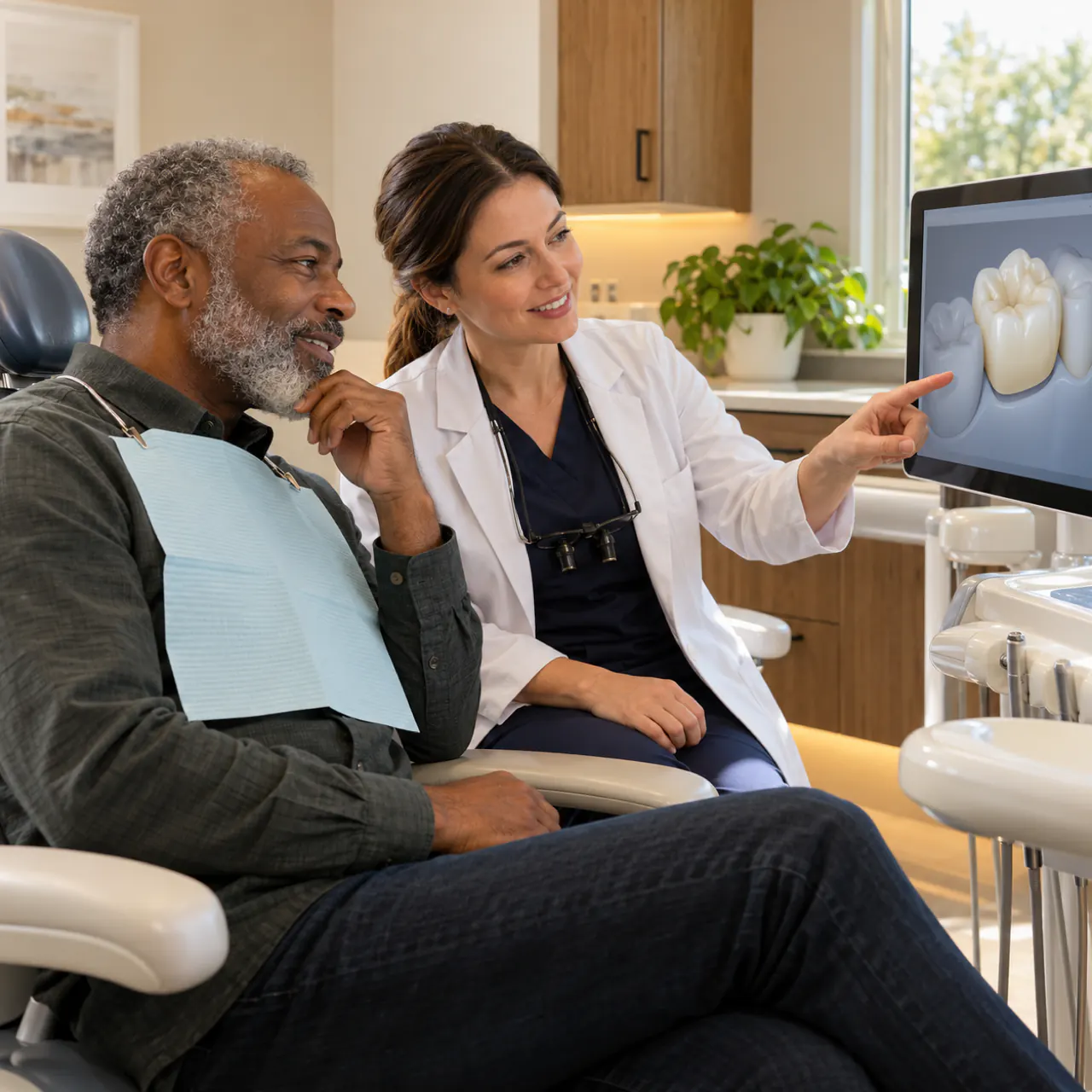
Planning the restoration
Why timing matters, and how we choose the right restoration.
Front teeth, premolars, and molars have different needs after root canal treatment.
Why you should not delay the crown
- Temporary fillings are not designed to last long
- A leaking temporary can let bacteria back into the canals
- Treated back teeth are prone to cracking under chewing forces
- A crack in a treated tooth may make it unrestorable
- Delays can mean redoing the root canal
- Teeth can shift slightly, affecting how a crown fits
- Chewing on an unprotected tooth risks breaking a cusp
- Completing treatment helps you return to normal eating sooner
Restoration options after a root canal
- A full ceramic crown for most molars and premolars
- A same-day CEREC crown when the tooth is suitable
- A lab-made crown for complex shade or bite situations
- An onlay when strong walls remain on a back tooth
- A bonded composite filling for some front teeth
- A post and core under the crown when structure is very limited
- A crown that also serves as a bridge anchor if needed
- Internal bleaching or a crown for a darkened front tooth
Completing your care in Guelph
Root canal crowns at 570 Kortright Rd W.
Whether your root canal was done at Ironwood Dental or by a specialist, we can plan the crown that completes it at our Kortright Road West office in Guelph. With CEREC available in our office, some suitable teeth can receive their ceramic crown in a single visit, which makes finishing treatment easier to fit into a busy week.
Related services
Related root canal and crown care
Questions patients ask
Crown after root canal FAQs
Answers about why crowns are recommended after root canal treatment, and how soon you should get one.
Do I really need a crown after a root canal?
For most molars and premolars, a crown is strongly recommended because treated back teeth are more likely to crack. Some front teeth with plenty of healthy structure may only need a filling. We base the recommendation on your specific tooth.
How soon after a root canal should I get a crown?
Generally, the sooner the better, often within a few weeks. Temporary fillings are not meant to last, and an unprotected tooth can crack or leak in the meantime.
What happens if I don't get a crown?
The tooth may hold up for a while, but it is at greater risk of cracking or of bacteria leaking back into the canals. A fractured tooth sometimes cannot be saved, even if the root canal was successful.
Can I get a same-day crown after a root canal?
Often, yes. If the tooth is suitable, we can design, mill, and place a CEREC ceramic crown in one visit. Your exam will confirm whether a same-day or lab-made crown is the better option.
Will the crown look natural?
Ceramic crowns are shaded and shaped to blend with your other teeth. If the treated tooth has darkened, the crown can help mask that discolouration.
My root canal was done by a specialist. Can you place the crown?
Yes. Many patients return to their general dentist for the final restoration after a specialist root canal. We review the specialist's notes and x-rays before planning the crown.
Do front teeth need crowns after a root canal?
Not always. Front teeth take less chewing force, so if most of the tooth is intact, a bonded filling may be enough. Teeth with large fillings or significant damage may still benefit from a crown.
Can a crown be placed on an old root canal tooth that never got one?
Often, yes, as long as the tooth and root canal are still healthy. We check for cracks, decay, and signs of infection first, and if the root canal shows problems, retreatment may be recommended before the crown.