

Sleep apnea care in Guelph
A dental assessment that answers one question first: is an oral appliance right for your mouth?
Sleep apnea is a medical condition diagnosed by a physician, usually through a sleep study. If an oral appliance has been suggested, or you are curious whether one could be an alternative to CPAP, a dental assessment checks whether your teeth, gums, bite, and jaw joints can support one comfortably and safely.
Why a dental assessment
Knowing your dental suitability helps you and your physician choose the right path.
An oral appliance depends on your teeth and jaw for support. A careful assessment helps avoid an appliance that is uncomfortable or unsuitable.
Find out if an appliance can work for you
An oral appliance needs enough healthy teeth to grip and a jaw that can move forward comfortably. The assessment tells you whether those conditions are met.
Catch dental issues first
Gum disease, loose teeth, or untreated decay should usually be addressed before an appliance is made. We identify these early.
Protect your jaw joints
We check for clicking, pain, or limited opening so any appliance plan respects the health of your jaw joints.
Support your physician's decision
Our findings can be shared with your physician or sleep clinic to help decide whether an oral appliance fits into your treatment.
Understand the options
We explain how oral appliances work, how they compare with CPAP in general terms, and what a realistic experience may look like.
Plan with your future dental work in mind
If crowns, implants, or dentures are planned, we consider how they may affect the fit and timing of an appliance.
Assessment visit
What we review during a sleep apnea dental assessment.
The visit focuses on your mouth and jaw, while respecting that diagnosis and overall sleep care belong with your physician.
Review your sleep history
We ask about your sleep study results if you have them, current treatment, and symptoms such as snoring, daytime fatigue, or waking unrefreshed. If you have not been diagnosed, we will recommend you speak with your physician.
Medical and dental history
We review medications, health conditions, and past dental work. We also ask about jaw pain, headaches, and teeth grinding.
Examine teeth and gums
Your dentist checks the number and health of your teeth, gum support, and any loose or heavily restored teeth that could be stressed by an appliance.
Assess the jaw joints and movement
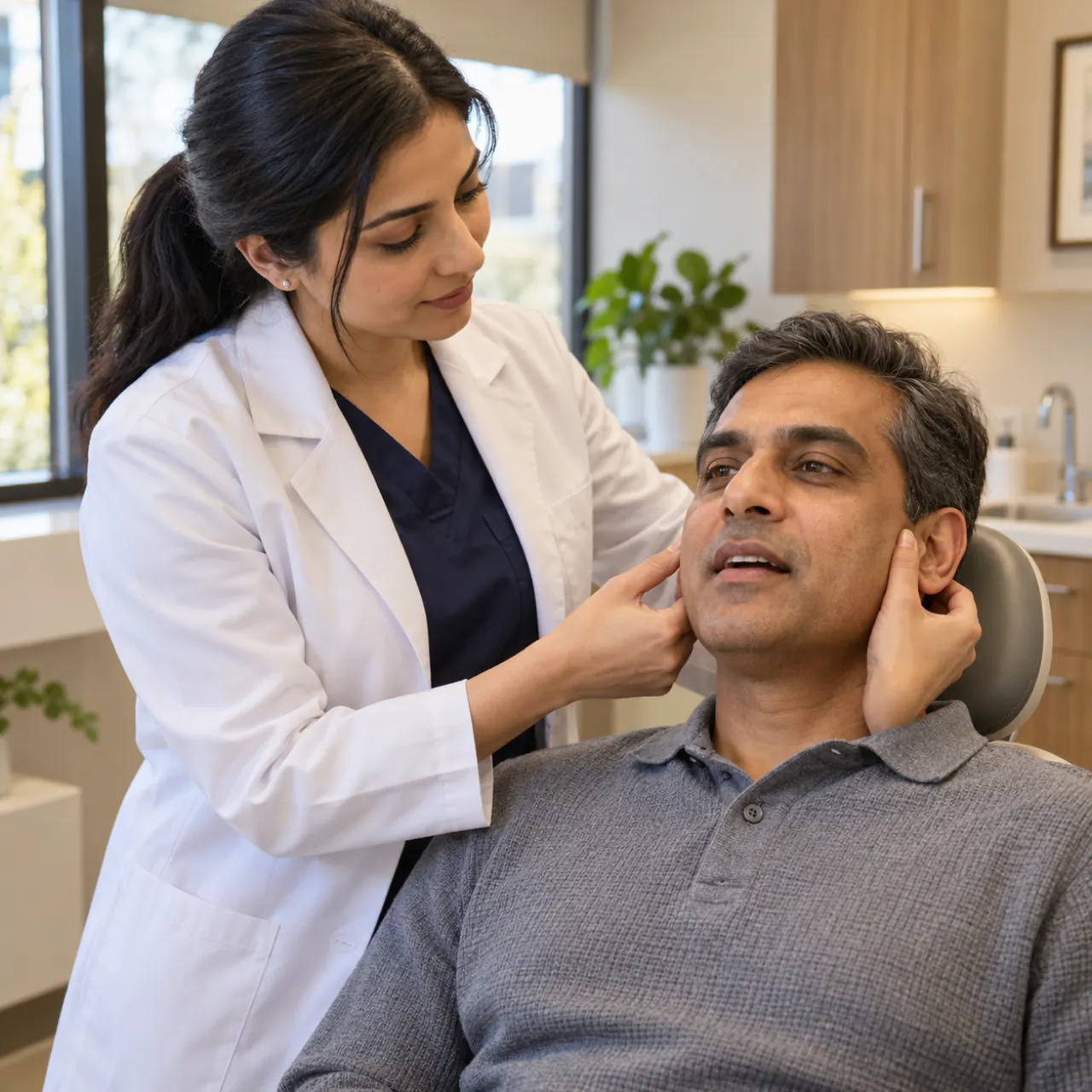
We gently feel the jaw joints and muscles and measure how far your lower jaw can comfortably move forward. This range is important for appliance design.
Look at the bite and airway signs
We note your bite relationship, tongue size, and the appearance of the soft palate and throat area. These observations add context but do not replace a medical diagnosis.
Share findings and next steps
We explain whether you appear to be a good candidate, what may need to be done first, and how we can work with your physician. With your permission, we send a summary to your doctor.
Assessment details
What we check, and what can affect suitability.
These are the dental and practical factors that guide our recommendation.
What the assessment checks
- Number and health of teeth available to hold an appliance
- Gum health and bone support around the teeth
- Untreated decay or failing fillings
- Jaw joint comfort, clicking, or locking
- Range of forward movement of the lower jaw
- Current bite and how the teeth meet
- Signs of clenching or grinding
- Existing crowns, bridges, implants, or dentures
Factors that can affect suitability
- Too few healthy teeth to anchor the appliance
- Active gum disease that needs treatment first
- Significant jaw joint pain or limited opening
- Limited ability to move the jaw forward
- Severe gag reflex or difficulty wearing devices
- Planned major dental work in the near future
- The severity of sleep apnea as determined by your physician
- Whether you have tried or prefer to avoid CPAP
Sleep care in Guelph
A dental perspective that complements your physician's care.
Guelph patients often come to our Kortright Road West office with a sleep study already in hand, while others are just starting to ask questions. Either way, we explain what we find in plain language and share our findings with your physician when you would like us to.
Related services
Related services for sleep apnea and oral appliances.
Questions patients ask
Sleep apnea dental assessment FAQs
Common questions about how a dentist fits into sleep apnea care.
Can a dentist diagnose sleep apnea?
No. Sleep apnea is diagnosed by a physician, typically through an overnight sleep study. A dentist can notice signs that may suggest a sleep concern and assess whether an oral appliance is dentally suitable.
Do I need a sleep study before this assessment?
A sleep study is needed before an oral appliance is made for sleep apnea, but you can book the dental assessment before or after it. If you have not been tested, we will encourage you to speak with your physician.
Who is usually a good candidate for an oral appliance?
Oral appliances are often considered for adults with mild to moderate sleep apnea, or for those who cannot tolerate CPAP, as recommended by their physician. Dental suitability depends on healthy teeth, gums, and jaw joints.
Can I get a sleep appliance if I wear dentures?
It is more challenging, because the appliance needs teeth to hold onto. Some partial denture wearers may still be candidates, and implants can sometimes help. We will look at your situation specifically.
What if I have jaw pain or TMJ issues?
Jaw joint concerns do not always rule out an appliance, but they need careful evaluation first. We may recommend treating jaw symptoms or adjusting the appliance plan to protect your joints.
Will you send my results to my doctor?
With your permission, yes. Sharing our findings with your physician or sleep clinic helps everyone involved make a coordinated decision about your treatment.
How long does the assessment take?
It is usually a single appointment similar in length to a thorough exam. If x-rays or impressions are needed, they may be taken during the same visit or at a follow-up.
Does the assessment commit me to getting an appliance?
No. The assessment simply gives you and your physician information. You decide afterward whether to move ahead with an appliance.