

Jaw joint assessment in Guelph
A thorough TMJ assessment so your treatment is based on a diagnosis, not a guess.
Your temporomandibular joints sit just in front of your ears and work every time you talk, chew, or yawn. When they hurt, click, or feel stiff, the first step is a structured assessment. We gather your history, examine the joints and muscles, measure movement, and decide whether imaging would add useful information before suggesting any treatment.
Why assess first
A clear diagnosis is the foundation of good jaw care.
Jaw symptoms can come from the joint, the muscles, the teeth, or a mix. A structured assessment helps sort out which.
A working diagnosis
Knowing whether you are dealing with a muscle, joint, or combined problem helps guide the right care.
A baseline for comparison
Measurements taken today can be compared at future visits to see if you are improving.
Rule out dental causes
Teeth and gums are checked so tooth problems are not missed or mistaken for joint pain.
Imaging only when it helps
We recommend x-rays or 3D scans only if they would answer a specific question or change the plan.
Clear explanation
We explain what we find in plain language, often using a model or diagram of the jaw.
A sensible next step
You leave knowing whether self-care, an appliance, further tests, or a referral is the most sensible next move.
The assessment
What a TMJ assessment includes.
The assessment is gentle and methodical. We explain each step and stop if anything is uncomfortable.
Detailed history
We ask about your symptoms, when they began, any injuries, and what makes them better or worse. We also review your medical history, medications, and any previous treatment.
Jaw movement measurements
We measure how wide you can open, how far you move side to side and forward, and whether your jaw deviates. We also note where any pain occurs during movement.
Joint examination
Your dentist feels the joints as you open and close and listens for clicking or grating. We check for tenderness at and around the joints.
Muscle examination
We gently press on the chewing muscles in the cheeks, temples, and under the jaw, as well as nearby neck muscles. This shows whether muscle tenderness is part of the picture.
Teeth, bite, and imaging
We examine your teeth and bite for wear, cracks, and contact problems. Depending on your exam, we may recommend a panoramic x-ray or a 3D scan to look more closely at the joints.
Findings and options
We share our working diagnosis and outline treatment options, from self-care to a splint or a referral. Complex cases may be coordinated with a trusted specialist.
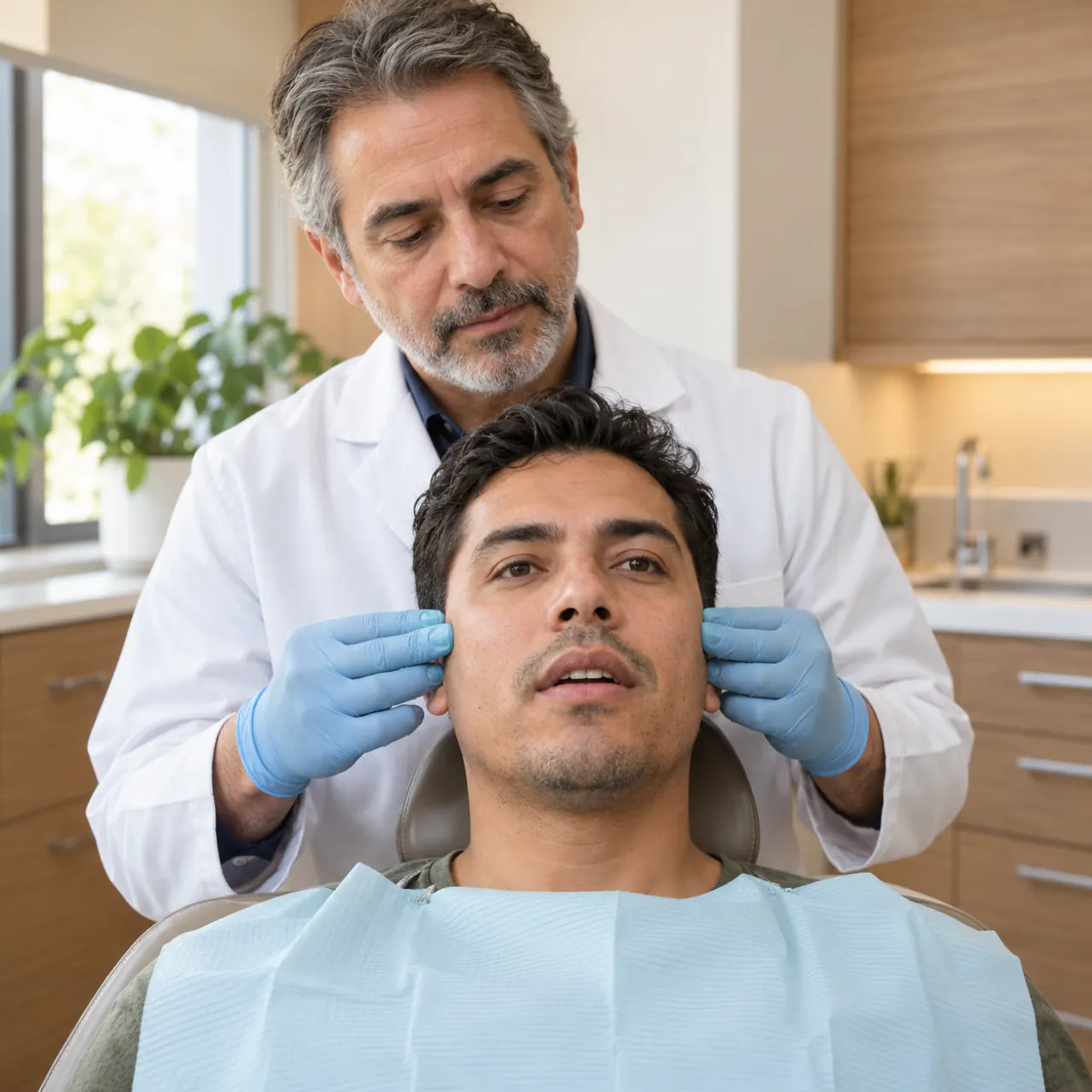
Assessment details
What we measure, and what you leave with.
By the end of your visit, you should understand what is likely going on and what the options are.
What we measure and record
- Comfortable and maximum mouth opening
- Side-to-side and forward jaw movement
- Deviation of the jaw while opening
- Clicking, popping, or grating in each joint
- Tenderness of the joints and chewing muscles
- Signs of clenching or grinding on the teeth
- How the teeth meet at rest and in movement
- Pain levels and how they change with movement
What you leave with
- A working diagnosis explained in plain language
- An understanding of whether muscles, joints, or both are involved
- Clear advice on what to avoid during flare-ups
- Self-care steps you can start right away
- Recommendations on whether an appliance may help
- Guidance on whether imaging is needed
- Information on referrals if other providers would help
- A plan for follow-up and re-measurement
TMJ assessments in Guelph
Unhurried jaw assessments on Kortright Road West.
A good TMJ assessment takes time to listen and examine properly. When you book with our Guelph office, let us know it is for jaw concerns so we can schedule enough time. You are welcome to bring past records, imaging reports, or notes from other providers.
Related services
Related pages for TMJ and jaw care.
Questions patients ask
TMJ assessment FAQs
What to expect from a TMJ assessment and how it guides what happens next.
What happens during a TMJ assessment?
We review your history, measure your jaw movement, feel the joints and chewing muscles, check your teeth and bite, and decide whether imaging would help. Then we explain what we found and what the options are.
Does a TMJ assessment hurt?
The assessment is gentle. Some pressing on tender muscles may feel sore, but we work carefully and stop if anything is too uncomfortable.
Will I need an x-ray or scan for TMJ?
Not always. Many TMJ concerns can be assessed through history and examination. Imaging such as a panoramic x-ray or 3D scan may be recommended if it would help answer a specific question.
What should I bring to my TMJ assessment?
Bring a list of your medications, any imaging reports or records from other providers, and notes about when your symptoms happen. If you already wear a nightguard or splint, bring it too.
Can ear pain be caused by the TMJ?
Yes. Because the joint sits just in front of the ear, TMJ problems can cause ear pain, fullness, or ringing. If you have ear symptoms without jaw signs, it is also worth seeing your physician to check the ear itself.
How do I know if my jaw pain is TMJ or a tooth?
A TMJ assessment includes checking your teeth and gums, which helps tell joint and muscle pain apart from tooth pain. Sometimes both are involved.
Will I start treatment on the same day?
Often you can begin self-care right away. If an appliance is recommended, we usually take records and fit it at a later visit.
Do you refer TMJ patients to specialists?
Many patients are managed with conservative care, but when symptoms are complex or not improving, we may coordinate with a trusted specialist. We explain why and what to expect.