

Smile alignment in Guelph
A crooked tooth can be moved, reshaped, or covered, and the right choice depends on the tooth.
Crooked teeth can be turned, tipped, set slightly higher or lower than their neighbours, or pushed forward or back. Some are best corrected by moving them with aligners. Others may be improved with bonding, reshaping, or veneers. We help you compare the options so you understand the trade-offs before you decide.
Why it is worth discussing
Understanding your options helps you choose with confidence.
Patients often assume there is only one way to fix a crooked tooth. In reality, there are several, each with different effects on your natural tooth.
Preserve natural tooth structure
Moving a crooked tooth into line usually means little or no enamel needs to be removed to make it look straight.
Faster cosmetic changes when suitable
For very mild cases, bonding or reshaping may improve appearance in one or two visits without tooth movement.
A better fit with the bite
Correcting a tooth's position can help it meet the opposite teeth more evenly, which may reduce uneven wear.
Easier to clean
Teeth that are straighter often have fewer hidden corners where plaque can collect.
Options can be combined
Some patients have teeth aligned first, then a small amount of bonding or reshaping to fine-tune edges.
Choices explained clearly
We describe what each option involves and how it affects your teeth long term, so you can make a decision that suits you.
Your assessment
How we decide between moving and reshaping.
We look at why the tooth looks crooked, how it meets your bite, and how much of your natural tooth you would like to keep.
Identify what looks crooked
We look at whether the tooth is rotated, tipped, too high, too low, or out of line front to back. Sometimes a tooth looks crooked because of its shape rather than its position.
Check how it fits the bite
We see how the tooth meets the teeth around and opposite it. A tooth that is out of line can affect your bite and how forces are shared.
Assess enamel, gums, and existing work
Enamel thickness, gum levels, and any fillings or crowns help determine which options are suitable.
Compare movement and cosmetic options
We explain how aligners, limited movement, bonding, reshaping, or veneers could change the tooth. We also note what each option would not change.
Visualize the result
Photos, scans, or models can help you picture the likely outcome. This makes it easier to compare options side by side.
Choose and begin
Once you decide, we plan the treatment and schedule your first step. If teeth are moved, we discuss retention before you start.
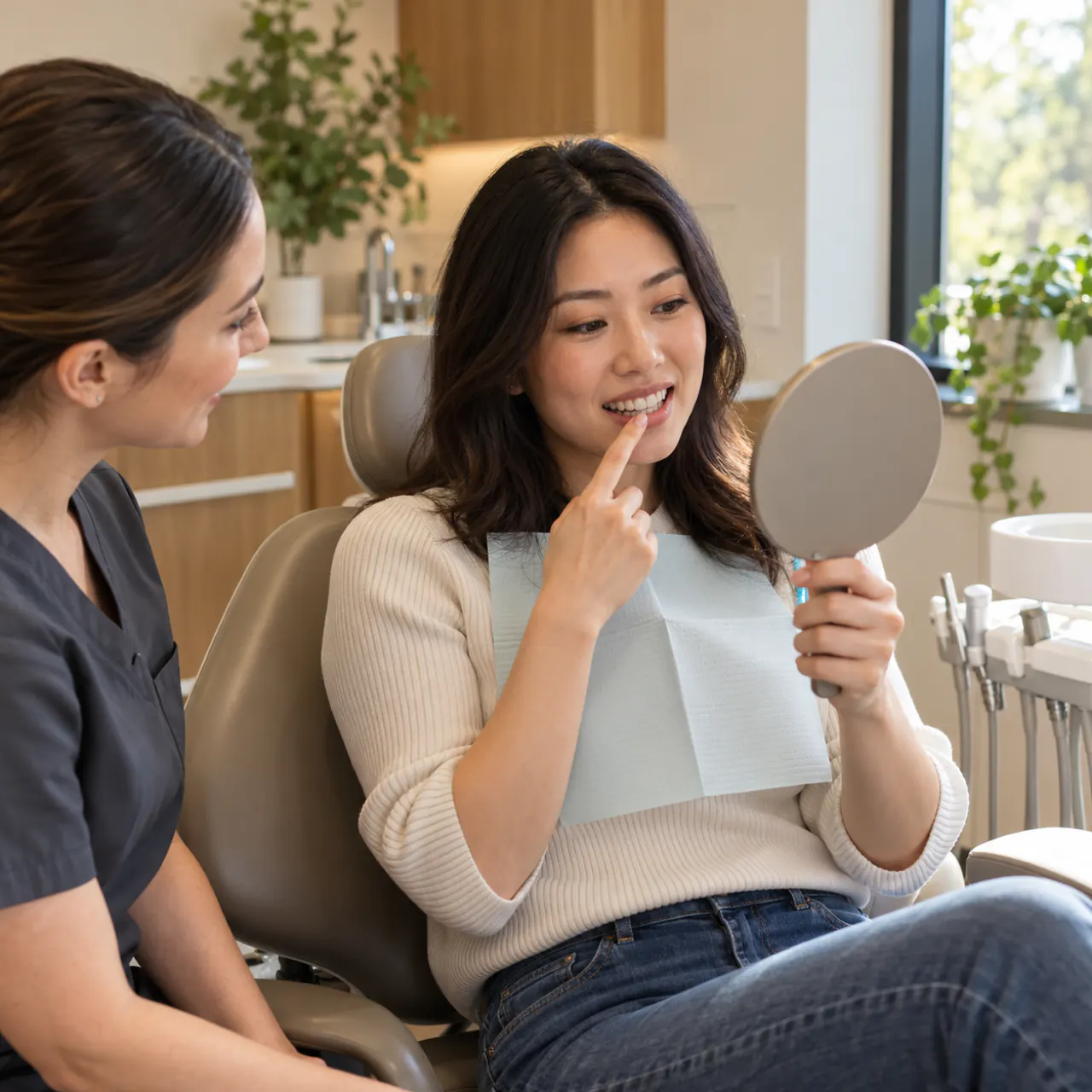
Movement or camouflage
Two different ways to make a tooth look straighter.
Moving a tooth changes its position. Cosmetic options change its shape. Both can work, depending on the situation.
Ways a tooth can be crooked
- Rotated or turned on its axis
- Tipped inward toward the tongue
- Flared outward toward the lips
- Sitting higher or lower than the teeth beside it
- Overlapping a neighbouring tooth
- Pushed behind the other teeth in the arch
- Unevenly shaped, making it look out of line
- Shifted after a nearby tooth was lost
Options we may compare
- Clear aligner treatment for several crooked teeth
- Limited movement for one or two teeth
- Composite bonding to fill or reshape edges
- Enamel recontouring for small edge irregularities
- Composite or porcelain veneers for shape and colour
- Alignment followed by bonding to fine-tune
- Crowns when a crooked tooth is also heavily restored
- Orthodontist referral for complex bite involvement
Crooked teeth care in Guelph
Talking through options with a team that knows your smile.
At our Kortright Road West office, the same team can discuss aligners, bonding, reshaping, and veneers, so you hear a balanced comparison instead of a single recommendation. Many Guelph patients start this conversation at a routine cleaning, and we are happy to book a separate visit for more time.
Related services
Related pages for straightening and shaping teeth.
Questions patients ask
Crooked teeth FAQs
These are the questions patients ask most when one or more teeth look out of line.
Can crooked teeth be fixed without braces?
Yes, in many cases. Clear aligners can move teeth without brackets and wires, and for very mild concerns, bonding or reshaping may improve appearance without moving teeth at all.
Is it better to move a crooked tooth or cover it with a veneer?
Moving a tooth usually preserves more natural tooth structure, while a veneer can change shape and colour at the same time. The best choice depends on how crooked the tooth is, its condition, and your goals.
Can bonding make a crooked tooth look straight?
For small irregularities, composite bonding can fill in edges and make a tooth look more even. It works best when the tooth is only slightly out of line. More noticeable crookedness is usually better addressed by moving the tooth.
Why is one of my front teeth turned?
A rotated tooth may have erupted that way, been pushed by crowding, or turned back after past orthodontic treatment. Rotations are one of the more common types of relapse.
Do crooked teeth affect my bite?
They can. A tooth that sits out of line may hit the opposite teeth unevenly, which can cause localized wear or chipping. We check your bite as part of the assessment.
How long does it take to straighten crooked teeth?
It depends on how many teeth need to move and how far. Mild cases can be relatively short, while complex cases take longer. We give you an estimate after your exam.
Will my teeth go crooked again after treatment?
They can, especially rotated teeth, if retainers are not worn. A retention plan is part of every alignment treatment we discuss.
Can adults fix crooked teeth?
Yes. Teeth can be moved at any age when gums and bone are healthy, and cosmetic options are available for adults too. Many of our patients start treatment well into adulthood.