

Overbite care in Guelph
Not all overbites are the same, and knowing which kind you have shapes the treatment.
People use the word overbite for two different things. A deep bite is when the upper front teeth cover too much of the lower teeth vertically. Overjet is when the upper front teeth stick out ahead of the lower ones. Both can affect wear, comfort, and appearance, and both can come from the teeth, the jaws, or a mix.
Why correct an overbite
A better bite can protect teeth and gums, not just change your profile.
A small overbite is normal. When it is deeper or more pronounced, correcting it may reduce wear, protect the front teeth, and improve comfort.
Less wear on front teeth
A deep bite can cause the lower front teeth to wear against the back of the upper teeth. Correction may reduce that wear.
Protects the palate and gums
In some deep bites, lower teeth touch the gums behind the upper teeth, which can cause irritation. Treatment may relieve that contact.
Lower risk of injury
Upper front teeth that stick out are more exposed to bumps and falls. Reducing overjet may help protect them.
Room for future dental work
Opening a deep bite can create space for crowns or bonding on worn teeth when that is part of the plan.
Easier lip closure
When upper teeth protrude, lips may not close comfortably. Reducing overjet can help lips rest more naturally.
A more balanced smile
Correcting an overbite can change how much of the lower teeth show and how the smile looks in profile.
Overbite assessment
How we work out what kind of overbite you have.
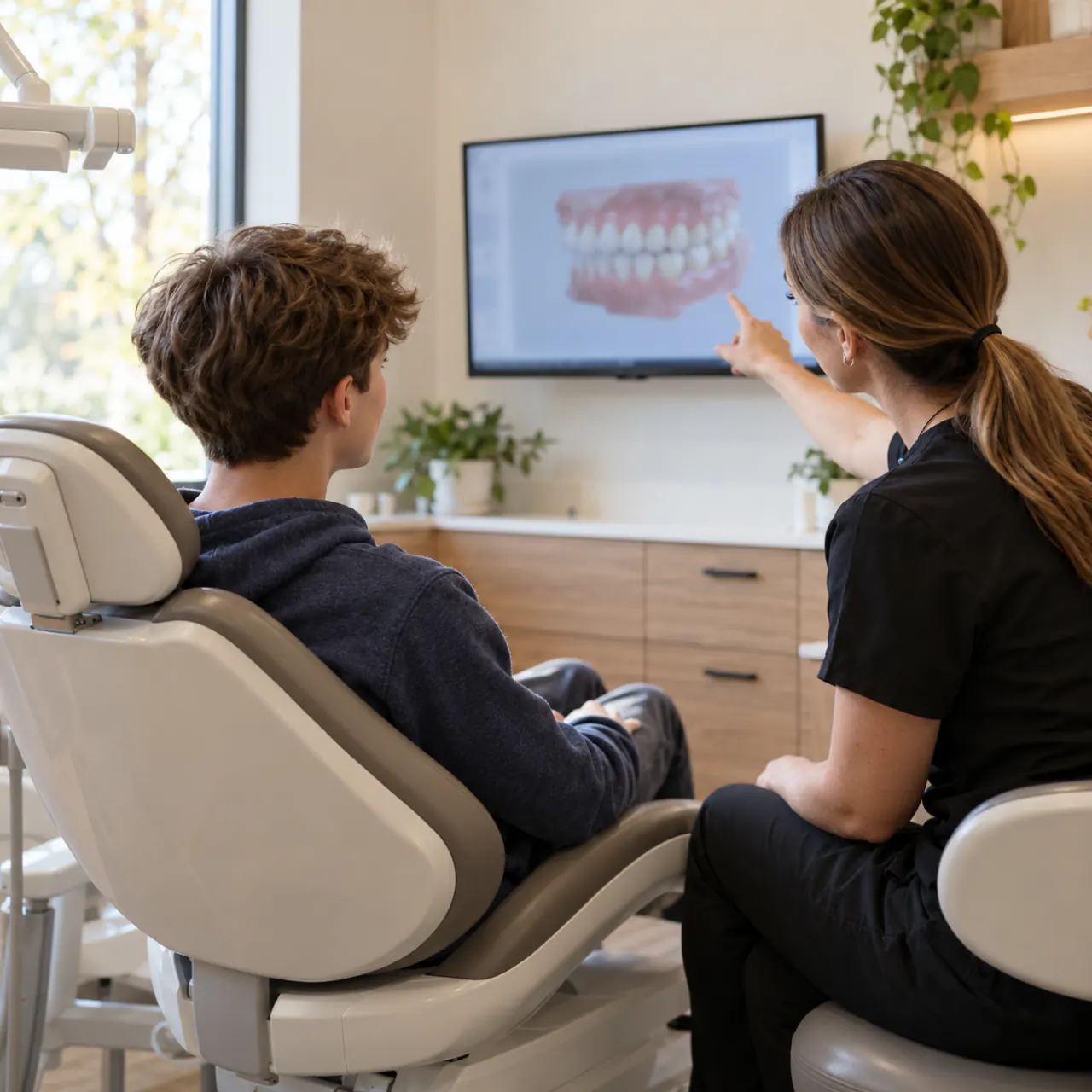
We measure the bite vertically and front to back, then look at whether the cause lies in the teeth, the jaws, or both.
Measure the bite
We look at how far the upper front teeth overlap the lower ones vertically and how far ahead they sit. This tells us whether you have a deep bite, overjet, or both.
Check for wear and tissue contact
We look for worn edges, chipping, and whether lower teeth are touching the gums behind the upper teeth. These findings help judge how much the bite is affecting you.
Assess teeth versus jaws
X-rays and records help show whether the overbite comes from tooth position, jaw size and position, or a combination. This is key to choosing treatment.
Consider growth and age
For growing children, timing can make a difference, and an early orthodontic assessment may be recommended. For adults, options focus on tooth movement and restorative care.
Explain the options
Tooth-related overbites may be treated with clear aligners or braces. Skeletal overbites may need orthodontist care, and in some adults, coordinated jaw surgery is discussed.
Plan treatment and retention
Once you choose a path, we plan the steps or coordinate a referral. After correction, retainers help hold the new bite.
Deep bite and overjet
The two kinds of overbite, and how they may be treated.
Understanding the difference helps explain why one person's overbite may be corrected with aligners while another needs a different approach.
Signs of a deep bite
- Upper front teeth covering most of the lower front teeth
- Lower teeth hidden when you bite and smile
- Wear on the edges of lower front teeth
- Wear on the inside surfaces of upper front teeth
- Lower teeth touching the gums behind the upper teeth
- Gum irritation on the roof of the mouth
- Short-looking front teeth from years of wear
- Jaw tension or clenching in some patients
Signs of overjet and possible approaches
- Upper front teeth sitting well ahead of the lower teeth
- Lips that do not close easily at rest
- Front teeth that are more prone to chips from falls
- Thumb sucking or tongue habits as contributing factors
- Clear aligners for tooth-related overjet
- Growth guidance in children, often with an orthodontist
- Comprehensive orthodontics for moderate to severe cases
- Coordinated jaw surgery for some skeletal adult cases
Overbite care in Guelph
Bite assessments at every stage of life.
At our Kortright Road West office, we see overbites in children whose jaws are still growing, in teens deciding between aligners and braces, and in adults noticing new wear on their front teeth. We explain what we see in plain language and, when growth guidance or jaw correction is involved, we coordinate with a trusted orthodontist or specialist.
Related services
Related pages for bite concerns.
Questions patients ask
Overbite FAQs
Overbites raise a lot of questions, especially about whether they need treatment. Here are the most common ones.
What is the difference between an overbite and overjet?
An overbite, or deep bite, describes how much the upper front teeth overlap the lower ones vertically. Overjet describes how far the upper front teeth sit ahead of the lower ones. Many people have some of both.
Is a small overbite normal?
Yes. A slight overlap of the upper teeth over the lower teeth is normal and healthy. Treatment is usually discussed when the overlap is deep enough to cause wear, tissue contact, or other concerns.
Can Invisalign fix an overbite?
Clear aligners can correct many tooth-related deep bites and overjet, sometimes with attachments or elastics. Overbites caused mainly by jaw position may need orthodontist care, which we can help coordinate.
Can an overbite be fixed in adults?
Yes, many adult overbites can be improved with aligners or braces when they are tooth-related. Skeletal overbites in adults may involve orthodontic treatment combined with jaw surgery, planned with specialists.
Does an overbite cause jaw pain?
Some people with deep bites notice jaw tension or clenching, but an overbite does not always cause discomfort. If you have jaw pain, we can assess both your bite and your jaw joints.
Can thumb sucking cause an overbite?
Prolonged thumb or finger sucking can push upper front teeth forward and contribute to overjet. Helping a child stop the habit is often an important part of managing the bite.
When should my child be checked for an overbite?
Overbites are often noticed during routine childhood checkups. An early orthodontic assessment may be recommended in the early school years, when growth can sometimes be guided.
Will my front teeth keep wearing down if I do not treat my overbite?
In some deep bites, wear can continue over time. We monitor wear at your regular exams and discuss options such as alignment, a nightguard, or restorations if it becomes a concern.