

Wisdom tooth planning in Guelph
A wisdom teeth assessment that tells you whether to watch, wait, or plan removal.
Wisdom teeth usually develop in the mid-teens to early twenties, often without any symptoms. An assessment looks at how they are forming, whether there is room for them, and how they may affect nearby teeth, so families can make a decision before problems start.
Why assess early
Knowing what is coming makes wisdom tooth decisions easier.
An assessment is not a commitment to surgery. It gives you a clear picture so any decision is based on findings rather than guesswork.
Decide before symptoms appear
Many wisdom tooth problems develop quietly. An assessment lets you make a choice while things are calm instead of during a painful flare-up.
Avoid unnecessary removal
If wisdom teeth are well positioned and easy to clean, keeping them and checking periodically may be completely reasonable.
Plan around orthodontic care
For patients who have had braces or aligners, we can discuss how wisdom teeth fit into the bigger picture of retention and long-term alignment.
Time any treatment well
If removal makes sense, younger patients often heal more easily, and planning ahead helps avoid exam weeks, tournaments, or travel.
Understand your own x-rays
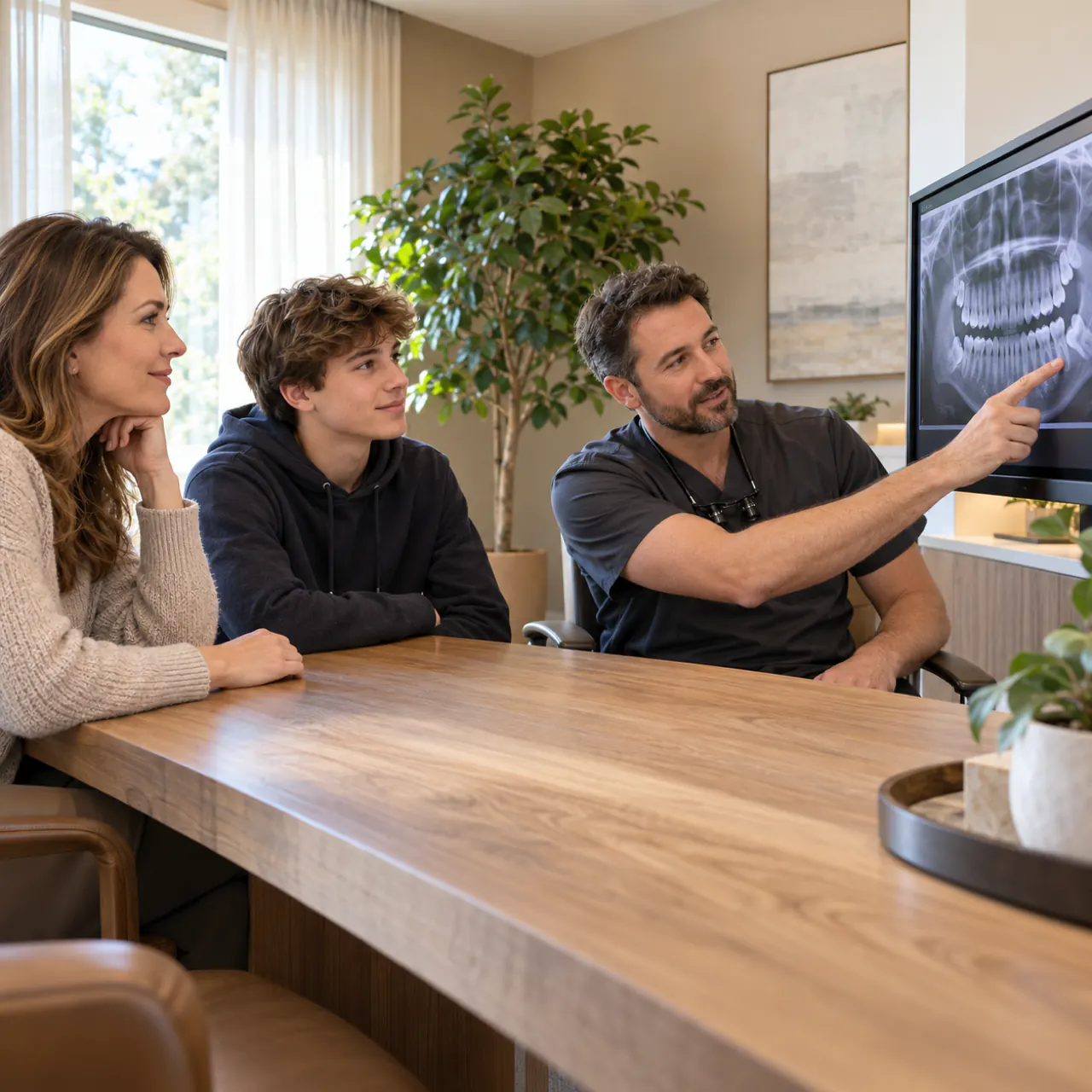
We walk you through the image so you can see the tooth angle, root development, and space available for yourself.
Keep a record for the future
Your assessment becomes a baseline, so changes in position or surrounding bone can be compared at future visits.
Your assessment visit
How a wisdom teeth assessment is organized.
Most assessments fit into a regular checkup or a short dedicated visit. Here is what we look at and how we share it with you.
Talk about symptoms and history
We ask about any pressure, tenderness, gum soreness, or jaw stiffness at the back of the mouth. We also note past orthodontic treatment and family experiences with wisdom teeth.
Examine the back of the mouth
Your dentist checks the gums behind the last molars, looks for partially erupted teeth, and assesses how easily the area can be cleaned. We also look at the bite and the health of the second molars.
Take a panoramic x-ray
A panoramic x-ray shows all four wisdom teeth, their roots, and the surrounding bone in a single image. If a tooth appears close to the nerve or sinus, 3D imaging may be suggested.
Review the findings with you
We show you each wisdom tooth on screen and explain whether it looks likely to erupt, stay impacted, or cause problems. Parents are welcome to join the conversation for younger patients.
Discuss the options
Depending on what we see, the recommendation may be to monitor, to remove one or more teeth, or to refer to an oral surgeon for complex cases. We explain the reasons behind each path.
Set a monitoring or treatment plan
If monitoring is suitable, we note when the next x-ray should be taken. If removal is planned, we book a separate visit and provide preparation instructions.
What we look for
Findings that shape a monitor-or-remove recommendation.
We weigh what the x-ray shows against your symptoms, age, and oral health before suggesting a path.
What the assessment checks
- Stage of root development for each wisdom tooth
- Angle of the tooth relative to the neighbouring molar
- Space available behind the second molar
- Whether the tooth is covered by gum, bone, or both
- Proximity of lower roots to the jaw nerve
- Proximity of upper roots to the sinus
- Gum health and pocketing around the back molars
- Signs of decay on the wisdom tooth or the tooth in front
Reasons monitoring may be suitable
- The tooth is fully erupted and in a functional position
- The gums around it are healthy and easy to clean
- There is no decay on the wisdom tooth or the second molar
- Roots are well away from the nerve and sinus
- No symptoms of pressure, swelling, or infection
- Bone around the tooth looks healthy on x-ray
- Removal risks currently outweigh the expected benefits
- You are comfortable with periodic x-ray check-ins
Planning in Guelph
Assessments that fit around school, sports, and work.
Many Guelph families book wisdom teeth assessments during a teen's regular checkup at our Kortright Road West office. If removal is recommended, we help you look ahead to a time that suits the school calendar, exams, or a summer break.
Related services
Related services for growing smiles and wisdom tooth care.
Questions patients ask
Wisdom teeth assessment FAQs
Common questions from patients and parents who want to understand wisdom teeth before deciding anything.
At what age should wisdom teeth be checked?
Many dentists like to look at wisdom teeth in the mid-to-late teens, when they are visible on x-ray but roots are still forming. Adults who have never had them assessed can be checked at any age.
Can wisdom teeth be left in if they do not hurt?
Often, yes. If they are healthy, functional, and easy to clean, keeping them with regular monitoring may be appropriate. A lack of pain does not always mean there is no problem, which is why x-rays are helpful.
Will wisdom teeth crowd my other teeth?
This is a common concern, but crowding usually has several causes, and wisdom teeth are only one possible factor. We look at your bite, past orthodontic care, and retainer use when discussing this question.
What kind of x-ray is used for a wisdom teeth assessment?
A panoramic x-ray is typically used because it shows all four wisdom teeth and the surrounding jaw in one image. A 3D scan may be recommended when more detail is needed near the nerve or sinus.
Do I need a referral for a wisdom teeth assessment?
No referral is needed. You can book an assessment directly, or ask for one during a regular checkup at our Guelph office.
What if I have only some wisdom teeth?
That is common. Some people develop all four, some develop fewer, and some have none. The assessment simply evaluates whichever teeth are present.
How often should monitored wisdom teeth be rechecked?
The interval depends on your age and what the first x-ray showed. Your dentist will suggest a timeline, and you should let us know sooner if you notice pain, swelling, or a bad taste at the back of the mouth.
Is a wisdom teeth assessment different from a regular checkup?
It can be part of a regular checkup, but the focus is specifically on the third molars, their development, and a decision about monitoring or removal. It may involve an x-ray that is not part of every routine visit.